

How the line operates
The machines do not simply sit in sequence. Each stage prepares the product condition required by the next stage, while bins, rods and trolleys provide the necessary buffers between continuous and batch operations.
- 01
Cut frozen blocks into grinder-ready pieces.
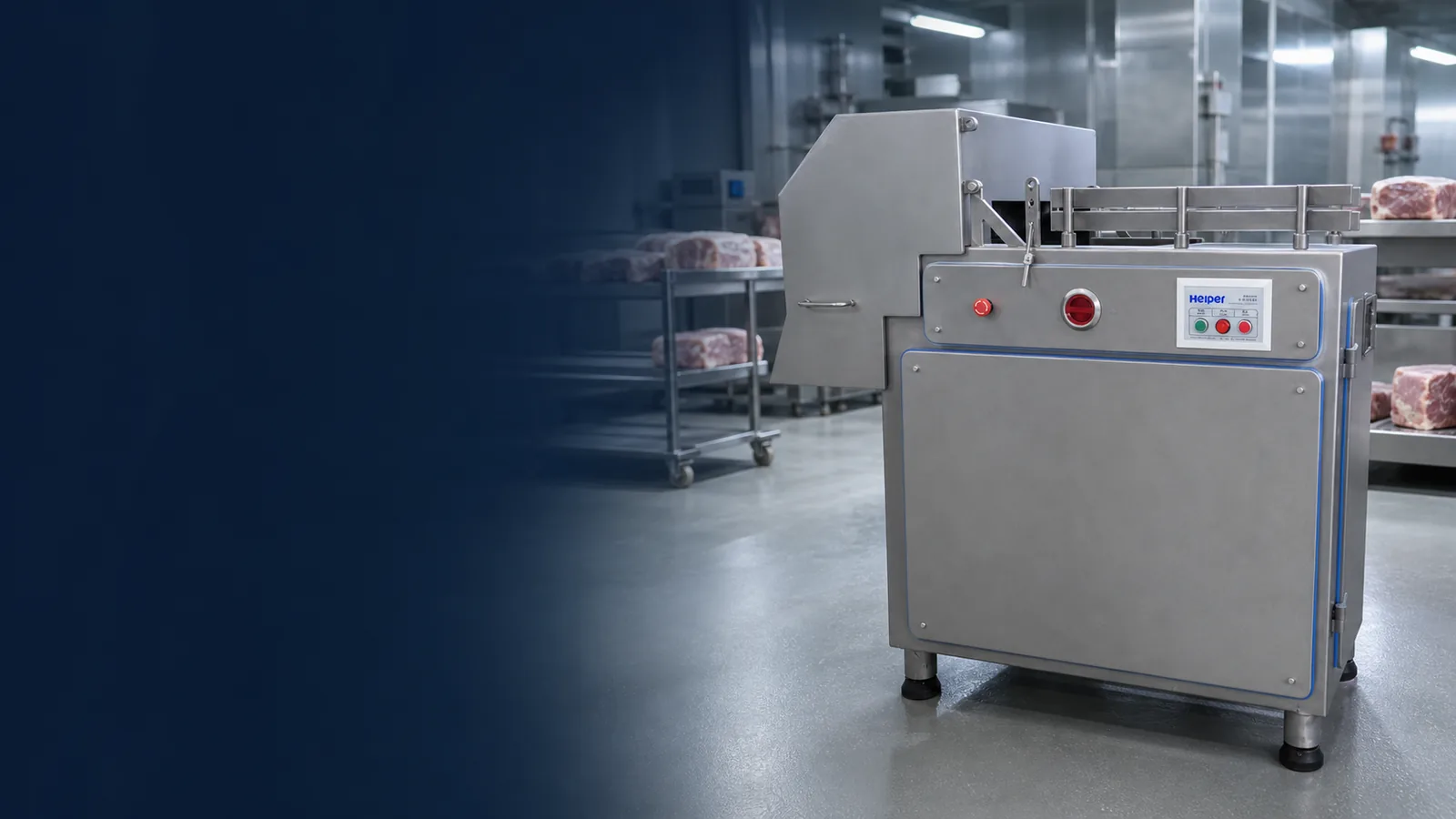
The QK-2000 frozen meat guillotine reduces large blocks without requiring complete thawing. Operators remove packaging, confirm raw-material condition and load blocks within the machine’s accepted range.
- 02
Transfer cut meat directly to grinding.
A three-metre food-grade conveyor bridges the QK-2000 discharge and JR-D120 hopper. Its final belt type, side guards, speed and discharge height are engineered around the physical installation rather than treated as a standalone catalogue machine.
- 03
Establish the required meat-particle structure.
The JR-D120 frozen meat grinder reduces the pieces through the selected plate. Plate size and product temperature are chosen for the intended sausage texture and the downstream bowl-cutting requirement.
- 04
Cut and emulsify the recipe-controlled portion.
The ZB-125 bowl cutter combines high-speed cutting with ingredient dispersion. For a coarse cooked smoked sausage, only the fraction that needs fine binding may be bowl-cut; the complete recipe does not always require full emulsification.
- 05
Load, season and mix under vacuum.
The YT-200 bin hoist tips prepared material into the ZKJB-1200 vacuum mixer. Meat, salt, seasoning, water or ice and recipe additions are distributed while reduced air supports a dense, consistent fill.
- 06
Meter sausage batter into the casing.
The ZKG-6500 automatic vacuum sausage filler feeds the casing with controlled portions while reducing trapped air. Actual throughput depends on casing, diameter, unit weight and particle size.
- 07
Link, arrange and hang in one coordinated system.
The GN-1200III linking and hanging system forms the specified link length and transfers the connected sausage onto rods. The system is presented as one coordinated machine group—not as unrelated machine images.
- 08
Build a continuous rod-and-trolley circulation.
One hundred stainless rods support hanging continuity. Operators place loaded rods on smokehouse trolleys with enough spacing for air, smoke and heat circulation. Twelve trolleys rotate through loading, thermal processing, unloading and empty return.
- 09
Dry, smoke and cook to the validated endpoint.
The double-door four-trolley QZX smokehouse applies the selected drying, smoking, cooking and exhaust recipe. Chamber load, cycle time and required core temperature must be validated with the customer’s product.
- 10
Cool and stabilise before cutting.
Cooked sausages move into the cooked-side cooling area. Showering or air cooling, drip control, transfer time and the target packing temperature are confirmed in the final project because warm or wet product can compromise cutting and sealing.
- 11
Cut the linked chain into individual sausages.
The GQC-3000 roller sausage cutter receives cooled links and separates them at the connection points. Product condition and link definition affect cutting accuracy.
- 12
Inspect by hand, then flow-wrap.
Operators use the human sausage sorting space to remove damaged pieces, check cutting quality and align the product. Accepted sausages then enter the BOSS450/132-X flow wrapping machine for film forming, longitudinal sealing, cross-sealing and pack cut-off.
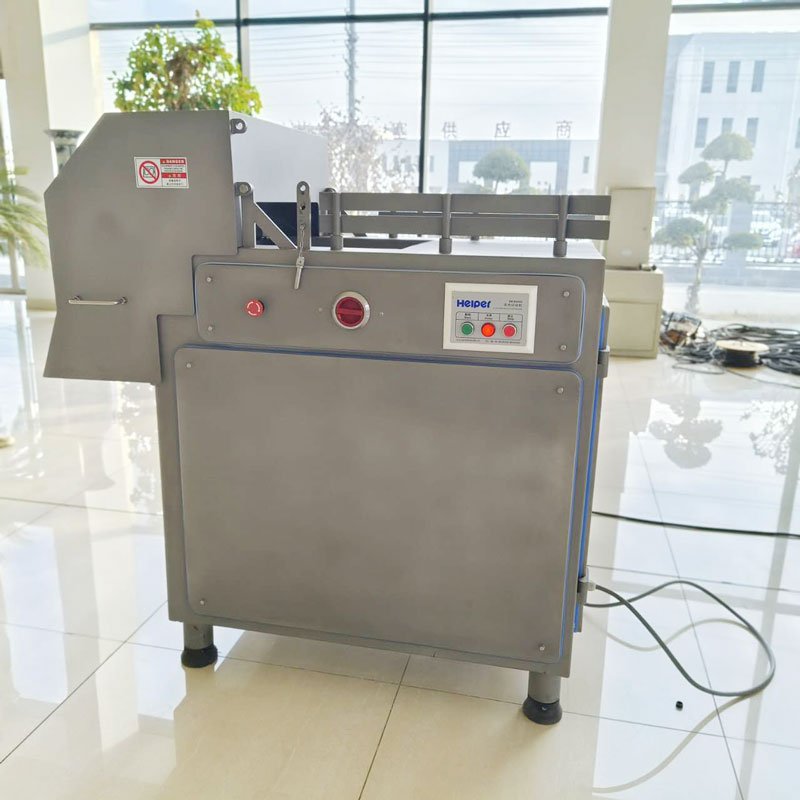
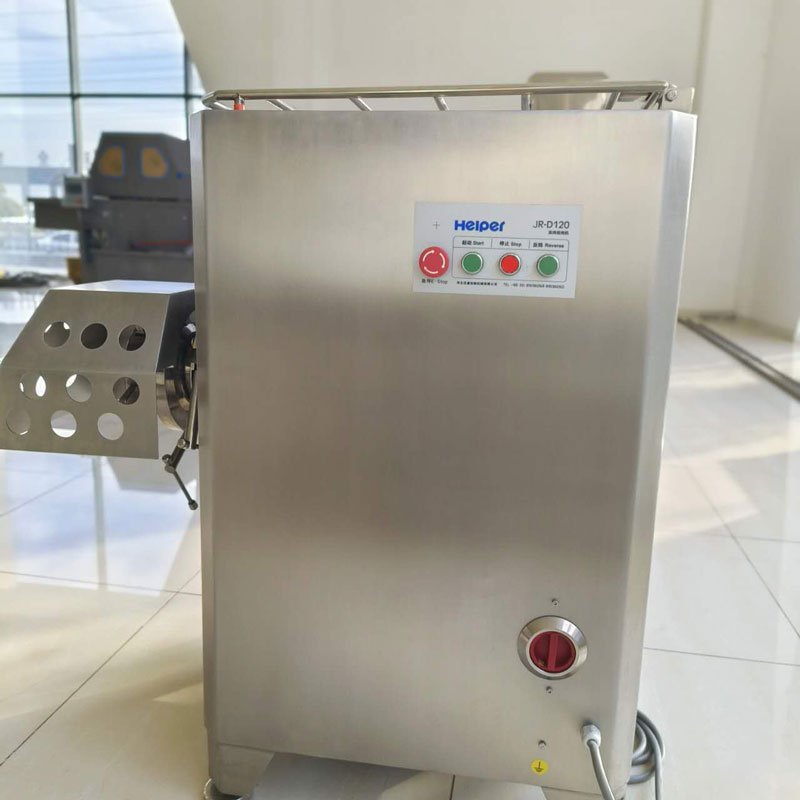
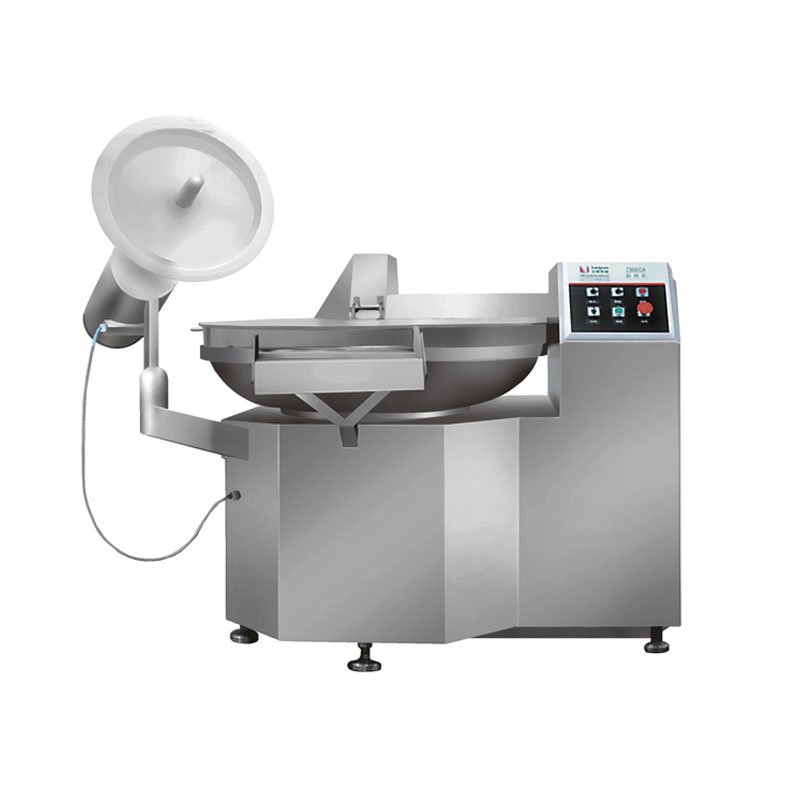

Image basis. Product photographs are HELPER-owned machine references. The line visualization and selected combination-system visuals are explanatory concept images, not evidence of one completed customer installation.
Every production node, with its machine source
Open a machine to review the original HELPER product page. The conveyor, cooling area and human sorting space are project interfaces rather than separate standard products.
Raw preparation
QK-2000 Frozen Meat Guillotine
Reduces frozen blocks to controlled pieces that the transfer and grinding stages can accept.
View QK-2000 →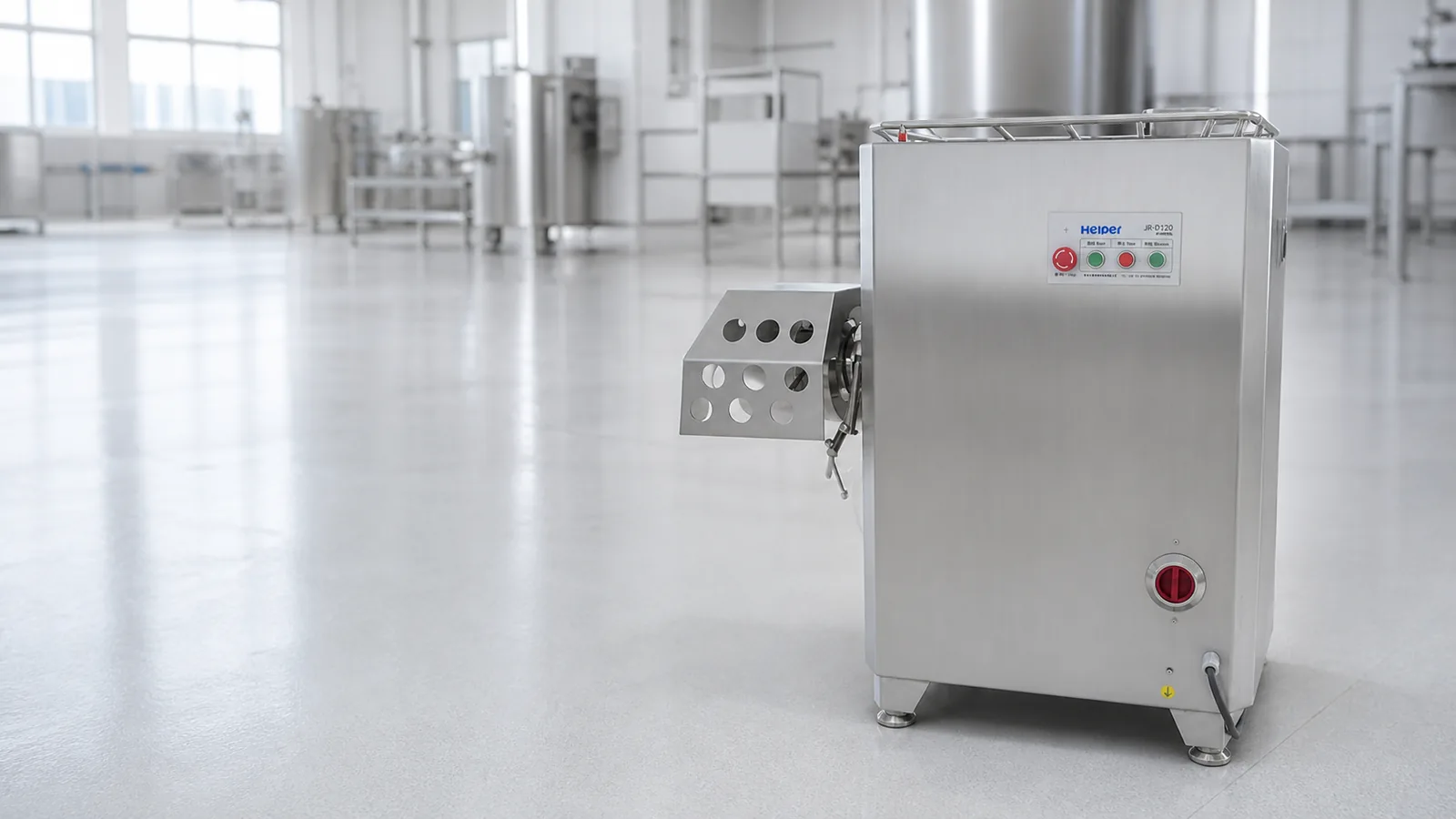
Size reduction
JR-D120 Frozen Meat Grinder
Creates the recipe’s required particle structure while limiting unnecessary thawing before bowl cutting.
View JR-D120 →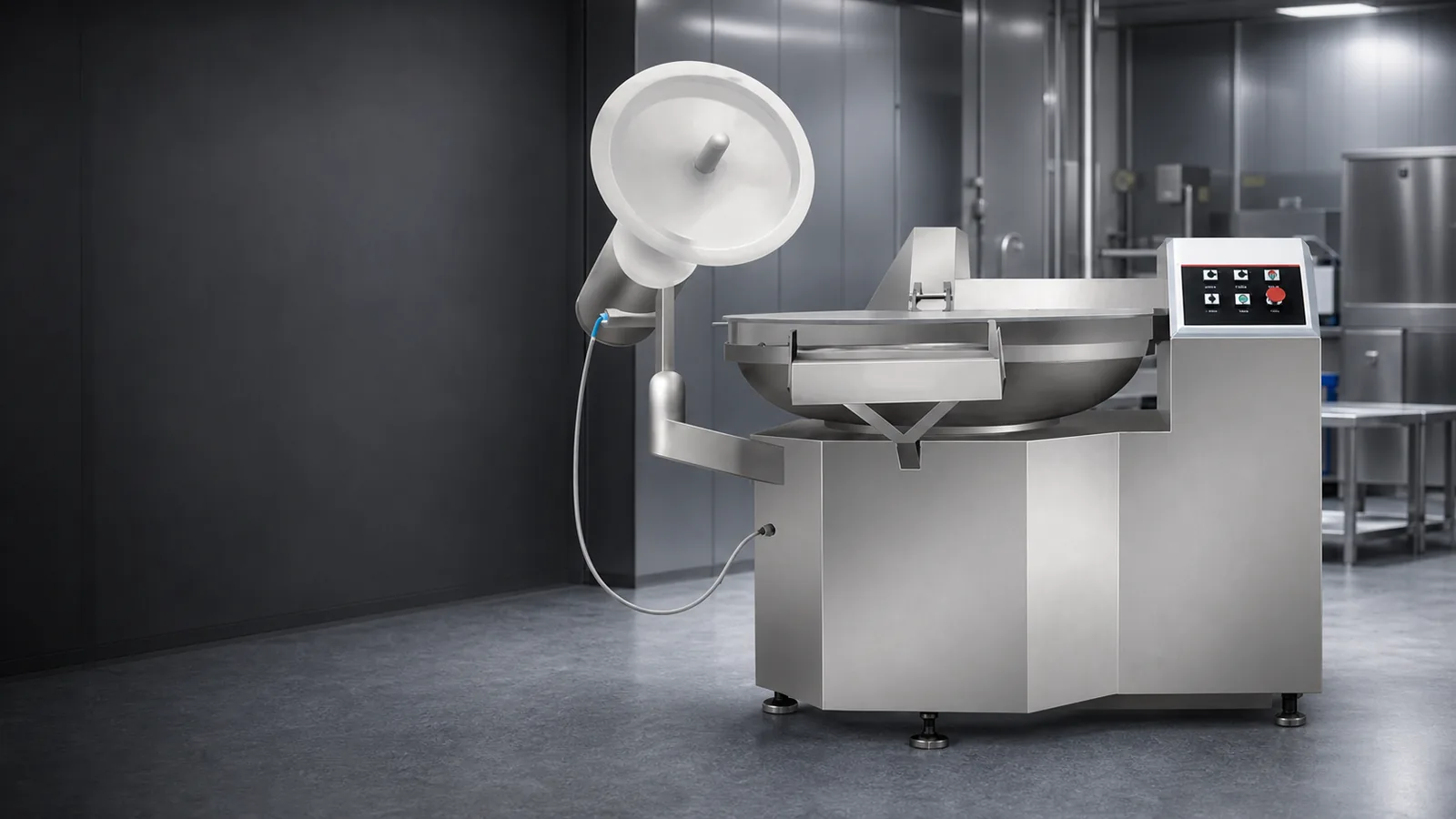
Fine preparation
ZB-125 Meat Bowl Cutter
Cuts, disperses and emulsifies the recipe-controlled fraction needed for binding and finished texture.
View ZB-125 →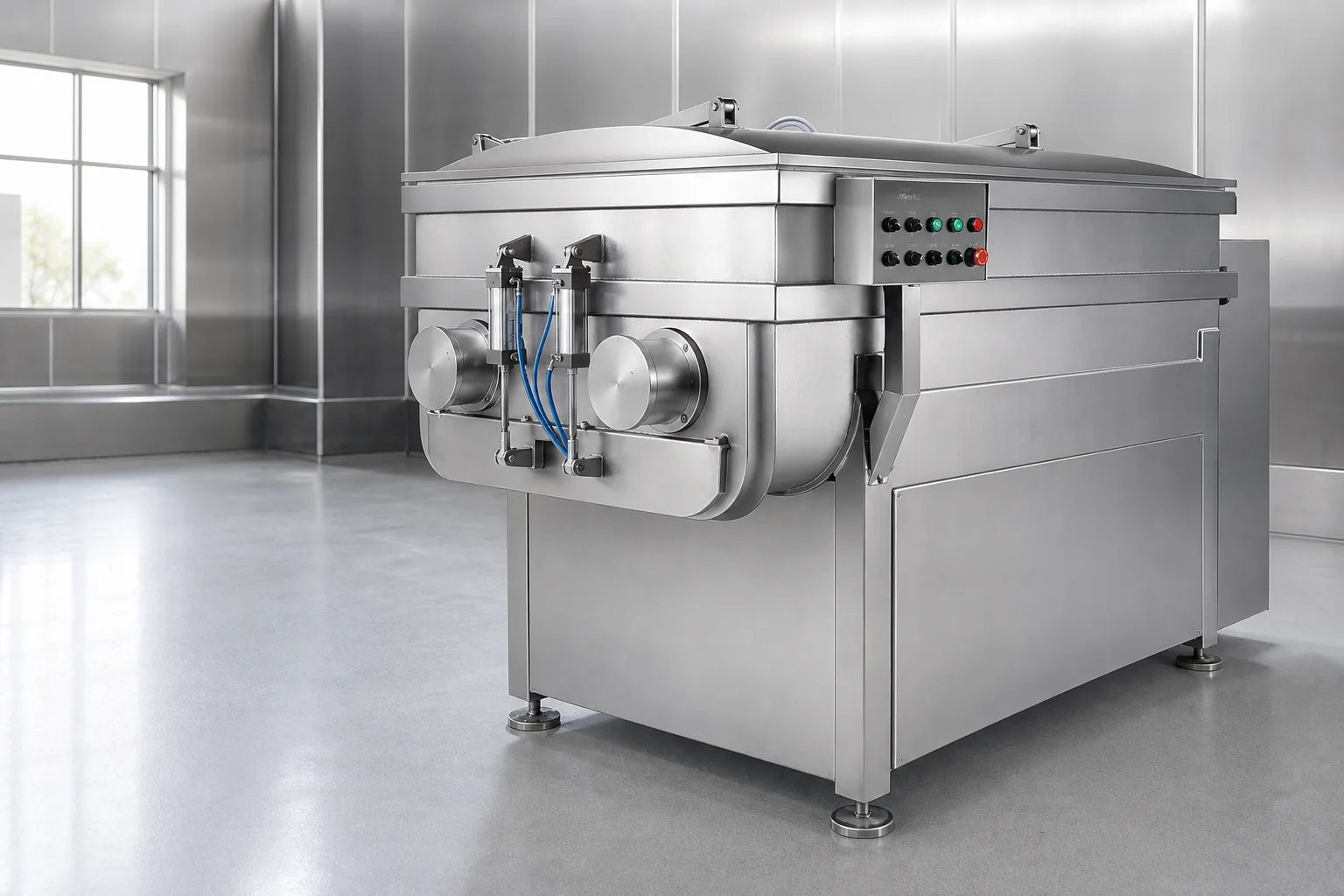
Recipe development
ZKJB-1200 Mixer + YT-200 Hoist
The hoist loads the batch; vacuum mixing distributes ingredients and supports a compact, repeatable sausage batter.
View ZKJB-1200 →View YT-200 →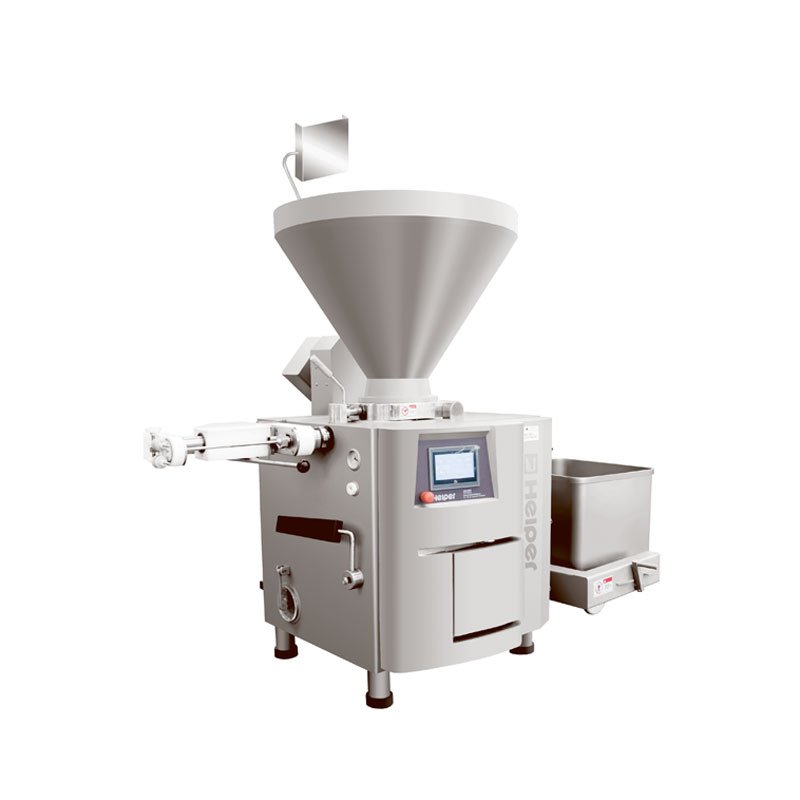
Portioning
ZKG-6500 Vacuum Sausage Filler
Meters prepared batter into the selected casing while reducing trapped air and feeding the linking stage.
View ZKG-6500 →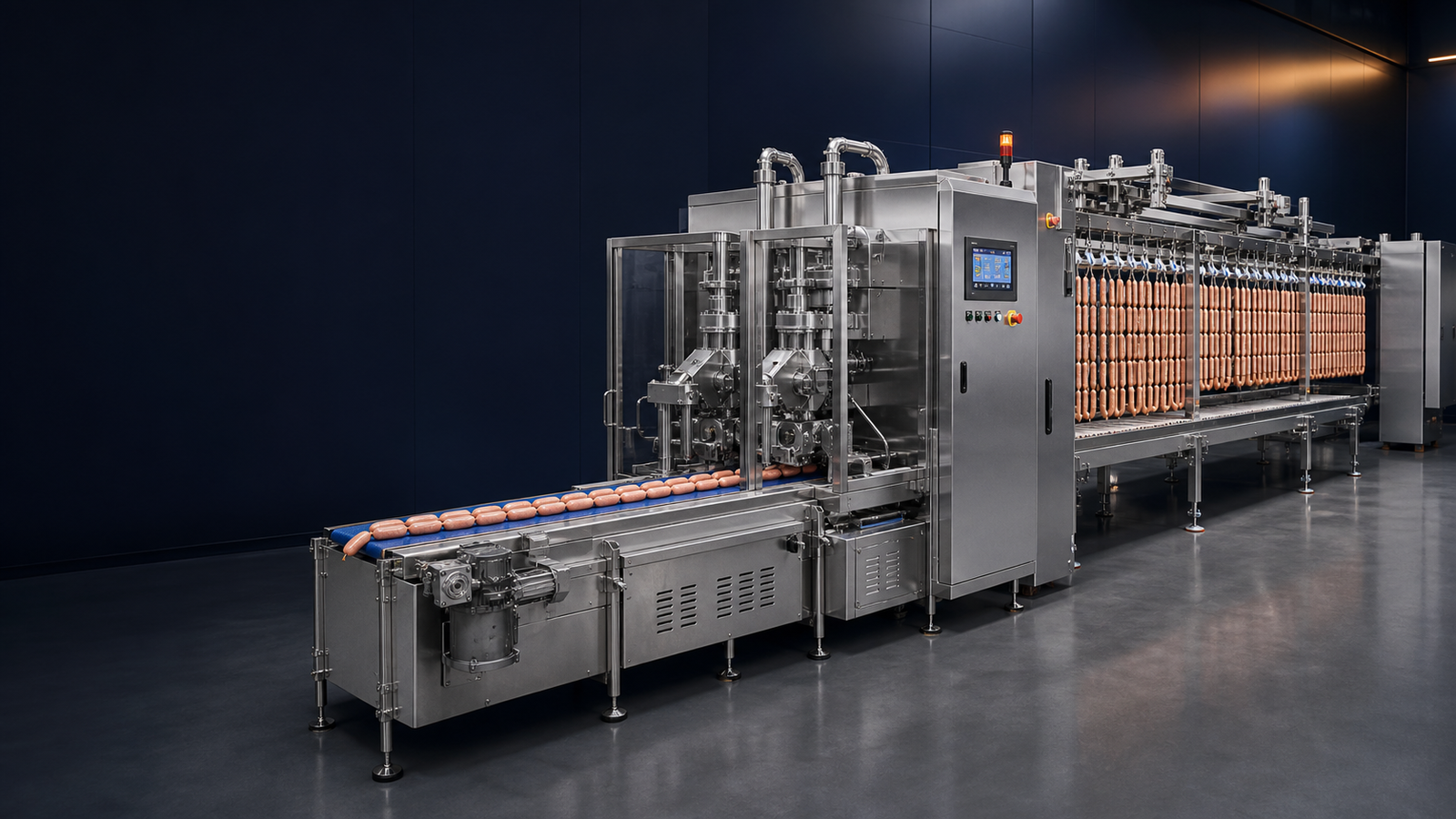
Forming and handling
GN-1200III Linking & Hanging System
Forms the selected link length, organizes the chain and transfers it onto the 100-rod circulation set.
View GN-1200III →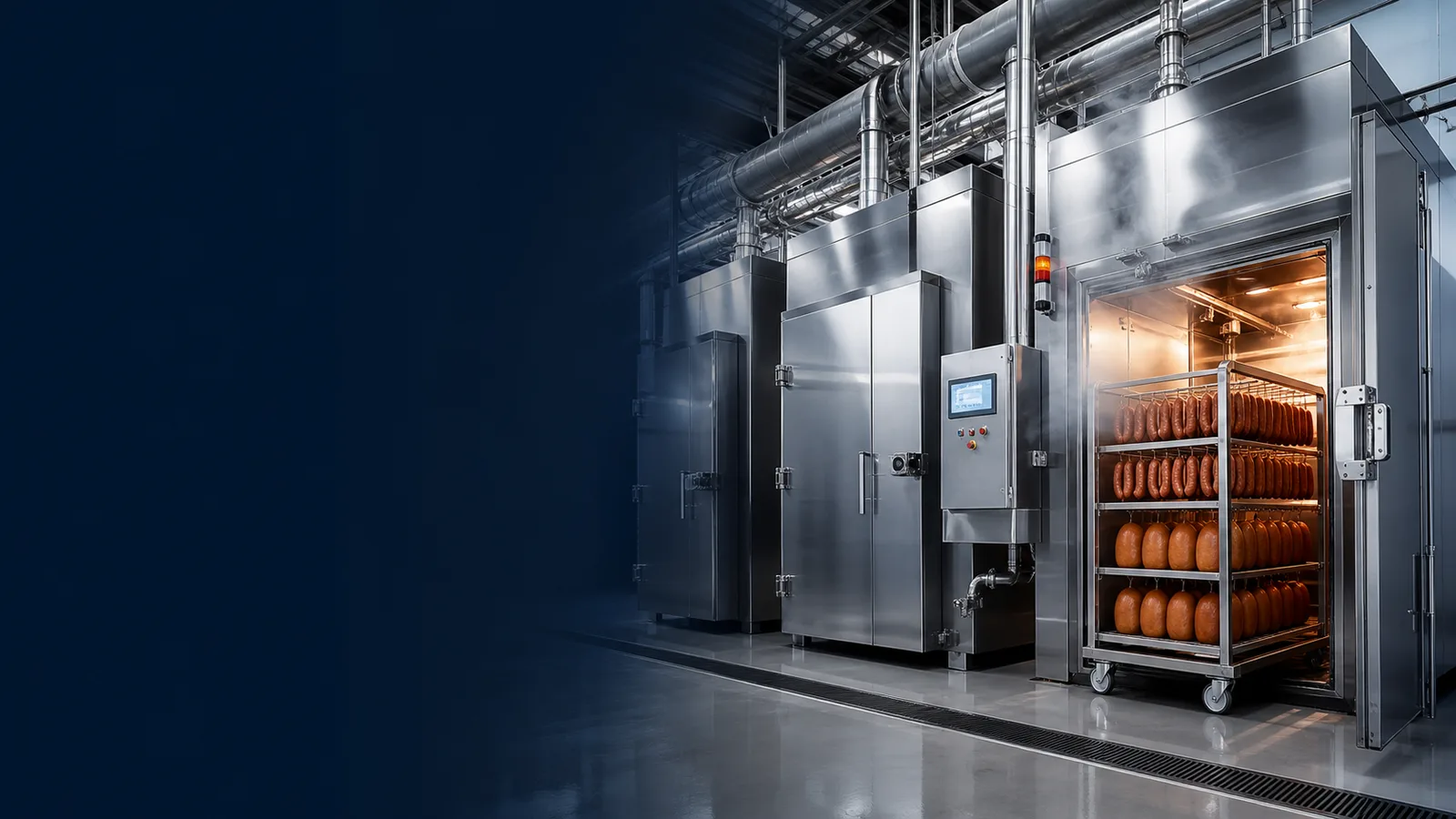
Thermal processing
Double-Door Four-Trolley Smokehouse
Runs the validated drying, smoking and cooking recipe while twelve trolleys circulate through the operation.
View QZX smokehouses →
Cooked-side cutting
GQC-3000 Roller Sausage Cutter
Separates the cooled linked chain into individual sausages before visual inspection and alignment.
View GQC-3000 →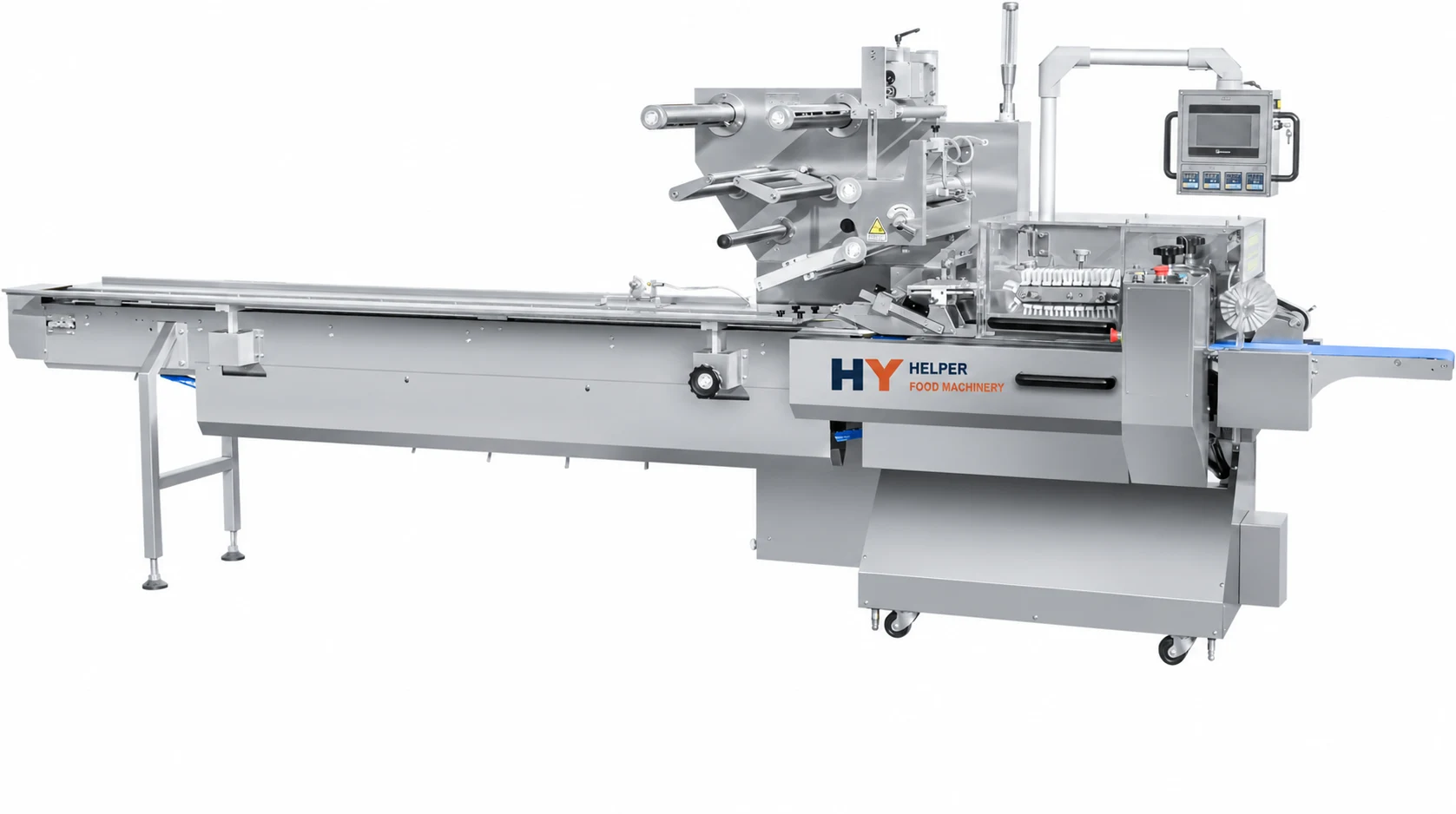
Primary packaging
BOSS450/132-X Flow Wrapping Machine
Receives manually aligned sausages and completes film forming, longitudinal sealing, cross-sealing and pack cut-off.
View BOSS450 →The smokehouse sets the production rhythm
Cutting, grinding and filling equipment can move material faster than the average 714 kg/h design rate. The batch mixer and smokehouse cannot be evaluated from maximum machine speed alone. The project schedule must balance mixer batch mass and cycle time with trolley loading, smokehouse load, drying and cooking time, cooling and changeover.
For a supportable 5 t/day claim, the customer and HELPER engineering team should agree the actual sausage diameter, unit weight, casing, recipe, chamber load, core-temperature endpoint and acceptable daily operating losses. A trial recipe and a documented cycle provide better evidence than a catalogue speed.

Factory layout: use the middle of the room deliberately
The preliminary layout keeps the main material route legible while reserving workable space for cooling, human sausage sorting and BOSS450 packaging. It is a planning reference—not a construction drawing. A final layout still requires room dimensions, columns, doors, drainage, floor loading, raw-material access, cooked-product exit, trolley return and maintenance clearances.

Raw-side preparation
Cutting, conveying, grinding, bowl cutting and mixing stay together to reduce handling distance and maintain a clear raw-material route.
Thermal boundary
The double-door smokehouse can support separation between loading on the raw side and unloading on the cooked side when the building allows it.
Cooked-side finishing
Cooling, GQC-3000 cutting, human sorting and BOSS450 packaging are arranged as one post-cook sequence with room for operators and product transfer.
Confirm before engineering release
- Product recipes, casing types, sausage diameters, lengths and unit weights
- Required saleable output and seven-hour shift definition
- Electrical voltage and frequency, water, drainage, steam or heating source, exhaust and compressed air where required
- Cooling method, inspection method and downstream packing format
- Cleaning method, allergen changeover, sanitation verification and operator access
- Installation, commissioning, product trials, training, spare parts and documentation scope
What this solution confirms—and what it does not
This page gives sausage producers a concrete starting point: a named production target, a complete equipment sequence, direct links to the individual machines and the interfaces that make them operate as one line. It does not claim that one identical layout or smokehouse recipe fits every product. Final engineering follows the customer’s recipe, plant, utilities, hygiene plan, packaging format and acceptance criteria.