
Codex Alimentarius
Codex quick-frozen food code Processing and Handling of Quick Frozen Foods (CXC 8-1976)
Relevant when wonton or shumai is frozen after forming and the project boundary includes freezing, storage or cold-chain handoff.
Wonton and shumai application
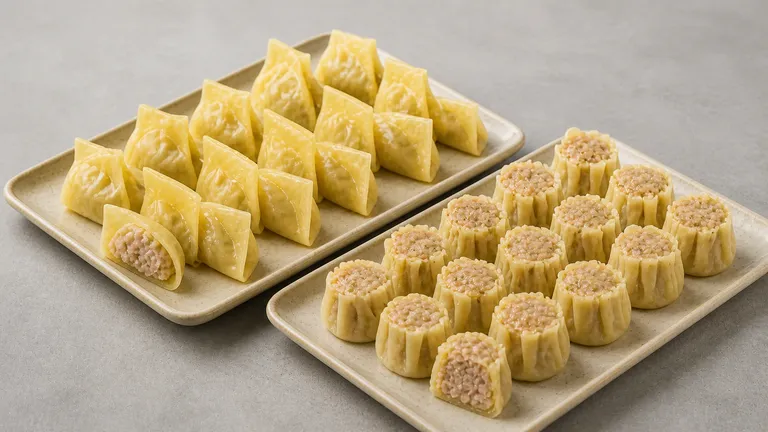
Folded wonton and open-top shumai are not interchangeable forming jobs. Clarify the target product, wrapper supply and filling behaviour before a machine trial.
Illustrative finished-product background. Equipment suitability requires sample and engineering confirmation.
Use the list as a scope check. The final process and equipment configuration still depends on samples, output targets and downstream requirements.
Use these official sources to frame product, hygiene and downstream requirements before equipment selection. They are planning references—not a substitute for the laws and standards that apply in the destination market.
Relevant when wonton or shumai is frozen after forming and the project boundary includes freezing, storage or cold-chain handoff.
Use for GHP and HACCP discussion around filling exposure, wrapper handling, cleaning access and transfer to steaming or freezing.
Supports hazard-based review of fillings, allergens, sanitation and process controls where the destination market makes the rule applicable.
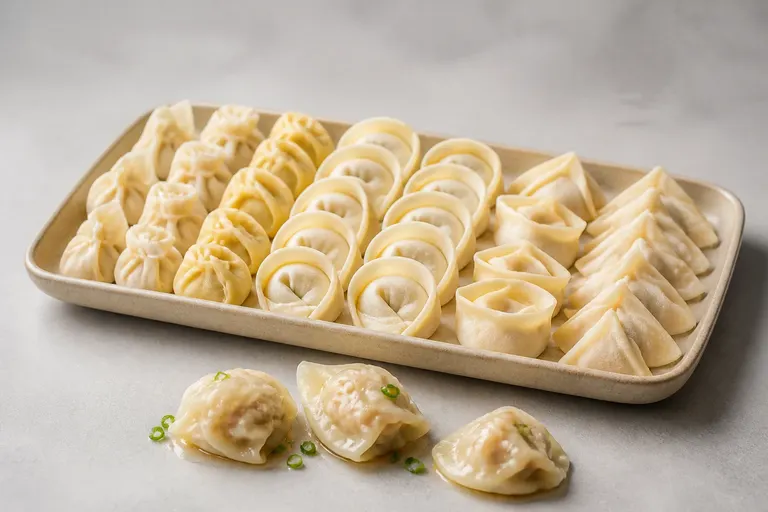
Wonton encloses and folds a wrapper around filling; shumai normally remains open at the top and depends on a different gathering and presentation geometry. Define the exact reference shape, dimensions, piece weight, wrapper exposure and base stability. A broad request for “wonton and shumai” is not enough to select tooling.
If both products are required, list the planned share of production, acceptable changeover time and which parts or settings must change. Confirm each product separately with samples.
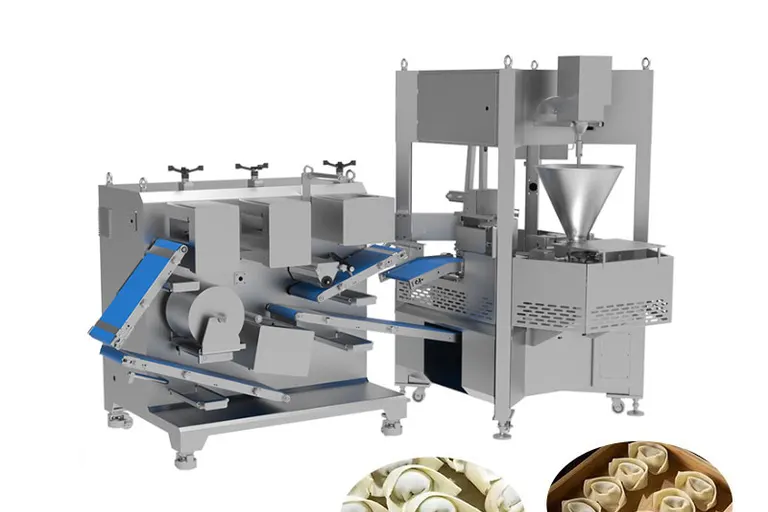
The machine needs a repeatable wrapper input and a filling that can be portioned without smearing the seal or deforming the product. Record wrapper size, thickness, moisture, stacking or feeding method, plus filling viscosity, particle size and temperature range.
During a trial, inspect centering, fold consistency, open-top appearance, product base, weight variation and release from tooling. A short run that produces a few attractive pieces is not the same as stable production.
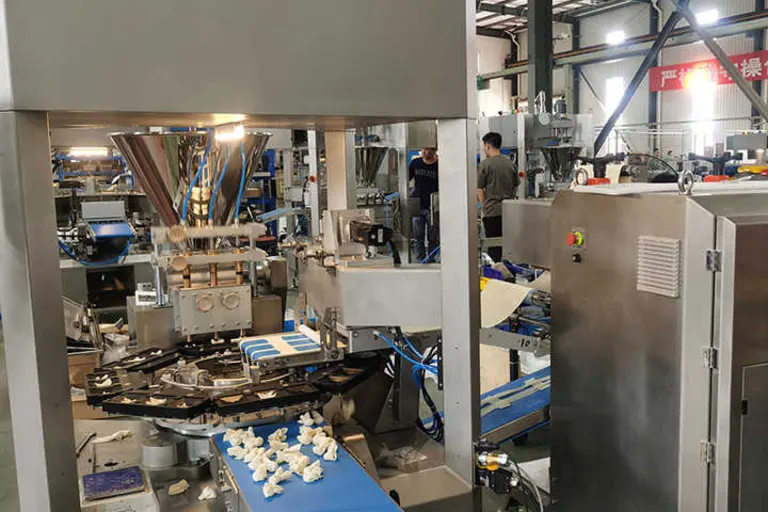
These products can deform before they reach steaming, freezing or packing. Define where each piece lands, the required spacing, whether manual tray loading is acceptable and how long the product waits before the next process. The transfer should avoid collision, dragging and wrapper drying.
For steamed products, plan cooking, cooling and hygienic handling. For frozen products, coordinate loading pattern, freezer residence time and packaging. The correct downstream path depends on the final sold condition, not just the forming shape.
Use the route comparison to decide which operations and interfaces belong in the proposal. Final scope remains project-specific.
Better inputs reduce assumptions and make capacity, tooling and line-boundary discussions more useful.
Use the guide for context, the tool for structured inputs and the product family only when the route is sufficiently defined.
Answers define the next engineering question; they do not replace product trials or a project-specific proposal.
Some configurations may support more than one product with tooling or setting changes, but this is not universal. Confirm the exact shapes, wrapper inputs and filling for both products, plus the required changeover procedure.
They may be suitable if size, thickness, moisture, stacking and separation match the feed system. Send representative wrappers for evaluation because storage and holding time can change their behavior.
Texture affects dosing stability, weight repeatability and clean forming. Large or firm particles, free liquid and temperature changes can alter flow. The actual recipe is more informative than a general description such as meat or vegetable filling.
Provide reference samples or multiple-view photographs with dimensions. Identify critical features such as fold count, open-top diameter, exposed filling height, base shape and acceptable variation.
Common project factors include an unsuitable landing surface, excessive drop height, crowding, dragging, delayed transfer and a wrapper that loses condition. Review the first downstream conveyor or tray as part of the forming cell.
Include it when HELPER is expected to balance the full route or define the transfer responsibility. Even when downstream equipment is sourced separately, its infeed, residence time and capacity should be known before the former is finalized.
Engineering claim status
Product geometry, wrapper behaviour and filling delivery must be reviewed together before configuration or output is promised.
The JZ2 wonton and shumai machine identity and official-labelled imagery are supported by current local primary evidence.
Folded wonton and open-top shumai routes are valid planning distinctions, but product-specific suitability still needs samples.
Speed, product weight, wrapper and filling limits, particles, moulds, changeover and downstream test records remain open.
Configuration gate: provide wrapper and filling samples, target geometry and downstream condition through the project brief.
Separate the folded and open-top routes, then prepare representative product inputs.