
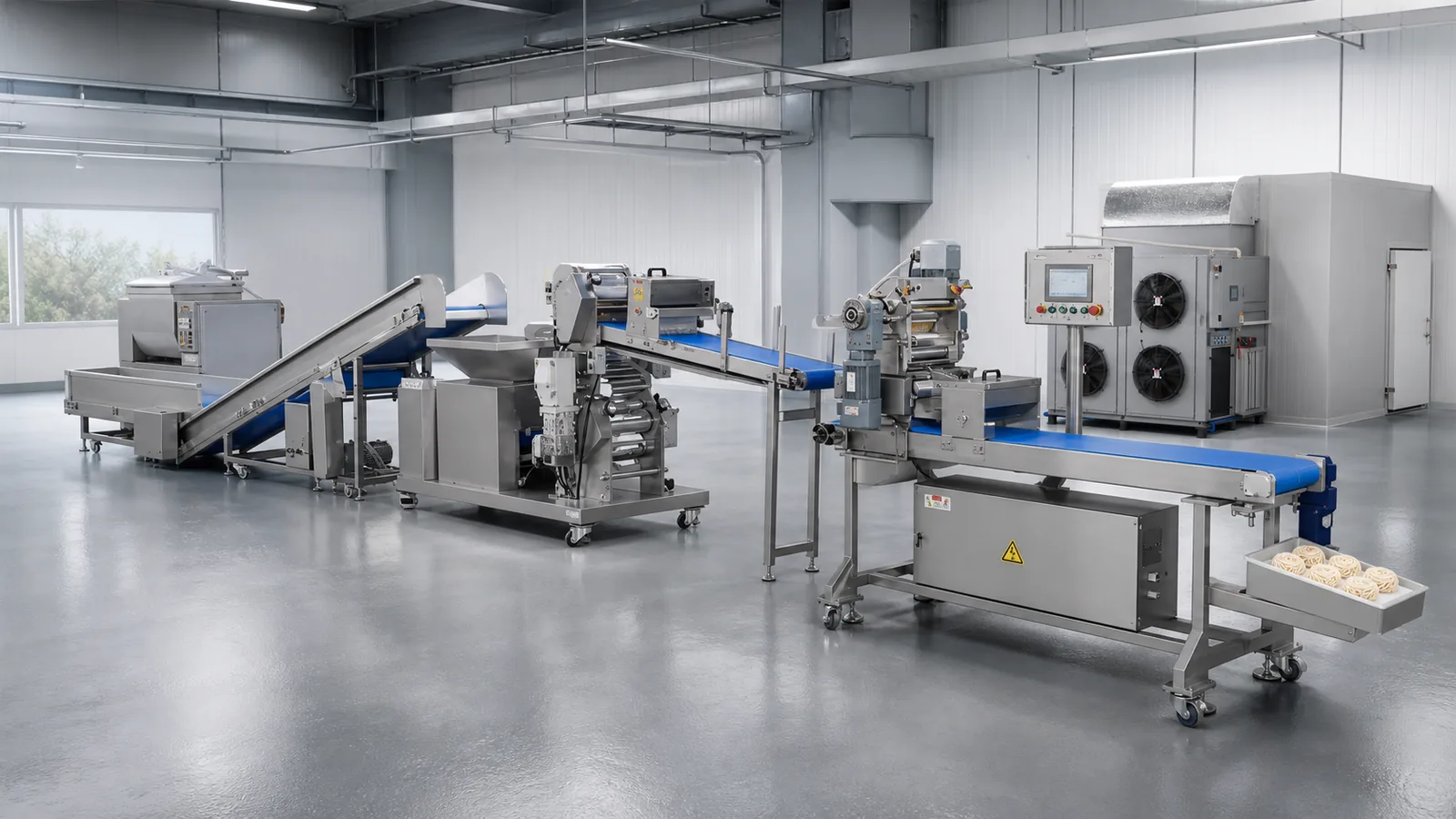
M-270 Fresh & Dry-Fresh Line
Compact forming route for fresh, egg and optional dry-fresh noodle products.
200–400 kg/hUp to 8 m*
View M-270
One dedicated family for fresh noodles, dry-fresh noodles, frozen cooked portions and handmade-style noodle processes. Select the route from the finished product, then confirm capacity, footprint and utilities.
The 2026 HELPER catalogue adds two customized handmade-style systems to the existing M-270, M-440, M-800 and DM-440 families.
Compact forming route for fresh, egg and optional dry-fresh noodle products.
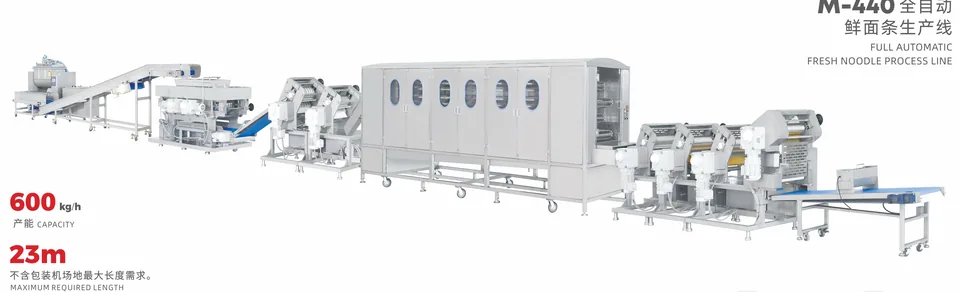
Medium automatic line with compact enclosed processing and progressive rolling.
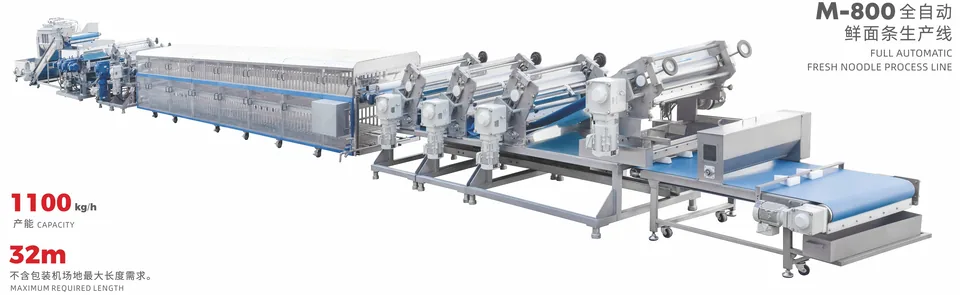
Large automatic line with extended multi-stage reduction and continuous processing.
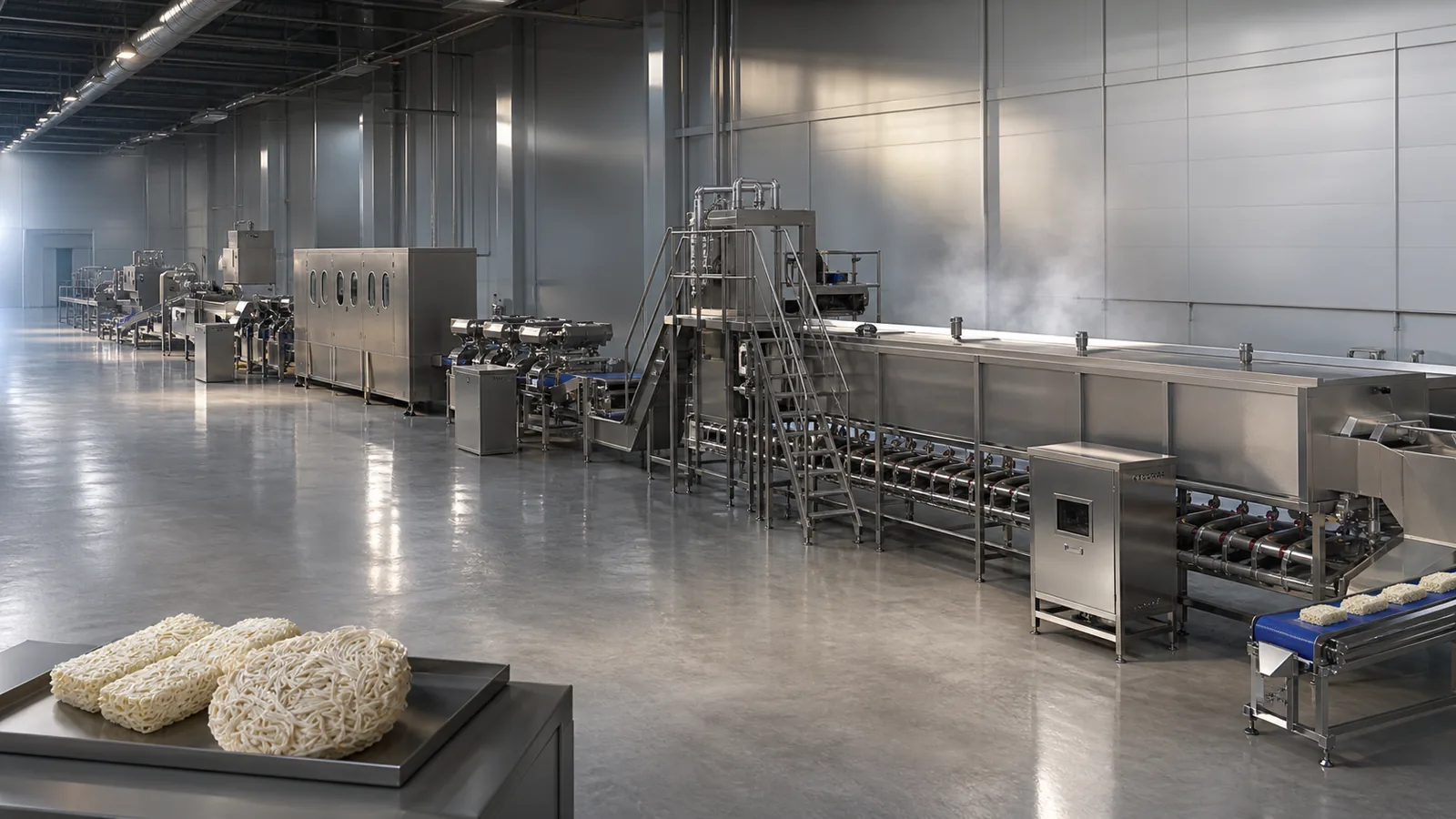
Fresh noodle forming, portion cooking, cooling and freezer interface.
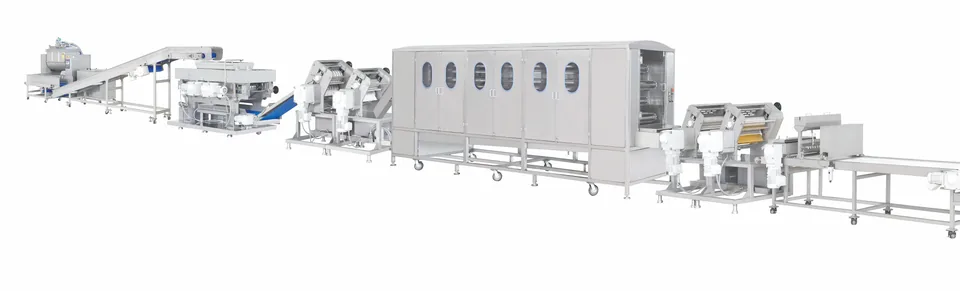
Conditioned blanks for knife-cut, pulled, latiaozi and huimian-style products.
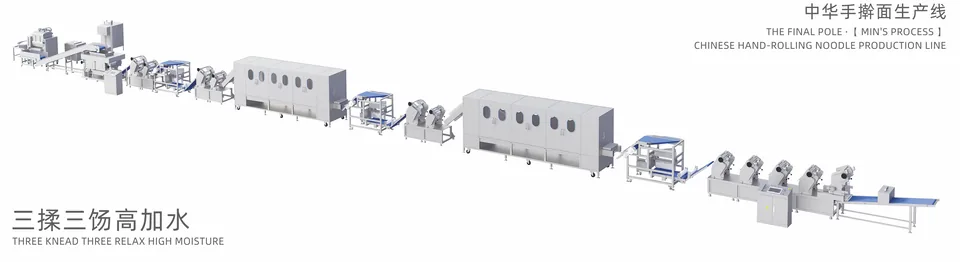
High-moisture route built around three kneads and three relaxation stages.
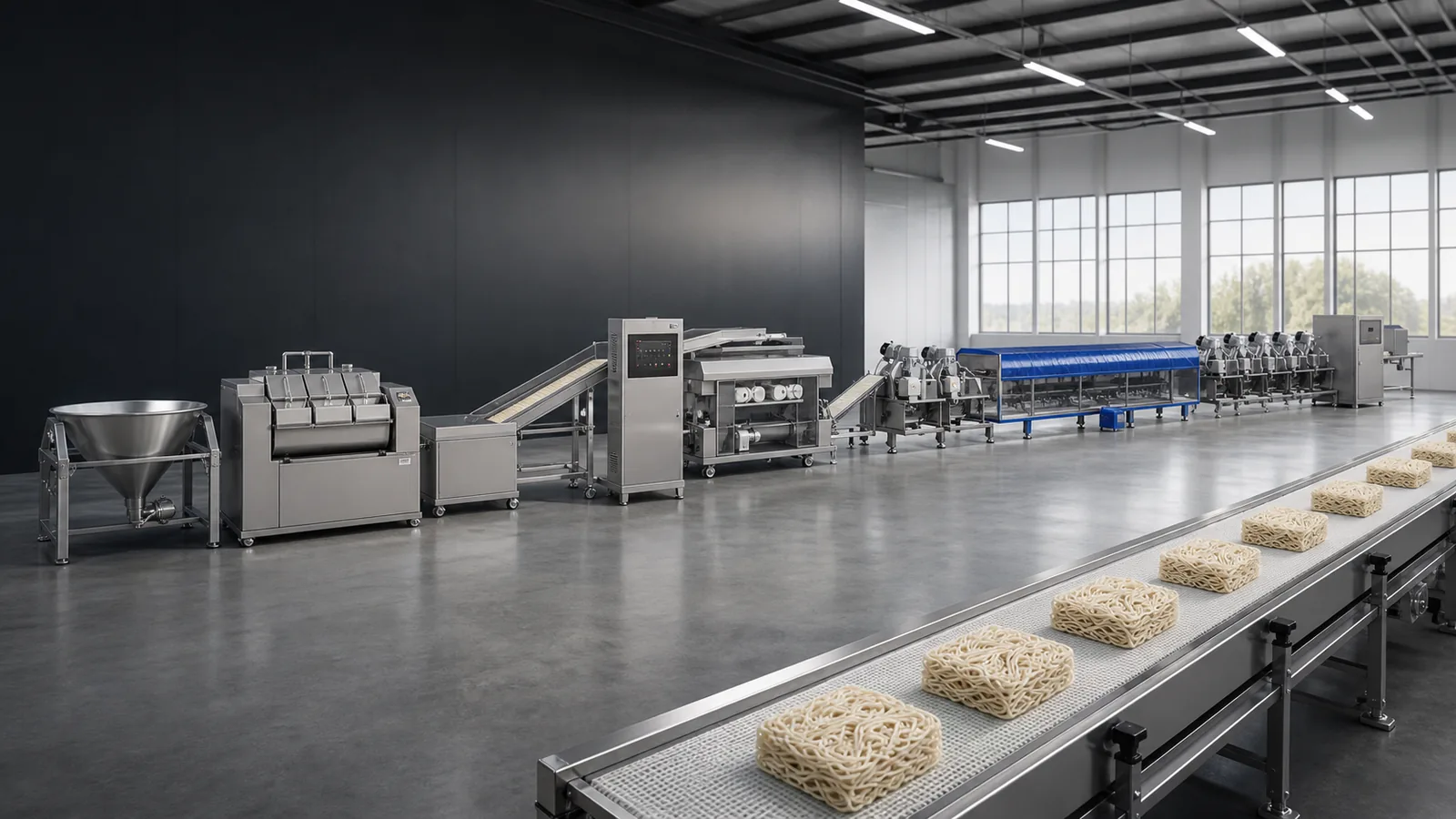
Forming, controlled drying, sterilization, detection and packing for non-fried blocks.
Working principle
This illustrated reference line shows the shared forming stages behind many fresh-noodle configurations before route-specific cooking, drying, freezing or packing modules are added.
This category covers HELPER’s current sheeted wheat-flour noodle systems. It does not describe pasta extrusion or rice-noodle processing, which use different dough or slurry architectures.
Most automatic noodle production lines share a controlled forming core: ingredient dosing, dough mixing, resting, compound sheeting, staged gauge reduction and cutting. The finished product then determines what comes next. Fresh noodles may move directly to dusting, portioning and packing; dry-fresh noodles add controlled moisture removal; frozen cooked noodles add cooking, cooling, portion handling and a freezer interface.
That distinction matters when comparing quotations. A forming-line output cannot be treated as packed-product output unless the downstream process, yield and dwell time have also been defined. Use the noodle production application guide to map the route before selecting a model. If the product name is ambiguous, first use the global noodle family map. For wheat products, compare white salted and alkaline dough behavior; then define the downstream controls in the post-cutting route guide. Soup, wok, cold-service and sauce requirements can be translated with the serving-use test matrix.
Match flour, water, salt and minor ingredients to the recipe and batch sequence.
Allow hydration and relaxation before the dough enters continuous reduction.
Combine and consolidate dough sheets to establish a stable structure.
Control roller gaps and reduction ratios instead of forcing thickness in one pass.
Set strand width, thickness, length and portion format for the target product.
Connect packing, drying, cooking, cooling or freezing according to product state.
Lengths below are the catalogue’s maximum site requirement without packaging where stated. Customized lines require an approved layout.
| Line | Finished route | Published output | Published site length |
|---|---|---|---|
| M-270 | Fresh / dry-fresh noodles | 200–400 kg/h | 8 m |
| M-440 | Automatic fresh noodles | 600 kg/h | 23 m |
| M-800 | High-output fresh noodles | 1,100 kg/h | 32 m |
| DM-440 | Frozen cooked portions | 5,000–10,000 portions/h | 43 m |
| Handmade intermediate | Conditioned blanks | Customized | Customized |
| Chinese hand-rolled | High-moisture fresh noodles | Customized | Customized |
The correct line family is the one that can hold the required product quality through forming and downstream treatment. Roller width and nominal kilograms per hour are only part of that decision.
Begin with flour strength, hydration, sheet thickness, strand dimensions and shelf-life route. The M-270 is the compact 200–400 kg/h family; M-440 and M-800 serve larger automatic fresh-noodle projects. If drying is required, temperature, humidity, residence time and final moisture must be matched to the noodle geometry.
The DM-440 route must be evaluated in portions per hour as well as dough throughput. Cooking loss, cooling method, target portion weight, freezing interface and pack format can limit accepted output even when the upstream forming section has spare capacity.
These projects are recipe-led. Repeated kneading, resting, blank formation and final hand finishing may be more important than nominal speed. Trials should confirm dough handling, relaxation time and the boundary between automated preparation and manual finishing.
The catalogue gives a line family, reference output and stated maximum site length where available. It is a practical starting envelope for model comparison, not a final engineering layout or performance guarantee for every recipe.
Final scope may change with cutter format, product contact parts, electrical standard, conveyor interfaces, sanitation access and downstream equipment. Estimate a first capacity range with the output calculator, then use the line selection guide to prepare the engineering brief.
These answers define the selection boundary before a model and layout are confirmed.
Start with the finished product state: fresh, dry-fresh, frozen cooked, handmade-style intermediate, high-moisture hand-rolled-style or air-dried instant egg noodles. The required downstream modules differ before capacity is compared.
Not always. Published output is a model reference. Accepted finished output must be confirmed with the recipe, noodle dimensions, moisture target, process yield, downstream dwell time and packing arrangement.
Provide a noodle sample or product specification, flour and recipe information, target accepted output, package format, available floor plan, electrical standard, water supply and any cooking, drying, freezing or packing requirements.
Some products can share upstream mixing, resting and sheeting equipment, while cutters and downstream treatment may change. HELPER must review the recipes and changeover requirements before confirming a multi-product scope.
Project-specific items may include the line layout, dough handling sequence, cutter and portion format, conveyor interfaces, cooking or drying conditions, freezing interface, utility standard, guarding and packing connection.
No. This page focuses on the current HELPER family of sheeted wheat-flour noodle systems. Pasta extrusion and rice-noodle processing require different process architectures.
Capacity only becomes useful after the recipe, product dimensions, accepted output, downstream process and available utilities are known.
Share your noodle product, hourly output and factory space.