
Industrial food processing machinery and complete production linessales@helperfoodmachinery.com
HELPER Food Machinery Contact Us

Youtiao & fried dough application

Plan forming and frying as one controlled interface.

Begin with dough condition, product dimensions and accepted output. Then define how formed pieces enter frying, leave the oil, cool and reach packaging.

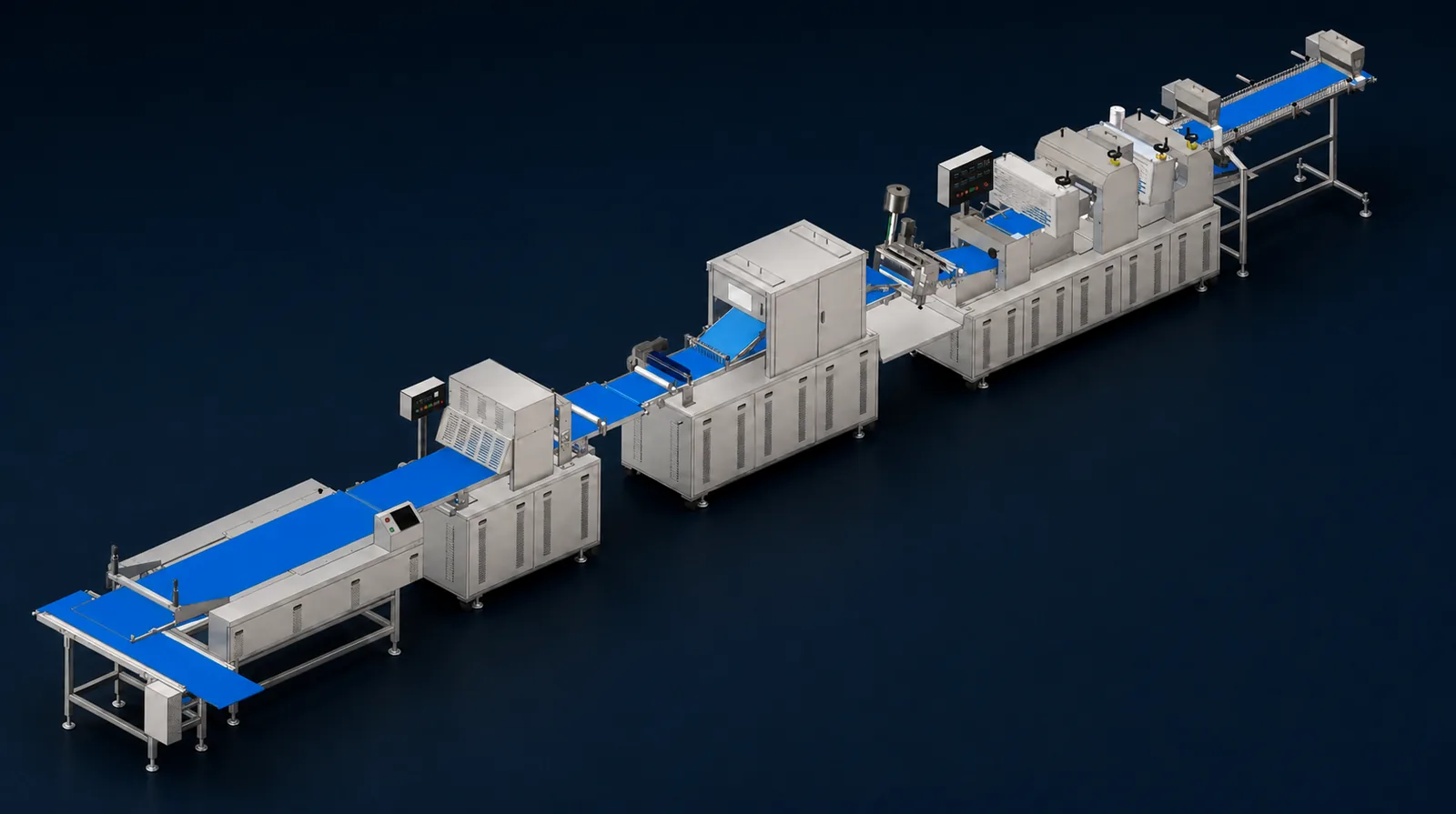
Product-family context image; provenance is under review. It is not customer-project or accepted-output evidence.

Define the fried-dough product before the line

Youtiao is not interchangeable with every cruller or fried-dough format. Record the target shape, paired or single-piece geometry, dimensions, unit mass, surface, internal texture and condition at packing.

  • Paired Youtiao forms
  • Single-strip fried dough
  • Recipe and dimension variants
  • Fresh packed or cooled products
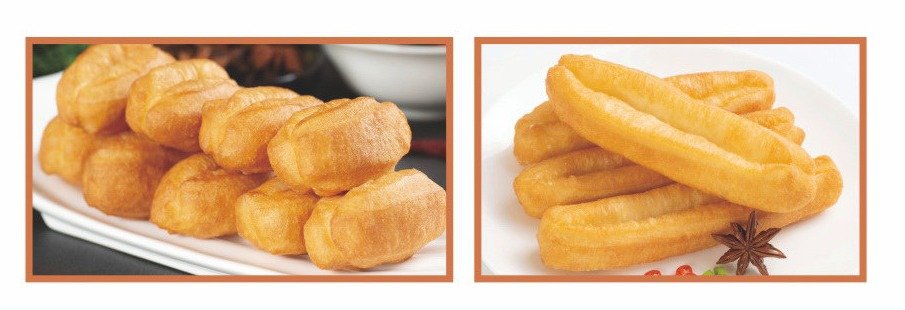
Official catalogue reference showing a Youtiao product and line presentation
Official-labelled catalogue reference. It supports product-family orientation, not a project output guarantee.

Start with dough development and release condition

Flour, hydration, leavening system, ingredient temperatures, mixing energy, resting time and ambient conditions influence extensibility. Define the condition required at divider or forming infeed, not only the mixer recipe.

During review, record sticking, tearing, elastic recovery and dimensional variation. A stable forming result requires a repeatable dough window.
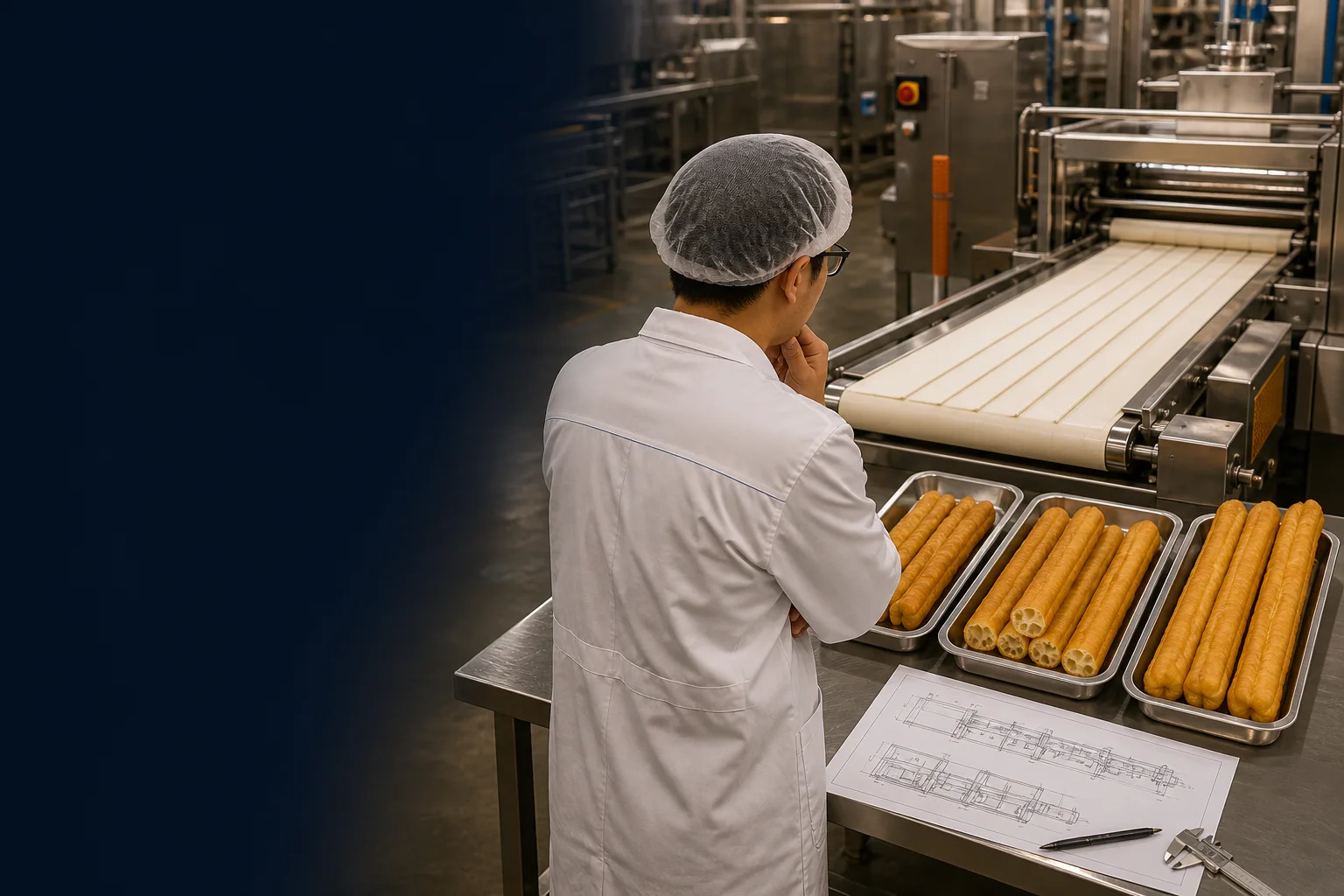
Editorial planning illustration for comparing Youtiao production routes
Editorial planning illustration; not a photograph of a verified customer project.

Forming discharge and fryer infeed must agree

Define piece length, width, spacing, orientation and permissible deformation at the hand-off. The fryer interface also needs belt width, loading pattern, oil temperature window, residence time and control responsibility.

If the fryer is supplied by another party, record the battery limit and signal exchange. HELPER forming equipment should not be described as a complete frying line until that scope is signed.

Decisions to make first

  • Recipe, hydration and resting window
  • Paired or single-piece geometry
  • Accepted pieces per hour or kg/h basis
  • Fryer infeed and oil-process boundary
  • Cooling, de-oiling and packaging hand-off

Planning process map

  1. Ingredient preparation
  2. Mixing
  3. Resting or relaxation
  4. Dividing and forming
  5. Fryer transfer
  6. Frying and de-oiling
  7. Cooling and packing

Prepare these inputs before engineering review

Use measurable product and interface conditions. A product name or a catalogue speed is not enough to define the line.

  • Recipe, hydration and resting methodInclude ingredient temperatures, ambient conditions and the acceptable dough condition at forming.
  • Finished geometry and unit massRecord paired or single form, length, width, thickness, weight and acceptable variation.
  • Accepted output basisState pieces per hour or kg/h after rejects, changeovers and the agreed test duration.
  • Fryer and oil-process interfaceProvide infeed height, belt width, spacing, oil-temperature window, residence time and control responsibility.
  • Available utilitiesList voltage, frequency, connected loads, fuel or heat source, extraction and cooling conditions.
  • Factory space and accessProvide layout, clear height, doors, drainage, hygiene zones and maintenance clearances.
  • Cooling and packaging hand-offDefine product condition, accumulation allowance and the upstream/downstream battery limits.

Published module evidence—and its limits

The following values come from HELPER catalogue-labelled material for the dough-block module. They do not define accepted Youtiao line output or a universal fryer scope.

Official specification · YTB-001

Published dough-block route

The source route is mixing → pre-pressing → fixed-length cutting → tray loading → cold resting. It applies to the dough-block module, not the complete line.

Official specification · YTB-002

Published electrical supply: 380 V

Confirm destination voltage, frequency and the signed electrical schedule before configuration.

Official specification · YTB-003

Published module power: 1.7 kW

This is a module value and must not be presented as the connected load of a complete Youtiao line.

Official specification · YTB-004

Published dough-block size: 380 × 560 × 40 mm

The dimensional value is supported by the Chinese catalogue field; final geometry still requires tray and interface confirmation.

Official specification · YTB-005

Published module productivity: 4,200 kg/h

This value belongs only to the named dough-block module and is not accepted Youtiao line output.

Official specification · YTB-006

Published thickness adjustment: 40–60 mm

Block length follows the turnover tray. Final accepted block dimensions require sample and interface confirmation.

Engineering claim status

The process route is useful; the final supply scope is project-specific.

Catalogue identity and planning logic do not establish a universal recipe window, output, oil consumption or full-line responsibility.

Verified source

Equipment-family identity

Local catalogue-labelled material supports the Youtiao line and dough-block-divider families.

Conditional

Forming route

Mixing, resting, dividing, pairing and fryer transfer are valid planning stages, subject to recipe and configuration.

Confirm for project

Performance and fryer scope

Accepted output, forming range, oil window, consumption, yield and fryer/cooling/packing supply remain unconfirmed.

Youtiao planning FAQ

These answers frame the next engineering question; they are not project guarantees.

Does HELPER supply the fryer in every Youtiao project?

No universal supply boundary is published. Dough preparation and forming may be discussed with the frying interface, but responsibilities must be written into the project scope.

Can catalogue speed be used as accepted output?

No. Accepted output depends on dimensions, dough condition, spacing, fryer loading, rejects, changeovers and test duration.

Why is dough relaxation important?

Mixing, resting and relaxation affect extensibility and recovery before dividing, pairing and stretching.

What should be confirmed at the fryer interface?

Confirm spacing, belt width and speed, entry condition, oil temperature window, residence time, extraction, cooling and controls.

Can the same route make every fried-dough product?

No. Treat each target recipe and geometry as a separate validation case.

Chat on WhatsApp