Standard for Instant Noodles (CXS 249-2006)
Relevant when the planned product is pre-gelatinized and dehydrated as an instant noodle. It is not a specification for every fresh or dried noodle format.
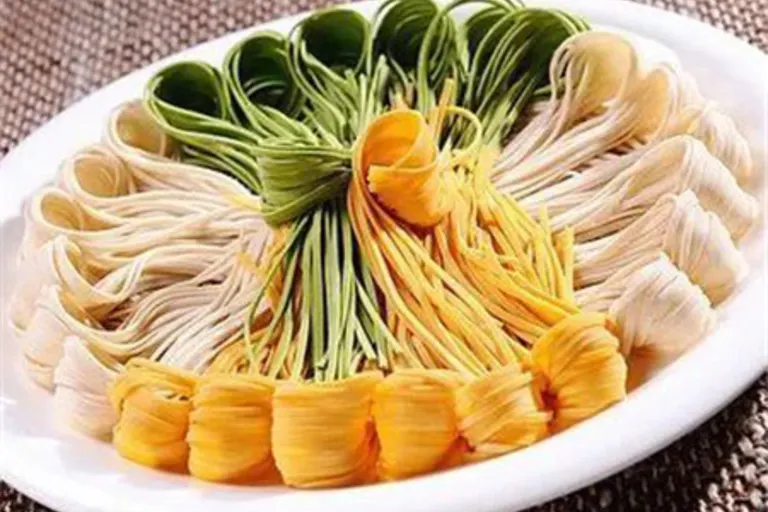
Noodle production application
The right route depends on the finished noodle, required shelf-life process and downstream handling—not only the target kilograms per hour.
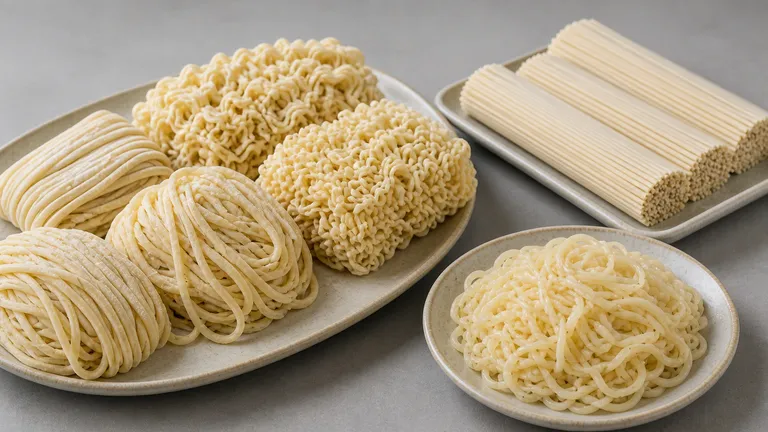
Illustrative finished-product background. Equipment suitability requires sample and engineering confirmation.
Use the list as a scope check. The final process and equipment configuration still depends on samples, output targets and downstream requirements.
40-second process animation
Follow the material as flour and water become dough, a continuous sheet and cut fresh noodles across six coordinated stages.
Use these official sources to frame product, hygiene and downstream requirements before equipment selection. They are planning references—not a substitute for the laws and standards that apply in the destination market.
Relevant when the planned product is pre-gelatinized and dehydrated as an instant noodle. It is not a specification for every fresh or dried noodle format.
Use for early discussion of hazard analysis, process controls, allergen controls and sanitation when the destination market makes the rule applicable.
A general GHP and HACCP reference for mapping hygienic design, sanitation access and control points across mixing, forming and downstream handling.

Fresh, chilled, air-dried, pre-cooked and frozen noodles may
begin with similar flour and water, but they do not create the
same factory problem. Record strand width and thickness, cut
length, portion weight, surface flour, moisture target and the
condition at packing. A line sized only around kilograms per
hour can still fail if the product arrives at cooling or packing
in the wrong geometry.
Use physical reference samples
wherever possible. A photo helps communicate appearance, but a
sample supports measurements, cooking tests and handling checks.
If several SKUs share one line, define the acceptable changeover
and which product is the most difficult to run.

The slitter cannot correct an unstable dough sheet. Mixing
uniformity, resting time, compound sheeting, gauge reduction and
roller condition all influence whether the final sheet feeds
straight and cuts consistently. The useful engineering question
is not simply “How many rollers?” but “What sheet condition must
reach the cutter at the planned speed?”
During a
trial, observe edge cracking, sticking, thickness variation,
elastic recovery and whether the sheet tracks without manual
correction. Those observations help define reduction stages,
dusting and the practical operating window for the intended
flour and hydration range.

Forming capacity is only one part of effective output. Drying
needs a controlled loading pattern and residence time; cooking
needs stable product spacing and heat transfer; cooling must
remove heat without damaging the noodle; freezing and packaging
need an orderly, repeatable infeed. The slowest accepted stage
determines saleable throughput.
Map accumulation,
reject handling and sanitation access between operations. If
downstream equipment is purchased separately, agree on belt
height, product orientation, transfer width and control signals
before the forming line is finalized.
Use the route comparison to decide which operations and interfaces belong in the proposal. Final scope remains project-specific.
Better inputs reduce assumptions and make capacity, tooling and line-boundary discussions more useful.
Move through three specific decisions: choose the process route, test the output basis, then package the confirmed inputs for engineering review.
Match the finished format and downstream process to a suitable line route.
Translate mass, portions, schedule and utilization into a planning scenario.
Record the product, capacity, utilities, factory and interface requirements for review.
Answers define the next engineering question; they do not replace product trials or a project-specific proposal.
Some upstream operations may be shared, but the downstream route changes substantially. Drying, cooking, cooling and freezing have different residence times, transfers and controls. Treat each intended format as a separate validated route before deciding what can share equipment.
Use both when packaging matters. Kilograms per hour describes mass flow, while packs per hour exposes portioning and packaging constraints. The project brief should also state operating hours, changeovers and expected saleable yield.
Dough response affects mixing, resting, sheet reduction, sticking and cutting. A catalogue description cannot establish the operating window for every flour. Representative materials make a trial relevant to the buyer’s actual product.
Freeze a reference recipe and a permitted variation range for the first engineering review. If the product definition continues to move, record which qualities are mandatory and which can be adjusted during trials.
It can be purchased later, but its infeed requirements should be known early. Portion shape, spacing, temperature, surface condition and conveyor height all affect whether the noodle transfers cleanly into packaging.
Measure sheet thickness, strand dimensions, portion weight, output over a meaningful run, reject causes and the condition entering the next process. Use agreed acceptance criteria rather than judging only a short visual demonstration.
Engineering claim status
Catalogue values are useful only inside the named model and configuration. Accepted factory output remains project-specific.
Published references for M-270, M440, M800 and DM440 remain tied to their named model pages and source scope.
Fresh, dried, cooked or frozen routes require the applicable configuration, recipe and downstream conditions to be stated together.
Sustained saleable output, recipe window, utilities, yield and changeover must be confirmed against samples and factory requirements.
No unverified default: prepare product, capacity, utility and downstream inputs in the project brief generator before engineering review.
Classify the noodle, define the eating endpoint, compare the downstream route, then collect inputs for engineering review.