
Direct answer
Plan sausage-line capacity on two clocks: the continuous or intermittent rate of filling and portioning, and the full batch turnaround of the smokehouse. Convert both to accepted output at named process boundaries, schedule whole trolley loads and whole chamber cycles, then verify that staging, thermal-process validation, cooling and packaging can support the plan.
Freeze the sausage process family
Map the connected line
Core filling and chamber formulas
kg/h = accepted portions/min x accepted portion mass (kg) x 60For continuous bulk filling, use measured accepted mass over representative running time.
kg/batch = raw kg/trolley x validated trolleys/chamber x thermal yield x acceptance factorThermal yield can include moisture loss; quality rejects remain visible.
kg/h = accepted batch output / full chamber turnaround hoursAverage throughput does not describe the pulsed release pattern.
batches = ceiling(required accepted output / accepted chamber batch output)Review whether a partial final load is permitted by the validated load pattern.
cycles = floor(available scheduled time / full chamber turnaround)Do not use fractional cycles that cannot finish in the planning period.
chambers = ceiling(required whole batches / whole cycles per chamber)Then test maintenance, staggering, utilities, cooling and cleaning.
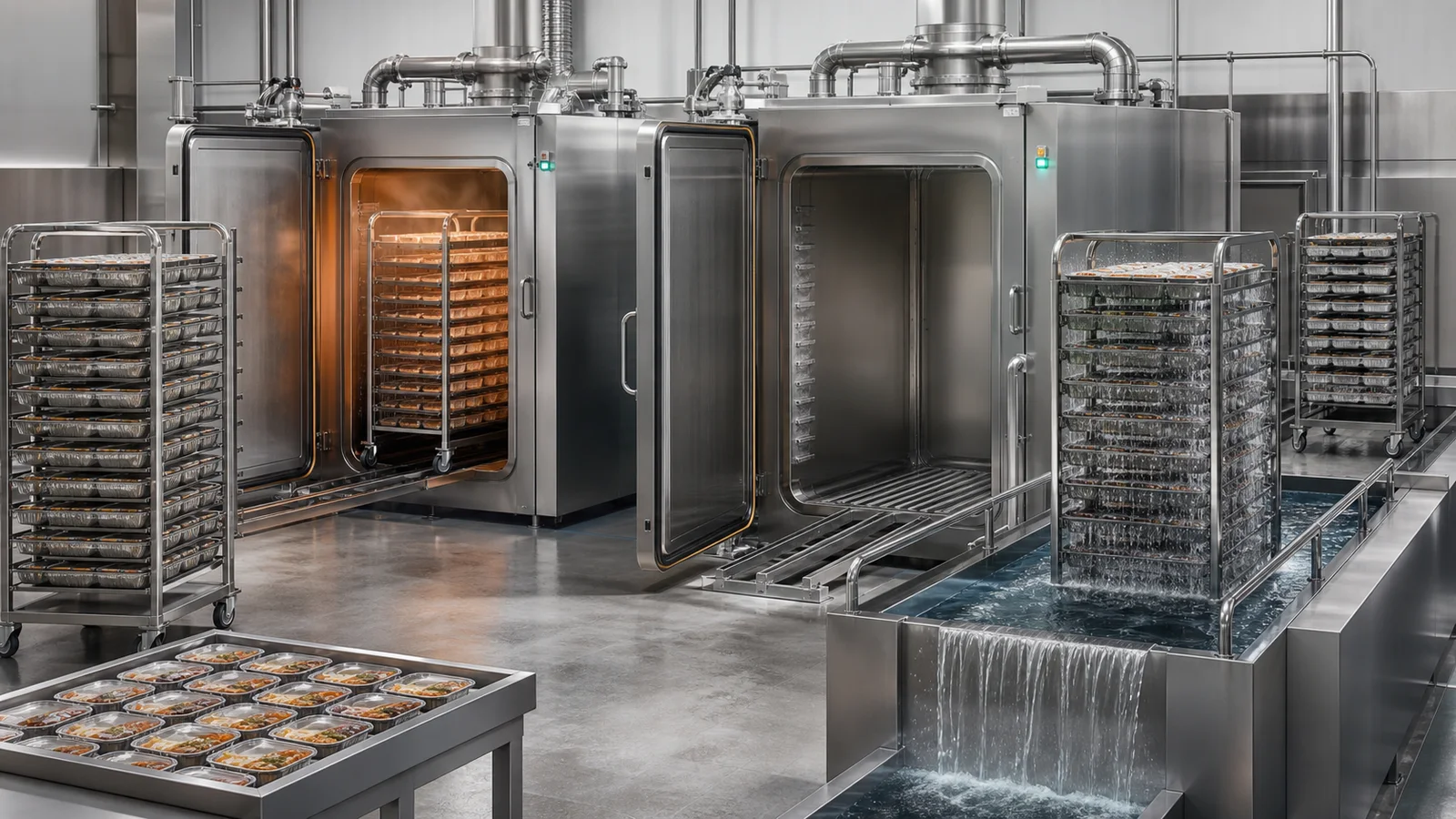
Use the complete smokehouse turnaround
turnaround = load + all recipe phases + shower/transfer + unload + clean/reset + unavoidable chamber waitingIf cooling occurs outside the chamber, it may not occupy chamber time, but it still controls trolley inventory, floor space and product release.
Check every operation after the filler
A filler maximum can be irrelevant if portioning, casing control or trolley loading cannot accept it. For linked products, measure accepted pieces and kilograms after the intended closure step.
Portion accuracy
Track average weight, standard deviation, underweight rejects and giveaway. Higher speed that increases variability may not increase accepted output.
Casing and closure
Diameter, casing type, link length, twist or clip integrity, casing change and break recovery affect sustained rate.
Hanging and spacing
Manual or automatic loading must maintain the validated product arrangement, air exposure and trolley mass.
Temperature and hold
Define maximum time and product temperature from filling through chamber entry, including stops and queue recovery.
Worked example: 3,000 kg accepted cooked sausage per shift
Smokehouse planning assumptions
250 x 4 x 0.92 = 920 kg/batchceiling(3,000 / 920) = 4 batches
floor(8 / 4) = 2 cycles/chamber
ceiling(4 / 2) = 2 chambersThe fourth batch creates excess capacity if every load must remain full. A reduced final load can be used only if the load arrangement and process remain validated.
Filler check for 100 g portions
A filler producing 180 portions/min with a 97% accepted-portion factor delivers 174.6 accepted portions/min or 1,047.6 kg/h raw product. Supplying four full 1,000 kg chamber loads takes about 3.82 ideal filler hours.
180 x 0.97 x 0.100 x 60 = 1,047.6 kg/hTrolleys are a production resource
Count trolley sets across filling, queueing, chamber occupancy, cooling, unloading, cleaning and return. A chamber with four positions may require more than four physical trolleys to avoid waiting, but additional trolleys can also create excessive pre-cook or post-cook holding.
trolleys in system = loading set + chamber sets + cooling/holding sets + cleaning/return setBuild the quantity from a time schedule. Do not use this expression as an automatic multiplication rule.
| Trolley state | Start trigger | End trigger | Data to record |
|---|---|---|---|
| Loading | First product placed | Validated load complete | Start/end, raw mass, count, spacing, product temperature. |
| Waiting for chamber | Load complete | Chamber entry | Hold time, environment, temperature, lot and chamber assignment. |
| In process | Door close/start | Validated recipe complete | Recipe, product probes, chamber conditions and deviations. |
| Cooling or stabilization | Thermal release | Validated cooling endpoint | Time-temperature history, location and product disposition. |
| Clean and ready | Product unloaded | Sanitation release | Cleaning, inspection, repair and ready time. |
Separate capacity planning from lethality and stabilization
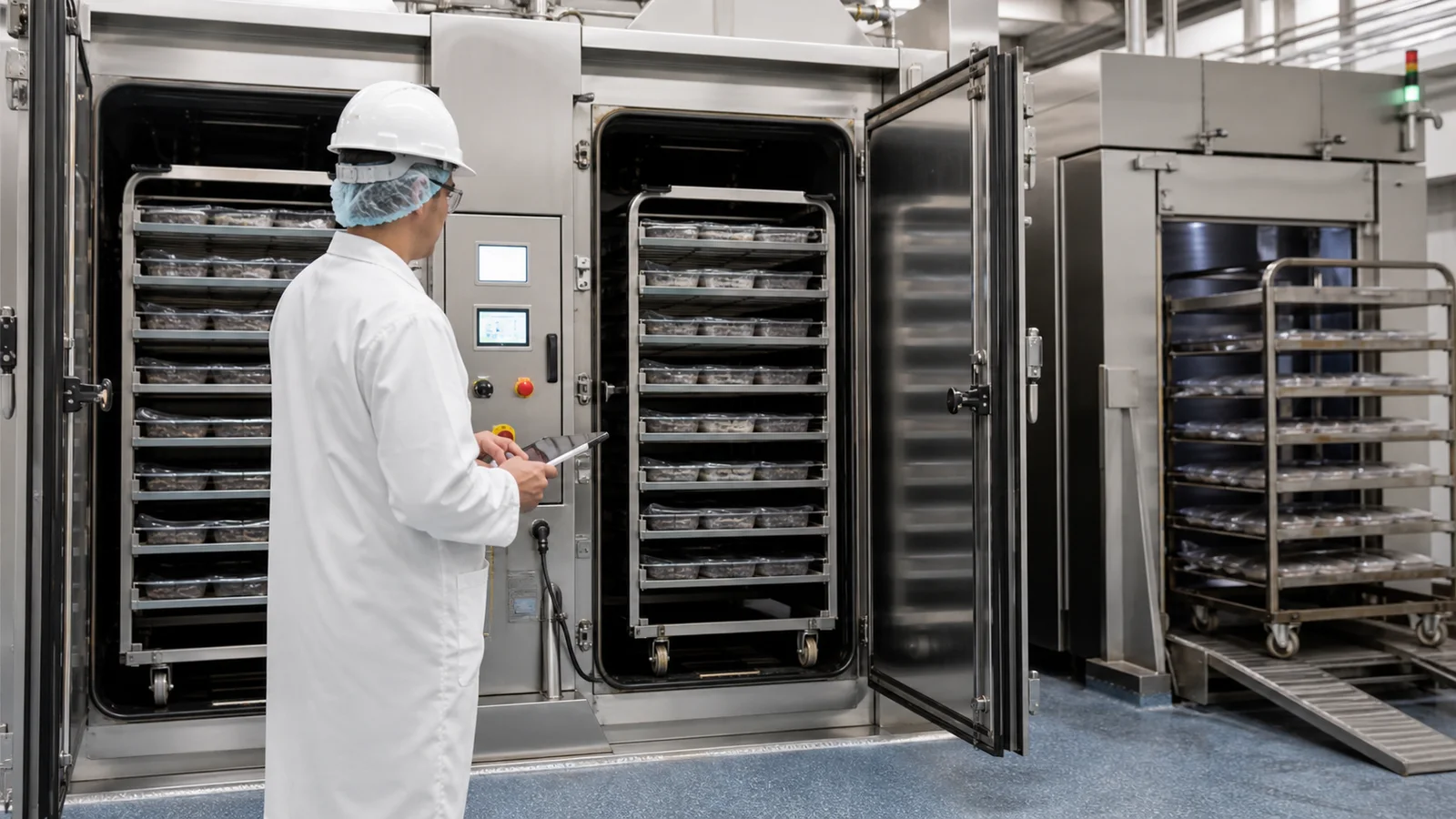
Capacity calculations can schedule equipment but cannot establish a safe smokehouse recipe. FSIS describes HACCP validation as both scientific or technical support and an in-plant demonstration that the process works as intended. Its 2021 cooking guidance identifies relative humidity as a critical operational parameter for many indirect heating processes, including smokehouse ovens, unless supported exceptions apply.
Check utilities, zoning and downstream release
Utility peaks
Stagger chambers and calculate peak steam, heating, smoke, water, exhaust, refrigeration and electrical demand, not only daily averages.
Raw-to-cooked separation
Plan trolley routes, doors, personnel, tools, drainage and air relationships so chamber loading and unloading do not defeat hygienic zoning.
Cooling capacity
Chamber output arrives in batches. Verify shower, chilled room, blast cooler or other system can receive the release without delaying validated cooling.
Packaging release
Peeling, separating, slicing and packing must absorb pulsed batches while controlling exposure time and temperature.
Line and smokehouse acceptance checklist
Sausage and smokehouse capacity FAQ
How is sausage filler capacity calculated?
Multiply accepted portions per minute by accepted average portion mass and by 60. Confirm the linker, clipper, casing supply, hanging and trolley loading sustain the same accepted rate.
How is smokehouse throughput calculated?
Calculate accepted output per validated trolley and chamber load, then divide by the complete turnaround. Use whole batch cycles in the actual schedule.
How many smokehouse chambers are required?
Divide required whole batches by validated whole cycles available per chamber and round up. Then test staggering, maintenance, utilities, cooling, cleaning and trolley logistics.
Can cycle time be shortened to increase capacity?
Not unless the revised product and process are scientifically supported and validated. Diameter, formula, casing, load, humidity, temperature, airflow and cooling can affect safety and quality.
Should smokehouse capacity use raw or cooked kilograms?
Either may be used if clearly named, but procurement and line balance should reconcile both with validated process yield and accepted-product criteria.
Research basis and further reading
- USDA FSIS 2021 Cooking and Stabilization Guidelines notice - explains lethality and stabilization scope for meat and poultry products and the need for current or alternative scientific support.
- FSIS Cooking Guideline, Revised Appendix A - discusses smokehouse ovens, indirect heating, relative humidity and critical operational parameters.
- FSIS Stabilization Guideline, Revised Appendix B - addresses cooling-rate validation and product time-temperature data for heat-treated meat and poultry.
- FSIS HACCP Validation - distinguishes scientific support from the in-plant demonstration that the process performs as designed.
- Codex CXC 58-2005, Code of Hygienic Practice for Meat - provides a risk-based hygiene framework covering meat preparations and manufactured meat.
- NIST-authored manufacturing KPI research - supports throughput, WIP, blocking and starvation analysis for connected production resources.
Scope note: This guide provides preliminary production scheduling and equipment-capacity methods. It does not establish a thermal process, fermentation, drying, cooling schedule or HACCP critical limit. Use qualified process and regulatory review.
Calculate the continuous and batch sides separately
Estimate filler output, chamber throughput and chamber quantity, then combine them in a trolley and cooling schedule.
Sausage Filler CapacitySmokehouse ThroughputChamber Quantity