
Confirm hopper height, opening and safe product fall when meat or other dense ingredients are tipped from a 200 L bin.
Other Food Processing & Auxiliary Equipment
Food-Grade Bin Hoists & Material Handling Systems
Move ingredients and meat between batch processes with a verified 200 L bin-and-hoist interface. Start with payload, discharge height, receiving hopper and cleaning method—not a generic lifting claim.
Request specifications
Current range
Products and product families
Compare the YT-200 mobile bin hoist and YC-200 transport bin. Confirm their lifting interface together before ordering.
 01
01
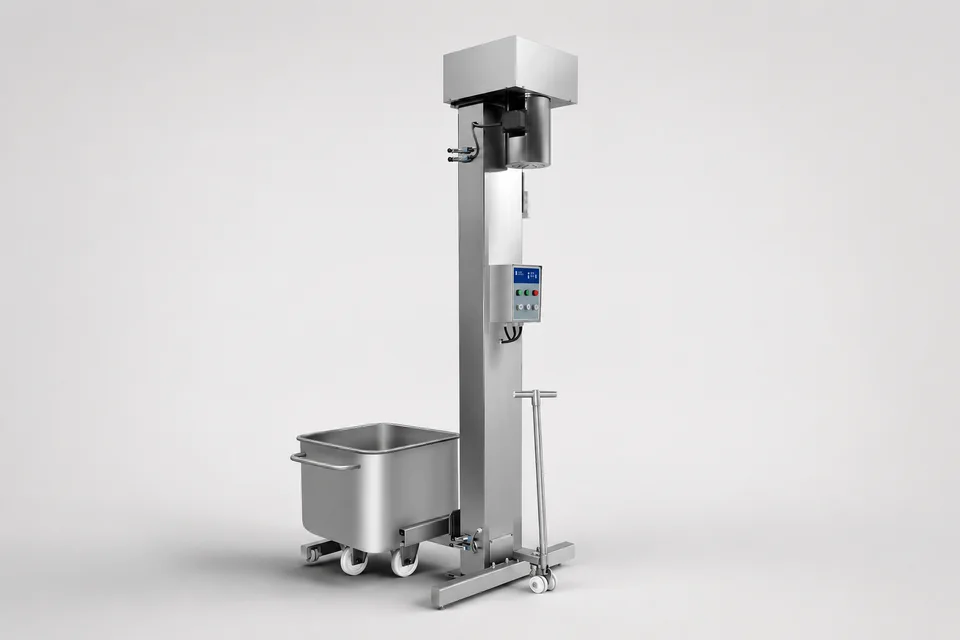
YT-200 Movable 200L Bin Hoist
Mobile stainless column loader with 200 kg lift load and 1.3–1.8 m discharge height.
View product page → Product visualization based on product imagery. See product page for actual photographs.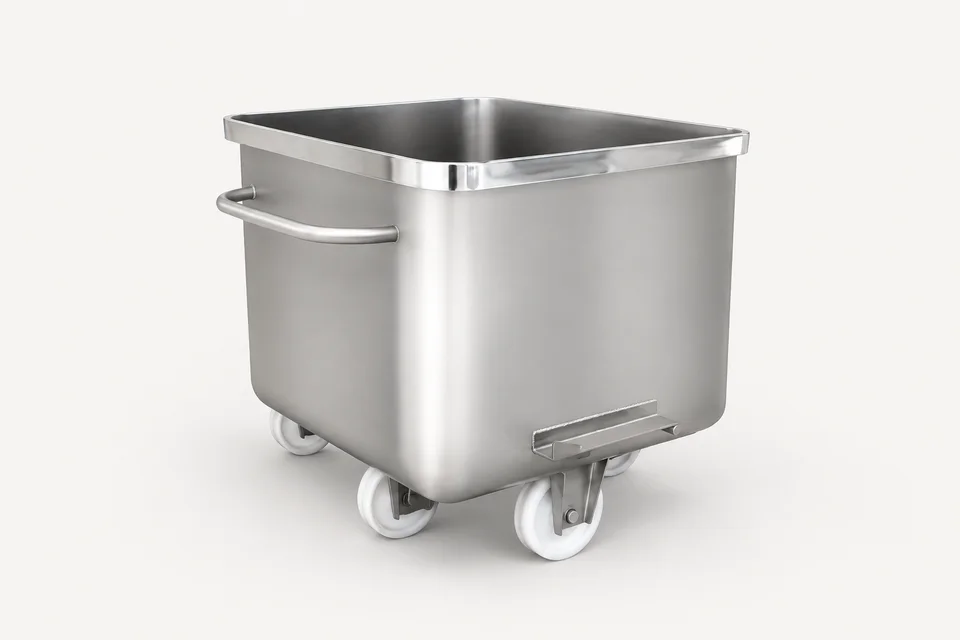 02
02
YC-200 Pushable 200L Meat Bin
SUS304 standard Euro bin for hygienic factory transport, lifting and washing interfaces.
View product page → Product visualization based on product imagery. See product page for actual photographs.
Verified HELPER equipment
One handling system, two controlled interfaces
The current published range connects a standard 200 L food bin with a movable chain-driven hoist. These are model-level facts from HELPER product records; final fit still depends on the customer's bin, product and receiving machine.
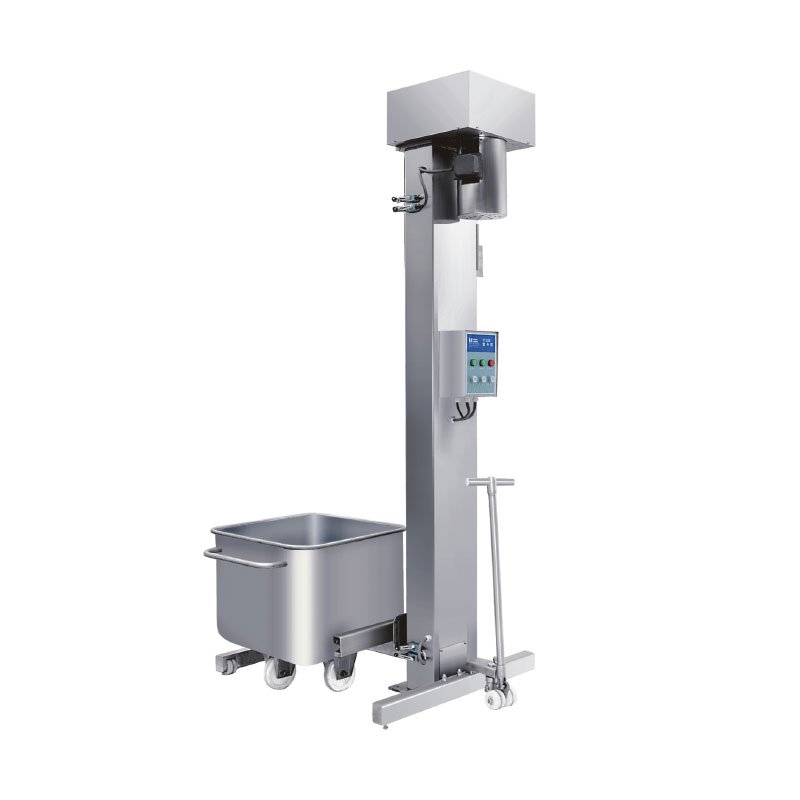
YT-200 movable bin hoist
Published for a maximum 200 kg lift load with project-matched discharge height. Its mobile frame brings the lifting point to mixers, grinders, tumblers or filling equipment.
Published parameters
Compare the verified 200 L bin and hoist
Use these values for preliminary screening. A quotation should confirm the exact bin geometry, payload centre of gravity, travel route and discharge interface.
| Equipment | YT-200 movable bin hoist | YC-200 pushable meat bin |
|---|---|---|
| Primary function | Lift and discharge a compatible food bin | Move food between batch processes |
| Published capacity | Maximum lift load: 200 kg | Nominal volume: 200 L |
| Published dimensions | 1400 × 1130 × 2700 mm | 800 × 700 × 700 mm |
| Height / mobility | 1.3–1.8 m lift or discharge height; movable frame | Four-wheel pushable design |
| Drive / material | 1.5 kW, chain-driven lift; stainless-steel construction | SUS304 stainless steel |
| Published weight | 500 kg machine weight | 34 kg product weight |
Engineering boundary: 200 L is the nominal bin volume, not an automatic 200 kg product load. Product density, fill level, sloshing, frozen blocks and an offset centre of gravity change the real lifting case.
Integration sequence
Specify the complete lift, not only the hoist
Define the payloadProduct, temperature, density, maximum batch mass and centre of gravity.
Confirm the binRim, wheel, trunnion and pickup geometry with a drawing or physical sample.
Match dischargeHopper height, opening, tipping direction, guarding and product fall distance.
Validate the routeFloor condition, turning radius, doors, drains, washdown and operator access.
RFQ checklist
Information needed for a food-sector bin hoist
This input set allows HELPER engineering to check whether the published YT-200/YC-200 direction is suitable or needs project adaptation.
Bin and loadBin drawing, empty weight, maximum filled weight, product temperature and whether the load can shift.
Receiving machineHopper drawing, discharge height, opening, tipping direction and required containment.
Factory conditionsAvailable headroom, aisle width, floor slope, drain location, cleaning chemicals and electrical supply.
Acceptance evidenceHeaviest real product, lift cycle, positioning accuracy, residue, guarding and cleaning inspection.
Food-grade selection is application-specific. Material declarations, weld finish, electrical standard, guarding and documentation should be confirmed for the destination market and the final configured machine.
Food-factory applications
Where industrial bin handling equipment fits
Food-sector manufacturers normally use a bin hoist at the controlled transfer between a mobile batch container and an elevated receiving machine. The correct arrangement depends on the real product, bin and discharge interface.
Match the lift cycle to batch timing and verify that the tipped product clears the bin without uncontrolled impact or residue.
Review containment, access and the interface with any receiving hopper, screw or buffer system before defining the lift position.
Check wheels, floor slopes, drains, parking stability and cleaning access across the complete route—not only at the discharge point.
Model details: for exact published values, review the YT-200 industrial bin hoist and YC-200 food-processing bin pages.
Ask for a complete loading-to-return demonstration
Discharge height alone does not describe the movement needed beside a hopper. Review a supplier-approved layout and demonstration against these separate questions:
Approach and loading sideShow how the filled bin reaches the pickup position, where the operator stands and how the empty bin leaves. Ask whether the quoted arrangement is front-loading or side-loading, and which handed layout is actually available.
Lift and tipping envelopeRequest a drawing showing the bin throughout its movement, not only the parked footprint. Have the supplier confirm clearance to the receiving hopper and surrounding equipment.
Product dischargeUse your representative material to observe where it lands, whether it remains in the bin and whether the receiving opening contains the flow. Confirm any proposed discharge aid as part of the quoted configuration.
Return and repeatObserve the return, bin removal and next loading cycle. Ask for repeatable cycle timing with the intended workflow rather than inferring production rate from lift speed alone.
Industry reference: Roser's column-dumper range separately lists loading side, handed position, discharge height, mobile bases and bin adaptations. Those are Roser options, not confirmed HELPER options. The checklist above identifies questions for a HELPER proposal; the supplier must validate the final arrangement, guarding and operating procedure.
Buyer questions
Food-sector bin hoist FAQ
These answers define the engineering checks required before a model or quotation is confirmed.
Does a 200 L food bin automatically allow a 200 kg lifting load?
No. The bin volume and lifting load are different limits. Product density, fill level, sloshing, frozen blocks and an offset centre of gravity must be checked against the configured hoist and bin.
What information is needed to select a food-sector bin hoist?
Provide the bin drawing and empty weight, maximum filled weight, product temperature, receiving-hopper drawing, discharge height and direction, available headroom, aisle conditions, cleaning method and destination electrical standard.
Can the YT-200 hoist load any mixer, grinder or filler?
Not without an interface review. The pickup geometry, hopper opening, discharge height, tipping direction, guarding, product fall and residue risk must be confirmed for the actual receiving machine.
What should be verified for a food-grade handling system?
Confirm food-contact materials, weld and surface finish, cleanability, drainage, guarding, wheel and floor compatibility, documentation and the acceptance test for the final configured system and destination market.
Need a technical recommendation?
Send your bin, payload and receiving-hopper drawings to our engineering team.
2026 catalog additions