
Suitable direction
Uniform sausages in non-edible cellulose casing, presented consistently after the validated thermal and cooling process.
After cooking and controlled cooling
Remove non-edible cellulose casing from suitable sausages with a machine configured around product diameter, casing condition, line presentation and the accepted peeled result.
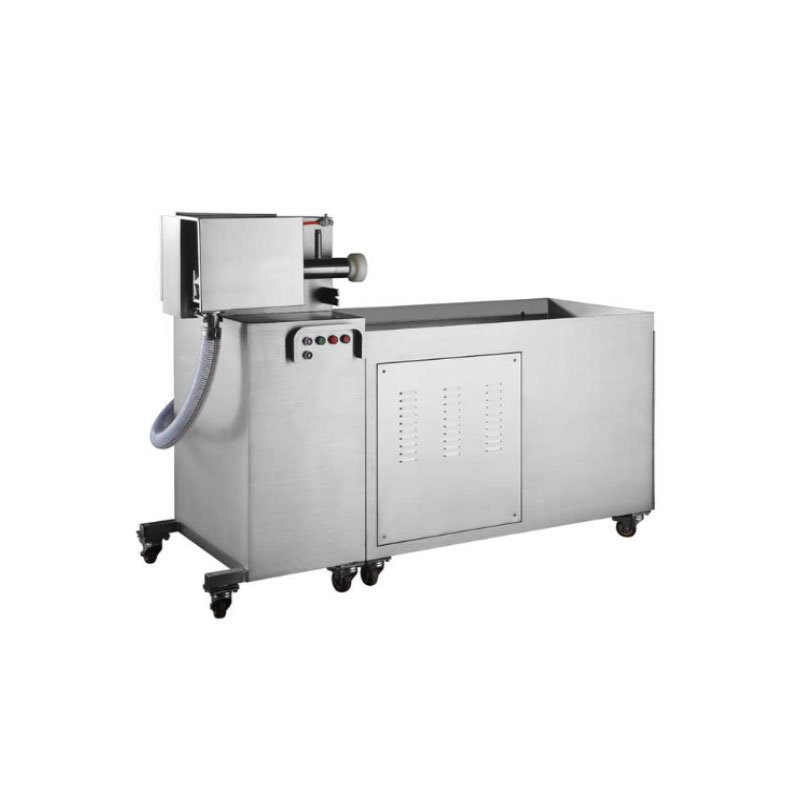
The published HELPER machine is for sausages made in removable cellulose casing. Casing material and post-cook condition must be confirmed before a quotation.
Uniform sausages in non-edible cellulose casing, presented consistently after the validated thermal and cooling process.
Changes in diameter, length, surface tack, wrinkles, moisture, product firmness or casing supplier can alter separation and feeding.
This category does not claim automatic removal of natural, collagen, alginate or other edible casings. Confirm the exact casing construction.
Published-data boundary: HELPER's current public material identifies the automatic cellulose-casing peeler but does not publish a verified universal capacity range. Throughput must therefore be agreed from sample trials and line conditions.
Peeling performance begins before the machine and ends after inspection. A speed figure has little value if the product arrives warm, wet, randomly oriented or outside the agreed diameter range.
| Input | What to provide | Why it changes selection |
|---|---|---|
| Product | Sausage type, diameter and length range, cooked weight, surface condition and firmness. | Defines guidance, contact and handling limits. |
| Casing | Supplier, material/construction, nominal calibre, overlap/seam details and sample reels. | Confirms that the casing is removable cellulose and how it separates. |
| Upstream process | Smokehouse/cooking program, shower or cooling step, exit temperature, holding time and feed method. | Controls product and casing condition at the peeler. |
| Output target | Accepted sausages per minute or kg/h, number of SKUs, shift pattern and allowable accumulation. | Sets the trial speed and line balance. |
| Quality limits | Maximum casing residue, surface marks, broken ends, product loss and reject method. | Turns “peels well” into measurable acceptance. |
| Factory | Layout, infeed/outfeed elevation, utilities, washdown method, operator access and destination standards. | Determines integration, hygiene, guarding and documentation. |
Use representative normal and difficult lots. Record both the accepted peeled output and the reasons for rejects.
The peeler is a finishing operation for the correct casing system. Connect it to the broader process only after filling, linking, thermal processing and cooling have been validated.
The published application is removable cellulose casing. Do not assume compatibility with natural, collagen, alginate or edible casing without written confirmation and a product trial.
Product diameter and firmness, casing separation, surface condition, orientation, feed stability, reject limits and downstream capacity all affect the accepted rate.
The sausage and casing condition at the peeler affects separation, surface damage and feeding. Agree a repeatable thermal and cooling state for the trial.
Send product and casing samples, dimensional range, thermal/cooling process, target accepted output, line layout, utilities and measurable peel-quality limits.