Huaxing Machinery is established.
Current HELPER group and specialist sites consistently trace the machinery business to 1986. The earliest operation is identified in official history material as Huaxing Machinery, beginning with practical metalworking and machine building rather than a ready-made portfolio of complete food lines.
This origin still matters to procurement teams: HELPER’s later product families grew from manufacturing practice—machining, fabrication, assembly and process adaptation—not from a trading catalogue assembled after the fact.
Source basis: current HELPER group, meat-machinery and dough-machinery About pages; official HELPER history graphics.

Stand-alone machinery becomes a processing family.
HELPER’s official histories place automatic clipping equipment and vacuum sausage stuffing in the 1990s. The pages disagree on the precise launch year of the vacuum stuffer, so the decade—not an unsupported single date—is the reliable conclusion.
The technical direction is clear: the business moved beyond general machinery into equipment for repeatable filling, portion control, casing closure and the connected needs of sausage and prepared-meat production.
- Equipment direction
- Automatic clipping and vacuum sausage stuffing
- What changed
- Machine design became tied to a defined food process and production outcome
Source basis: HELPER group history graphic and the legacy HELPER machinery history page. Exact 1990s milestone years require internal archive confirmation.
Vacuum dough mixing opens a second engineering path.
Legacy HELPER pages place the first vacuum dough mixer in 2003 or 2004, while later history material records the formal food-machinery business under a different year. The responsible reading is that the early 2000s marked HELPER’s expansion from meat machinery into dough handling and flour-food equipment.
By the end of the decade, official histories also record early automatic noodle machinery. That work connected mixing, dough development, sheeting, cutting and downstream handling—an important shift from one machine to an engineered process route.
Source basis: HELPER legacy About and history pages. The exact corporate and product dates in this period remain source-dependent.

New production space, then a precision-casting branch.
Both surviving official timelines record a factory move in 2010. They then record the precision-casting branch entering operation in 2011. Together, these milestones show HELPER investing in the manufacturing base behind its widening equipment range.
For a machinery buyer, the significance is not the building alone. More controlled production stages can improve the coordination of parts, fabricated assemblies and machine build schedules—but the exact process scope for any order still belongs in the technical and commercial agreement.
Source basis: official HELPER group history graphic and legacy HELPER history page.
The Xingtang production base is completed.
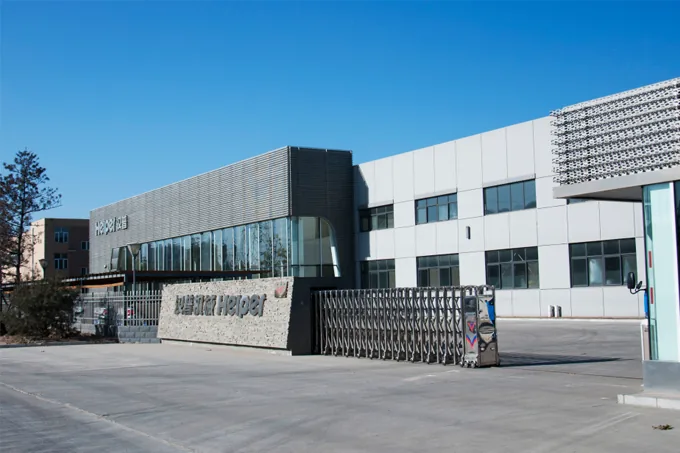
Official HELPER histories identify 2015 as completion of the Xingtang production base. This added another manufacturing node to a group already working across meat processing, flour-food machinery and supporting industrial capabilities.
The group structure visible today reflects that development: different HELPER businesses and specialist sites present meat machinery, dough and noodle systems, food-production solutions and related manufacturing capabilities under a shared machinery identity.
Source basis: matching 2015 entries in official HELPER group and legacy history material.
From individual machines to coordinated food-production systems.
Current HELPER specialist sites describe in-house design, engineering and manufacturing teams, more than 300 people, and customers in more than 100 countries and regions. These are first-party company figures, not independent market statistics, and should be understood in that context.
The product scope now spans meat preparation, sausage production, vacuum dough mixing, wrappers, noodles, dumplings and selected prepared-food systems. Project work can connect individual machines with layout, utilities, transfers, controls, commissioning and training according to the agreed delivery boundary.
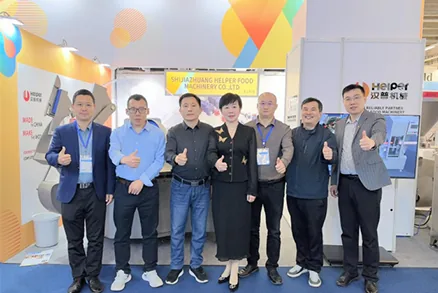
International exhibitions provide one visible part of that work: they bring food formats, operating questions and market-specific requirements into direct discussion before a line configuration is fixed.
Source basis: current HELPER meat- and dough-machinery About pages, plus official HELPER exhibition material.