
How should sausage processing equipment be selected?
Start with the finished sausage and validated process. Define filling structure and temperature, casing material and diameter, portion length or weight, closure method, accepted output, thermal treatment, cooling and packaging. Then match the filler, linker or clipper, smokehouse, handling, peeler and packaging interfaces as one balanced system.
Who should use this guide?
Sausage manufacturers
Adding a new product, casing or automation level to an existing plant.
Meat plant engineers
Balancing filling, closure, smokehouse, cooling and downstream capacity.
Procurement teams
Comparing proposals on one controlled product and test basis.
Choose the sausage process route first
Fresh sausage
Preparation, filling and portioning are followed by chilled handling or packaging without a lethality step at the factory.
Cooked or smoked sausage
Filling and closure feed hanging or trolley loading, a validated thermal/smoke process, controlled cooling and packaging.
Skinless cellulose-cased product
Filling and linking are followed by cooking/smoking, cooling, casing removal, separation/inspection and packaging.
Large-calibre sausage or ham
Filling, controlled casing tension, voiding and clipping are integrated with molds or trolleys, thermal processing, cooling and slicing/packing.
A complete line extends beyond the filler
The actual route depends on the product. A filler capacity claim does not establish line output when linking, trolley loading, smokehouse cycles, cooling, peeling or packaging is slower.
Minimum product data for equipment selection
| Input | What to define |
|---|---|
| Product process | Fresh, cooked, smoked, fermented/dried, skinless, large calibre or another validated route. |
| Filling | Fine emulsion or coarse structure, temperature, viscosity, largest particle, inclusions and sensitivity to smearing. |
| Casing | Natural, collagen, cellulose, fibrous, plastic or other specified casing; edible/removable; supplier and size range. |
| Diameter | Nominal calibre and acceptable filled-diameter range under the specified filling and thermal conditions. |
| Portion | Length, weight, tolerance, link pattern and pieces per retail pack. |
| Closure | Twist/link, string tie, single/double clip, continuous strand or no separate closure. |
| Capacity | Accepted kg/h and portions/min, product mix, changeovers, efficiency, rejects and batch schedule. |
| Thermal and cooling | Validated time/temperature/humidity/smoke route, trolley loading, cooling limits and post-lethality exposure. |
| Packaging | Bulk, vacuum, thermoform, tray or other format; presentation, packs/min and inspection requirements. |
Casing and closure determine the downstream machine
| Product/casing direction | Typical equipment questions |
|---|---|
| Small natural or collagen casing | Can the casing run at the required twist/link speed and tension without breakage? What diameter and length range is validated? |
| Cellulose skinless product | Are filling/linking, thermal process, cooling condition and peeler range matched to the exact casing and diameter? |
| Large fibrous or plastic casing | What filling horn, casing brake, voiding, clip size, loop and trolley/mold arrangement are required? |
| Tied specialty product | Is string type, knot pattern, tail length, product spacing and downstream handling defined? |
Do not select closure equipment from diameter alone
Casing material, wall behavior, filled pressure, product structure, closure style and thermal expansion all affect performance. Confirm the specific casing brand/type and filled product during trial.
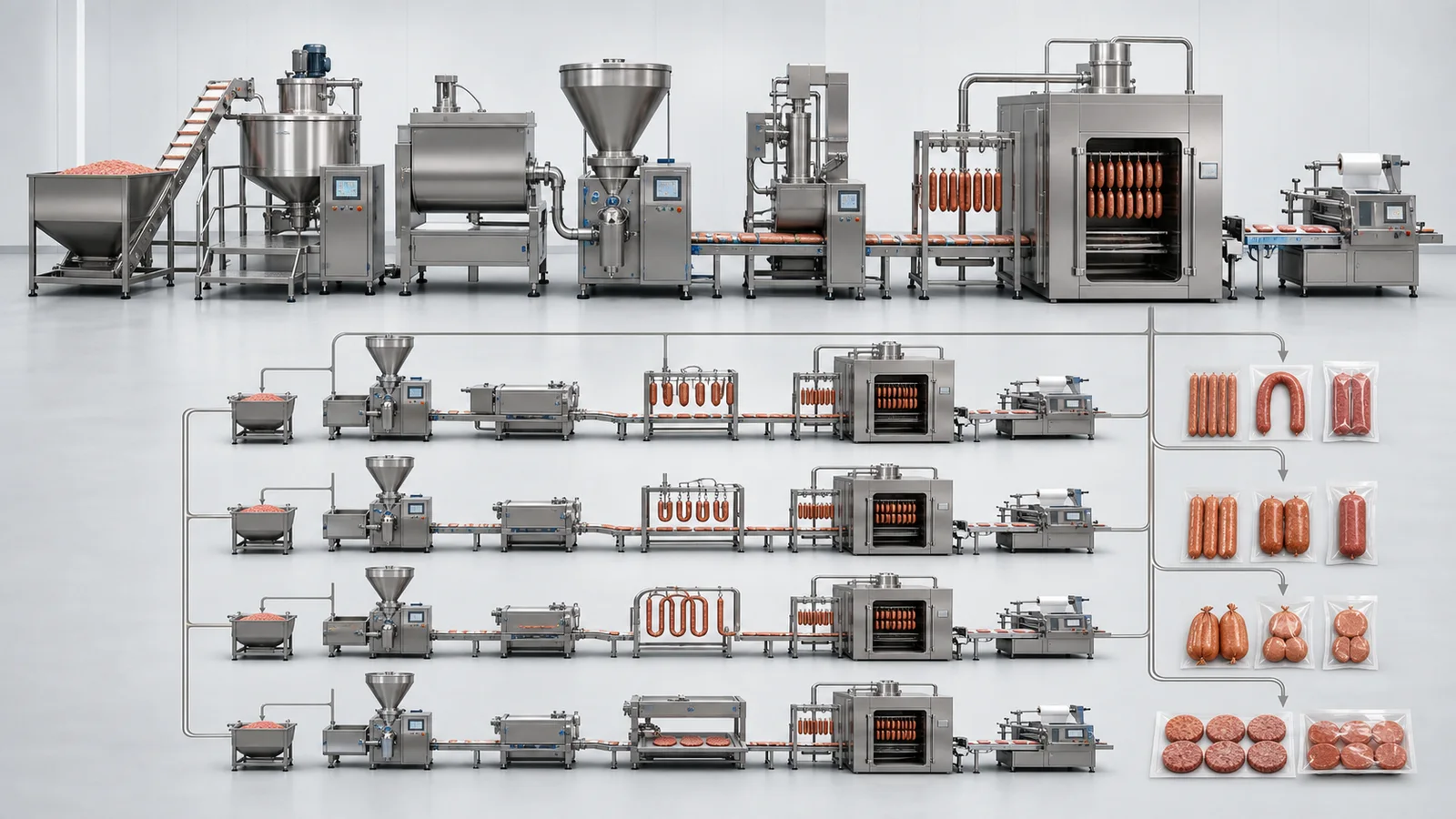
How to select each equipment module
| Module | Selection questions |
|---|---|
| Vacuum filler | Product range, hopper/feed system, particle passage, pressure, air removal, weight control, refill method and cleaning. |
| Linker or tying machine | Casing range, portion length/weight, twist or knot pattern, strand handling, cut/separation and accepted pieces/min. |
| Clipper | Casing calibre, clip/loop, voiding, filling interface, product spacing, safety guarding and change parts. |
| Smokehouse | Trolley load, product arrangement, process steps, air distribution, humidity, smoke, core measurement, cleaning and cycle time. |
| Cooling system | Validated stabilization route, product diameter, loading, shower/air/chill method, endpoint, handling and condensation control. |
| Peeler | Casing and diameter range, product condition at entry, peel quality, breakage, separation, casing waste and sanitation. |
| Packaging interface | Product grouping, orientation, buffer, inspection, pack format, seal contamination risk and accepted packs/min. |
Filling behavior must be tested at production conditions
Temperature and viscosity
Product temperature and fat/protein condition affect feed, pressure, smearing, air pockets and portion repeatability.
Particle and inclusion size
Coarse meat, vegetables or cheese inclusions must pass the complete feed, pump, horn and cutoff path without damage or separation.
Casing tension
Underfill can reduce shape quality; overfill can increase breakage or closure problems. Establish the validated operating window.
Compare mass, portion and batch capacity
Accepted kg/h = nominal portions/min x portion weight (g) x 60 x efficiency / 1,000At 300 nominal portions/min, 20 g per portion and 85% efficiency, accepted output is approximately 306 kg/h. The filler must support this mass flow, while the linker, hanging/loading, thermal process and package system must support the same accepted production.
Large-calibre and thermal products also require a batch calculation: usable kg per trolley or chamber, complete cycle time, loading/unloading time and scheduled operating hours.
Thermal processing and cooling are food-safety controls
Equipment selection does not establish a safe process
For cooked ready-to-eat meat products, the processor must support and validate lethality and stabilization for the actual product, diameter, formulation, equipment and jurisdiction. FSIS guidance illustrates how U.S. establishments substantiate and verify lethality and cooling controls, but it is not a universal recipe for every market or sausage.
Post-lethality peeling, handling and packaging also change contamination risk. Layout, zoning, air/water movement, equipment cleanability and environmental controls must be included in the project scope.
Sausage equipment trial and acceptance
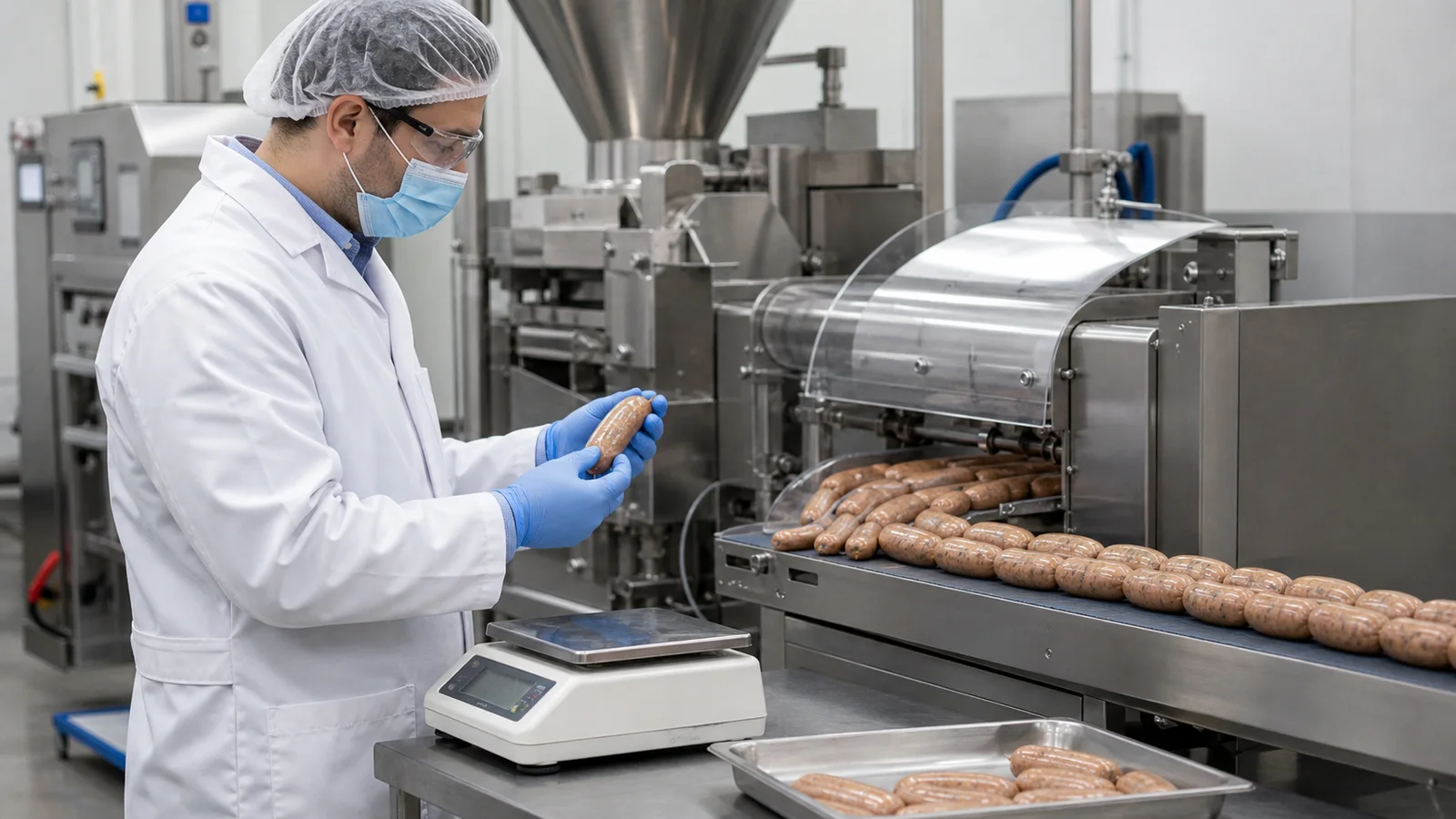
Product measurements
- portion weight and length distribution;
- filled diameter and appearance;
- air pockets and smearing;
- casing breakage or closure failure;
- thermal yield and package presentation;
- peel quality for skinless products.
Production measurements
- sustained accepted kg/h and portions/min;
- start-up and steady-state rejects;
- hopper refill and pressure stability;
- casing changes and operator interventions;
- changeover, dismantling and cleaning time;
- upstream/downstream balance.
Use actual product, casing and operating temperature. Trials with water or a simplified batter may check basic function but cannot validate production quality, casing behavior or accepted output.
Worked example: cooked skinless sausage line
Translate the product into equipment scope
- Product
- 20 g cooked skinless sausage in a specified small-calibre cellulose casing.
- Target
- 300 nominal portions/min at 85% planning efficiency, approximately 306 kg/h accepted output.
- Front end
- Validated fine batter preparation, vacuum filler, matched horn/casing system and linking.
- Thermal section
- Trolley or continuous handling, validated cooking/smoking process and controlled cooling.
- Finishing
- Casing conditioning as required, peeling, separation, inspection, buffering and packaging.
- Acceptance
- Weight, diameter, link length, breakage, thermal yield, peel quality, sustained output and package presentation.
Common sausage equipment selection mistakes
Do not treat the vacuum filler as the complete sausage line
- Choosing a filler before fixing casing, diameter and closure method.
- Comparing kg/h without portion rate, weight and accepted-quality basis.
- Testing a smooth batter when production contains coarse or fragile inclusions.
- Assuming every small-calibre product can use the same linker and casing.
- Sizing smokehouse capacity without trolley load and complete cycle time.
- Adding a peeler without validating casing, cooling and product condition.
- Ignoring post-lethality exposure between cooling, peeling and packaging.
Sausage equipment enquiry checklist
- Name the finished sausage process.
- Provide complete product description.
- State filling temperature and structure.
- State largest particle or inclusion.
- Identify casing type and supplier.
- Define casing and filled diameter.
- Define portion length and weight.
- Select twist, tie, clip or other closure.
- State accepted kg/h and portions/min.
- Provide thermal process requirements.
- Define trolley/chamber loading.
- Define cooling and peeling conditions.
- State package format and speed.
- Provide actual trial product and casing.
- Agree sustained-test duration.
- Define pass/fail and reject criteria.
Research sources and boundaries
- FAO, Small-scale Sausage Production. The technical manual describes filling, linking, clipping, smokehouse and handling relationships. It is an older process reference, not a current regulatory specification. Accessed 7 August 2026.
- FAO, Guidelines for Slaughtering, Meat Cutting and Further Processing. The guide describes natural, synthetic and cellulose-casing applications and downstream handling. Accessed 7 August 2026.
- USDA FSIS Directive 7111.1, Verification Procedures for Lethality and Stabilization, Revision 2. Relevant to U.S. verification of supported processes; destination-market and product-specific requirements still apply. Accessed 7 August 2026.
- USDA FSIS Stabilization Guideline for Meat and Poultry Products, Revised Appendix B. Use only within its scope and scientific support conditions. Accessed 7 August 2026.
- Feng et al., Cooked sausages with different casings and cooling treatments. International Journal of Food Science & Technology 51 (2016), 2270-2279, DOI 10.1111/ijfs.13224. The study supports treating casing and cooling as product-specific variables.
Research date: 7 August 2026. This guide supports preliminary equipment selection. Meat formulation, curing, fermentation, lethality, stabilization, shelf life, post-lethality controls and legal compliance require validated product-specific programs.
Sausage processing equipment FAQ
What information is needed to select sausage equipment?
Define product process, filling structure, casing material and diameter, portion weight or length, closure method, accepted output, thermal process and packaging format.
Do all sausages need a linking machine?
No. Products may be twist-linked, tied, clipped, filled as a continuous strand, filled into molds or otherwise portioned depending on casing and format.
When is a sausage peeler required?
A peeler is generally required for defined skinless products made in removable casings after the validated cooking and cooling process.
How should sausage-line capacity be compared?
Compare accepted kilograms per hour and portions per minute at the specified casing and product, then verify smokehouse cycles, cooling, peeling and packaging can accept that output.
Build a preliminary sausage equipment direction
Use the selector to organize product process, casing, closure, diameter and output before technical confirmation.
Open sausage selector Calculate filler capacity