
How should vegetable processing equipment be selected?
Start with the exact crop, incoming condition and finished specification. Define size range, firmness, fragility, soil load, required trimming or peeling, target cut, accepted output, yield, wash-water controls, dewatering target and package condition. Then trial the complete washing, cutting and handling sequence using representative raw material.
This page owns the selection method. To compare available HELPER machines, browse industrial vegetable processing and handling equipment. For a quick preliminary screen, use the interactive vegetable equipment selector.
Who should use this guide?
Fresh-cut processors
Planning salads, prepared vegetables and ready-to-cook products.
Central kitchens
Automating multiple crops and cut formats with controlled changeovers.
Project and procurement teams
Comparing line proposals on yield, quality, hygiene and accepted output.
Classify the raw material before choosing a machine
Lettuce, cabbage and leafy greens
Low bulk density, floating behavior, fragile leaves, field soil and large cut-surface area affect conveying, washing and dewatering.
Carrot, potato and similar crops
Firm structure and surface soil may support brushing, abrasive or other peeling and higher-force cutting, but shape variation affects feed and yield.
Onion, pepper, cucumber and fruit
Orientation, cavities, seeds, skin condition and variable geometry affect trimming, cutting support and waste separation.
Tomato, soft fruit and fragile products
Impact, compression and drop height can dominate quality. Gentle transfer and narrow operating limits are more important than maximum speed.
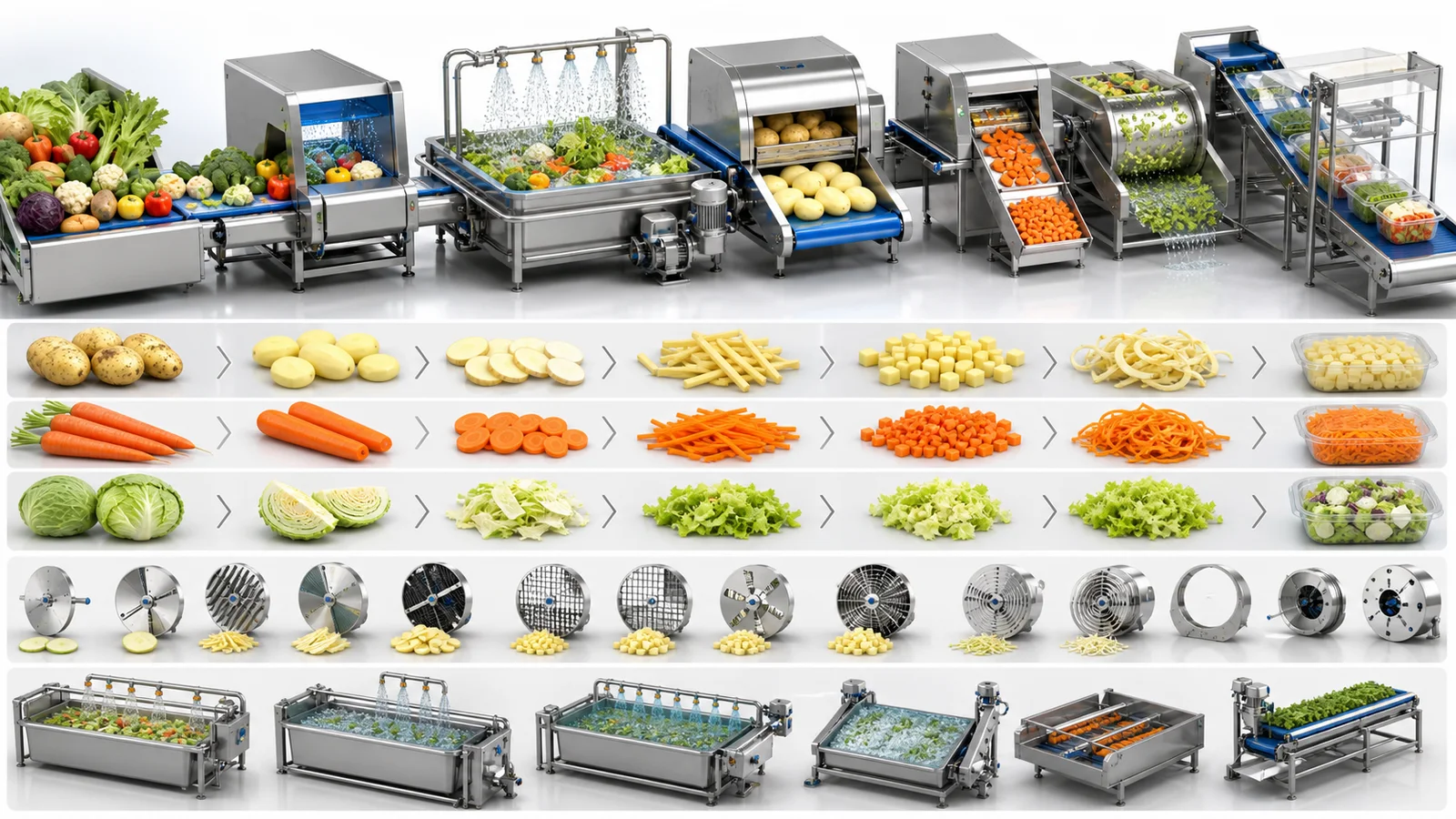
Typical fresh-cut preparation sequence
The correct order is product- and hazard-specific. For some products, washing before cutting can reduce the organic load introduced into post-cut wash water. The line design must follow the processor's validated food-safety plan rather than a universal sequence.
Minimum data for vegetable equipment selection
| Input | What to define |
|---|---|
| Crop | Variety, maturity, density, firmness, buoyancy, typical and extreme dimensions and seasonal variation. |
| Incoming condition | Soil, stones, leaves, roots, damaged produce, field heat, initial microbial risk and receiving temperature. |
| Preparation | Inspection, trimming, topping/tailing, coring, peeling or seed removal requirements. |
| Target cut | Slice, strip, shred, dice or cube; dimensions, tolerance, orientation and maximum fines/breakage. |
| Capacity | Accepted packed kg/h, raw feed kg/h, operating schedule, crop mix, changeovers and efficiency. |
| Yield | Trim, peel, cut, defect and dewatering losses, plus the definition of saleable product. |
| Water process | Water source, single-pass or recirculated arrangement, temperature, organic load, monitoring, treatment and discharge. |
| Downstream | Dewatering endpoint, inspection, chilling, package format, shelf-life process and packs/min. |
| Sanitation | Wet cleaning, allergen or crop changeover, drainage, dismantling, chemical compatibility and verification access. |
How to select each equipment module
| Module | Selection questions |
|---|---|
| Receiving and inspection | Can the feed system meter variable product without crushing? How are stones, soil, damaged units and foreign material removed? |
| Washer | Does spray, flume/bubble, brush, drum or another action suit density, fragility, soil and required water-control strategy? |
| Peeler | Is the crop compatible with abrasive, brush, knife or another validated method? What are peel completeness, flesh loss and surface-damage limits? |
| Cutter | How is product oriented and supported? Which tool creates the specified cut, and how are fines, breakage, jams and tool wear controlled? |
| Dewatering | What free-water endpoint is needed? Can centrifugal, air or vibration action achieve it without unacceptable bruising or deformation? |
| Inspection and packaging | How are defects and foreign material detected, product buffered, temperature maintained and stable feed delivered to packaging? |
Washing must control cross-contamination
More water does not automatically mean a safer process
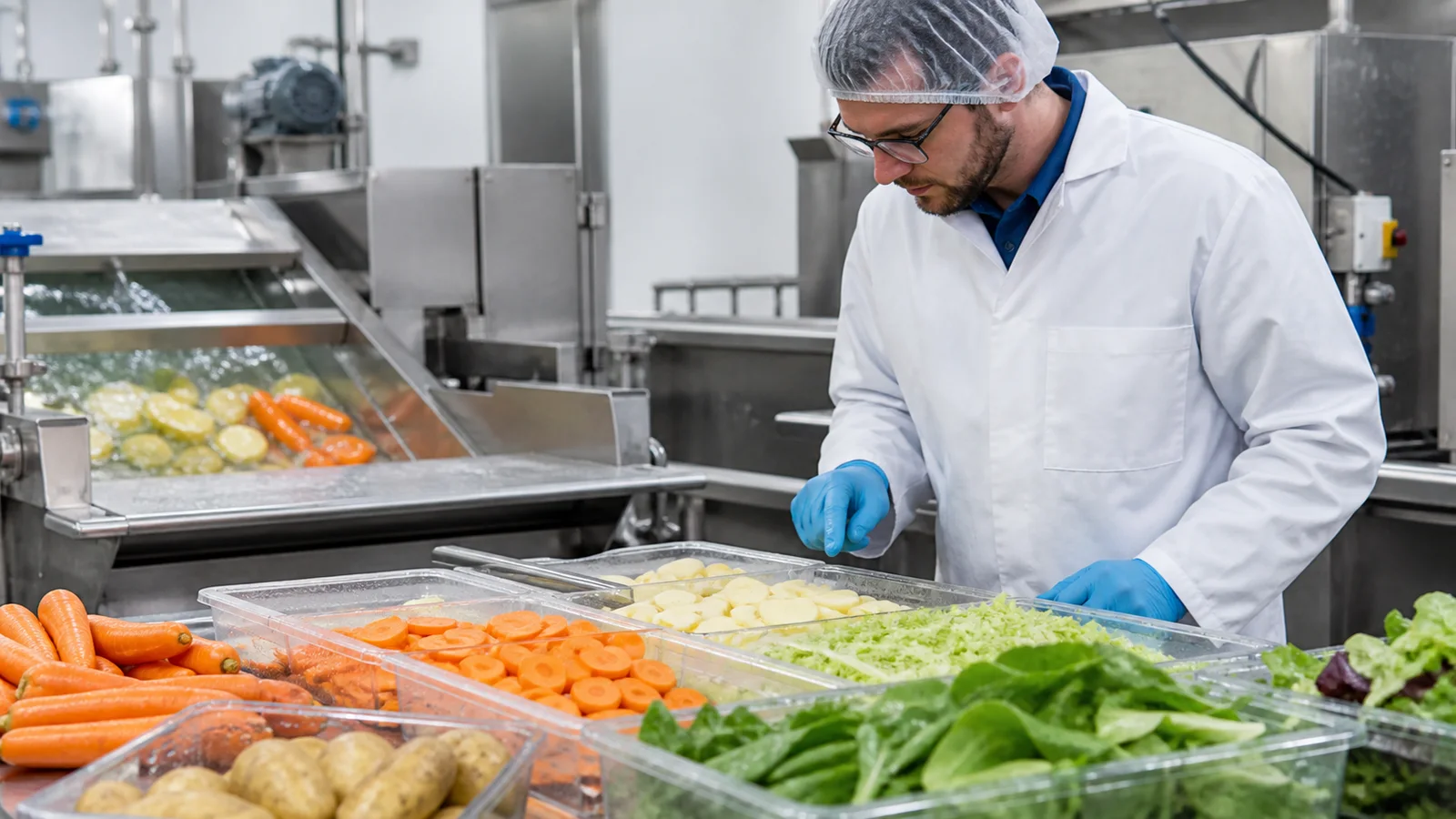
FDA fresh-cut guidance identifies water quality as critical because cut or sliced produce can be vulnerable and may have no later kill step. Research also shows that organic matter released by cut produce can consume sanitizer and change wash-water performance. Equipment selection therefore must include water flow, product-to-water loading, filtration, monitoring, treatment control, make-up and discharge - not only tank size or bubble intensity.
This page does not prescribe a sanitizer or concentration. Chemical choice, limits, monitoring, contact conditions and worker/environmental controls must be approved and validated for the crop, water and jurisdiction.
Define cut quality before selecting a cutter
| Acceptance item | Example definition |
|---|---|
| Geometry | Target dimensions and tolerance distribution, not only nominal blade spacing. |
| Integrity | Limits for cracks, crushing, torn tissue, bruising and deformation. |
| Fines and fragments | Maximum undersize fraction and how it is sampled and weighed. |
| Surface condition | Clean cut, juice release, discoloration or other product-specific indicators. |
| Yield | Accepted cut product divided by prepared input on a stated mass basis. |
| Tool condition | Blade inspection/sharpening interval and performance at the end of the planned run. |
Blade speed is not the product specification
Cut quality depends on the crop, maturity, temperature, orientation, feed pressure, blade geometry and sharpness. Mechanical damage can reduce fresh-cut quality and shelf life, so the trial must score saleable cut product rather than only machine throughput.
Size the line from packed yield
Required nominal raw feed = accepted packed kg/h / process yield / operating efficiencyFor 1,000 kg/h accepted carrot dice, 90% process yield and 85% planning efficiency, the screening raw-feed requirement is about 1,307 kg/h. Verify every module at peak soil load and the most difficult approved crop size.
Keep process yield and operating efficiency separate. Yield accounts for material loss; efficiency accounts for time and rate loss. Water pickup or removal also changes mass, so define the weighing points.
Three common line constraints
Variable raw material
Oversize, undersize, stones, clods and maturity changes can restrict feeding, peeling or cutting before nominal motor capacity is reached.
Water and dewatering
Wash loading, organic matter, filter capacity and dewatering batches can constrain an otherwise fast cutter.
Inspection and packaging
Defect removal, chilling, buffer behavior and packer feed often determine accepted packed output.
Vegetable line trial and acceptance
Product and yield evidence
- incoming size and defect distribution;
- soil and foreign-material condition;
- peel removal and flesh loss;
- cut dimensions, fines and damage;
- free-water or dewatering endpoint;
- accepted yield at defined weighing points.
Process evidence
- sustained raw and accepted kg/h;
- water conditions and monitoring response;
- jams, stops and operator interventions;
- tool wear across the test period;
- changeover, dismantling and cleaning;
- downstream package-feed stability.
Trials should include representative normal and difficult lots. A clean, uniformly sized sample can hide soil-removal, orientation, cut-quality and yield limitations.
Worked example: 1,000 kg/h carrot dice line
Translate packed demand into equipment criteria
- Raw material
- Defined carrot variety and maturity with measured diameter/length range and realistic soil load.
- Finished product
- Specified dice dimensions, tolerance, maximum fines, surface-damage limit and chilled package condition.
- Target
- 1,000 kg/h accepted packed product, 90% planning yield and 85% operating efficiency.
- Raw-feed screen
- Approximately 1,307 kg/h nominal raw input before detailed mass-balance confirmation.
- Line scope
- Inspection, washing, peeling, trimming, dicing, validated post-cut handling, dewatering, inspection and packaging feed.
- Acceptance
- Cleaning performance, peel/flesh loss, cut distribution, fines, accepted yield, sustained output and water-control records.
Common vegetable equipment selection mistakes
Do not test only the easiest crop lot
- Selecting a washer without testing buoyancy, fragility and realistic soil.
- Assuming washing is a kill step or relying on unmonitored recirculated water.
- Choosing a cutter from blade spacing without cut-quality tolerances.
- Comparing raw feed rate instead of accepted packed output and yield.
- Ignoring seasonal size, maturity and firmness variation.
- Over-dewatering fragile leaves to reach a number while damaging product.
- Leaving inspection, chilling and packaging feed outside the line balance.
Vegetable equipment enquiry checklist
- Name each crop and variety.
- Provide typical and extreme dimensions.
- Describe soil and incoming defects.
- Define trimming and peeling requirements.
- Provide cut drawings and tolerances.
- Set fines and damage limits.
- State accepted packed kg/h.
- Define yield and weighing points.
- Describe water source and reuse.
- Define wash monitoring requirements.
- State dewatering endpoint.
- Define chilled and package condition.
- Provide normal and difficult trial lots.
- Agree test duration and sample plan.
- Define cleaning/changeover criteria.
- Confirm waste and wastewater scope.
Research sources and boundaries
- U.S. FDA, Guide to Minimize Food Safety Hazards of Fresh-cut Produce. The guidance addresses equipment, water quality, cross-contamination, temperature and sanitation considerations. Accessed 7 August 2026.
- Codex CXC 53-2003, Code of Hygienic Practice for Fresh Fruits and Vegetables. Adopted 2003 and revised through 2017 in the current Codex file. Accessed 7 August 2026.
- Abnavi et al., Modeling free chlorine consumption and cross-contamination during fresh-cut produce wash cycles. Journal of Food Science 84 (2019), DOI 10.1111/1750-3841.14774. The study supports monitoring wash-water chemistry under changing organic load.
- Nou et al., Whole-leaf wash and cross-contamination during fresh-cut lettuce processing. Journal of Food Science 75 (2010), M283-M290. The study demonstrates that process sequence can affect wash-water control.
- Monitoring the effect of cutting blade sharpness on fresh-cut product quality. Acta Horticulturae 1319. The work supports including blade condition and tissue damage in cutter acceptance.
Research date: 7 August 2026. This guide supports preliminary equipment selection. Produce safety, sanitizer use, process-water controls, shelf life, chilled storage and legal compliance require crop- and market-specific validation.
Vegetable processing equipment FAQ
What information is needed to select vegetable equipment?
Define the crop and size range, incoming soil and defects, required operation, target cut, accepted output, yield, washing-water controls, dewatering target and package condition.
Can one vegetable cutter process every crop?
No. A cutter may support several tools, but crop geometry, firmness, fiber direction, maturity and target cut require separate trials and operating limits.
Does washing make contaminated produce safe?
Washing is not a universal kill step. Wash systems must be designed and controlled to avoid water-mediated cross-contamination, with product-specific food-safety validation.
How should vegetable-line capacity be compared?
Compare accepted packed output after trimming, peeling, cutting, washing, dewatering, defects and operating efficiency, not only raw feed rate.
Identify the correct vegetable equipment direction
Use the selector to organize crop, operation, cut size and accepted output before technical confirmation.
Open vegetable selector Calculate required capacity