
KJJ-230 Automatic Meat Tying Machine
Bind pork loin, chops, cooked meat and seafood with adjustable compression and repeatable knot placement.
Hold product shape without clips or casing
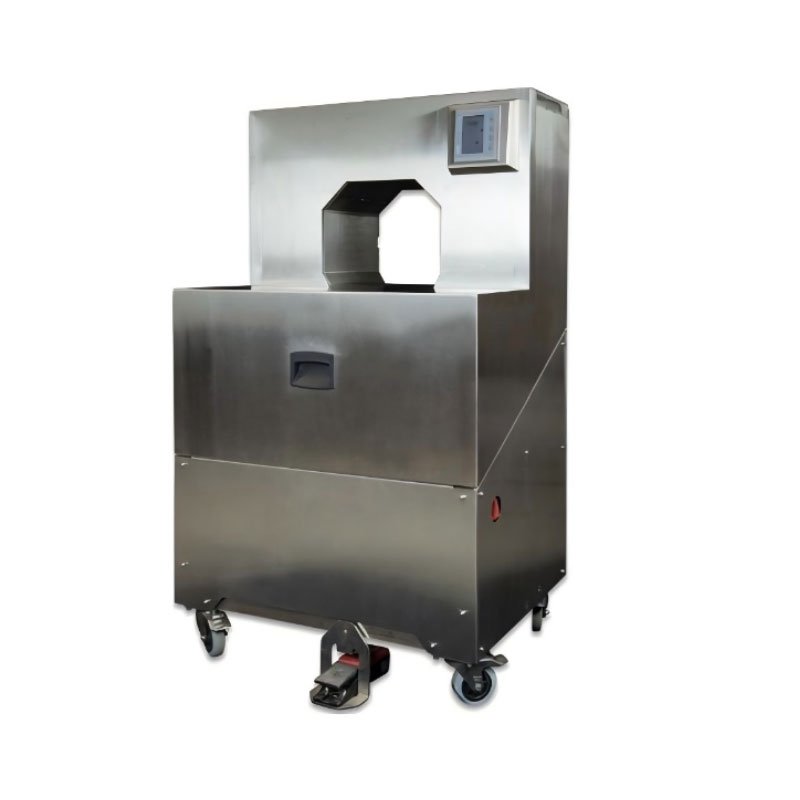
The HELPER KJJ-230 applies food-grade string around a product passed through its octagonal tying aperture. Its knotting mechanism forms and tightens each loop, reducing repetitive hand tying and helping processors maintain a more consistent presentation. Published applications include pork loin, pork chops, seafood, cooked meat and barbecued pork. The source also names flowers, asparagus and other root-vegetable bundles, demonstrating that selection depends on shape and tying response rather than meat alone.
The stainless cabinet, mobile casters, front service enclosure, touchscreen and foot control create a compact production station. The operator presents the product, initiates a cycle and advances it by the required spacing. This is a tying machine—not a sausage linker, clipper, slicer or portion cutter.
Binding tightness is adjustable. That flexibility matters because a tender cooked product can deform under force that may be appropriate for a firm raw loin. Product trials must define acceptable compression, loop count and spacing.
Four steps to a controlled tied product
Trim and form the product; confirm approved string and recipe.
Support the product centrally through the tying aperture.
Trigger the programmed knot and compression setting.
Move by the specified pitch and repeat until complete.
Published “single-lap strapping time” of 20–30 laps per minute describes tying cycles, not guaranteed finished pieces per minute. Product length, number of loops, operator presentation, spacing and rework determine accepted output.
KJJ-230 technical schedule
| Item | Published value |
|---|---|
| Power | 4 kW |
| Single-loop rate | 20–30 loops/min |
| Maximum product diameter | 230 mm |
| Loops per tying position | Adjustable; usually 1–2 |
| Compression force per turn | 1–5 kg, adjustable |
| String diameter | 1–2 mm |
| Air pressure | 5–7 bar |
| Weight | 210 kg |
| Dimensions | 510 × 630 × 1290 mm |
Source hygiene: the exact page contains two paragraphs about vacuum dough kneading and dough elasticity. They are unrelated template contamination and are deliberately excluded from this product.
String and product validation
Supply food-contact certification, diameter, tensile strength, knot behaviour and spool format for the proposed string. Confirm whether it must tolerate cooking, smoking, chilling or freezing. A nominal 1–2 mm diameter alone does not establish suitability.
Provide product length, minimum and maximum diameter, weight, temperature, surface moisture, firmness and required loop pitch. Test the most delicate and least uniform product, not only a selected firm sample.
See the tying mechanism in context
The exact HELPER page exposes this video ID. It is placed after the process and verified specifications so buyers can compare machine movement with the proposed application.
Review product support, hand position, foot-control timing, knot formation and advance between loops. Final safeguarding and operating method must be confirmed for the supplied configuration.
Specify appearance, retention and cleanability
Agree measurable results: loop position, spacing tolerance, knot security, string tails, product deformation and percentage requiring rework. After tying, test the product through its real downstream process. Heating or chilling can change diameter and string tension, while handling and packaging may loosen an apparently acceptable knot.
The official description identifies 304 stainless steel and calls the machine waterproof and moisture-proof. Buyers should still confirm the control enclosure rating, permitted wash method and parts requiring dry cleaning. Product residues can enter the aperture and knotting area; cleaning access and post-cleaning inspection must be included in sanitation procedures.
Safety and factory acceptance
The working opening and knotting mechanism create pinch and entanglement risks. Validate two-hand positioning, foot-pedal protection, emergency stop, guard interlocks where fitted and safe string replacement. Operators should never reach into the knotting path during an enabled cycle.
Run every product size at minimum and maximum compression. Record successful ties, missed knots, broken string, double feeds, deformation, cycle time and stops. Challenge low string, jam recovery, power loss and emergency-stop restart. Contract output should be accepted tied products, not unloaded machine cycles.
KJJ-230 selection questions
Is this a sausage tying machine?
No. It binds products such as loins and chops with string around the outside. It is not a casing linker or clipper.
Does it automatically feed the meat?
The published page confirms automatic knotting, but not an automatic product conveyor. Operator presentation and advance should be assumed unless included in the quotation.
Can it tie products smaller than 230 mm?
Yes, 230 mm is the published maximum diameter. Actual minimum size and performance require a product trial.
How many loops can it apply?
The number is adjustable; the source says one or two loops are typical. A long product receives repeated tying positions as it is advanced.
Send samples, dimensions and string requirements
Include product temperature, firmness, diameter range, desired loop pitch, compression limit and downstream thermal process.
Request a KJJ-230 tying trial