
Which dumpling machine should you choose?
Choose the forming platform from the exact finished product, not the word dumpling. Define wrapper recipe and thickness, filling composition and particle size, finished weight, filling ratio, fold or pleat geometry, seal requirement, accepted output and downstream process. Confirm the result with actual dough and filling over a sustained trial.
Who should use this guide?
Frozen food factories
Planning dumpling forming, freezing and packaging as a balanced line.
Central kitchens
Moving from manual forming to repeatable portioning and shape control.
Project and procurement teams
Comparing equipment on the same product and acceptance criteria.
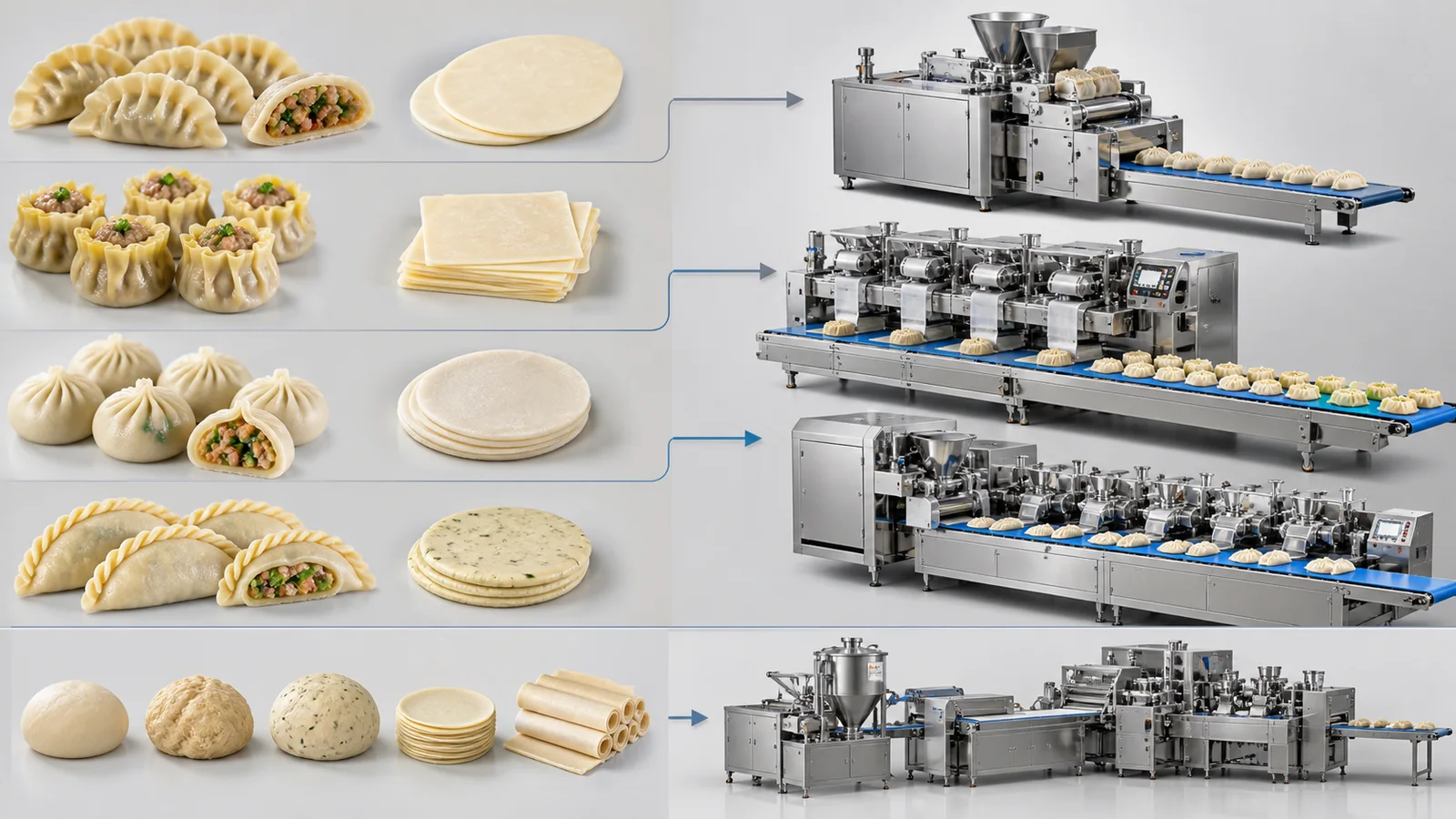
Product name does not define the forming method
Dumpling and gyoza
Typically require controlled wrapper placement, filling dose, edge registration, folding and a reliable closed seal with the specified pleat or profile.
Wonton
Wrapper geometry, filling placement and fold sequence vary. The tooling must support the required final shape rather than a generic folded parcel.
Shumai
Requires wrapper gathering and side-wall support while leaving the top open. Filling surface and finished height become acceptance criteria.
Khinkali and pleated products
Deep pouch geometry, pleat count or appearance, top closure and liquid-retaining filling can require a dedicated forming and handling method.
Minimum product data for machine selection
| Input | What to define |
|---|---|
| Finished geometry | Photos and dimensional drawing, fold/pleat pattern, open or closed top, orientation and allowed deformation. |
| Wrapper | Flour and recipe, hydration, sheet or piece supply, thickness profile, diameter/size, elasticity and surface dusting. |
| Filling | Meat/vegetable ratio, temperature, free liquid, viscosity, largest particle, compressibility and sensitivity to smearing. |
| Product weight | Total target and tolerance, wrapper weight, filling weight and required filling ratio. |
| Seal | Seal width and appearance, leakage limit, product-free sealing area and cooking/freezing integrity. |
| Capacity | Accepted pieces/min and kg/h, daily production, product mix, changeovers, efficiency and reject definition. |
| Downstream | Manual or automatic tray loading, cooking, freezing, inspection, packaging and required presentation. |
| Sanitation | Cleaning method, allergen/species changeover, dismantling, filling-temperature control and hygienic zoning. |
Match the product to the forming platform
| Platform question | Selection implication |
|---|---|
| How is wrapper supplied? | Continuous sheet, pre-cut wrapper or dough-fed forming changes the sheeting interface, trim, synchronization and tooling. |
| How is filling dosed? | Pumpable homogeneous fillings, coarse inclusions and free-liquid recipes place different demands on hoppers, feed screws, nozzles and cutoff. |
| How is shape produced? | Folding, pressing, gathering, pleating and top closure require product-specific tools and motion sequences. |
| How is seal protected? | Filling must not contaminate the sealing land. Wrapper moisture, dusting and tool pressure influence closure stability. |
| How is product discharged? | Soft products may need supported release, controlled drop height, orientation, tray placement or a matched transfer conveyor. |
| How is changeover done? | Confirm which formats require tooling, feeder, nozzle, recipe and conveyor changes and measure the complete changeover time. |
One platform should not be described as universal without evidence
Shared drives or sheeting modules do not mean all products use the same mold, wrapper, filling system or speed. Request the exact tested product range, tooling list, operating limits and changeover procedure.
Filling behavior often sets the practical speed
Flow consistency
Filling must feed and stop predictably at the nozzle. Temperature, free water and fat condition can change dosing behavior during a shift.
Particle passage
The largest real inclusion and its shape must pass through the feed and cutoff path without blockage, damage or separation.
Seal cleanliness
Overfill, stringing or liquid migration into the wrapper edge can increase leaks even when average dose weight is correct.
Machine trials should use representative production filling at its actual operating temperature. A smooth substitute filling can conceal feed, cutoff and sealing problems.
Compare accepted pieces and mass output
Accepted pieces/min = lanes x nominal pieces/min/lane x efficiency
Accepted kg/h = accepted pieces/min x product weight (g) x 60 / 1,000
Example: 2 lanes x 80 pieces/min x 85% efficiency x 22 g gives 136 accepted pieces/min and about 179.5 kg/h. The result is valid only for the specified product and accepted-quality definition.
Do not compare only maximum pieces per minute. A lighter product creates lower kg/h at the same piece rate, while a complex pleat, coarse filling or difficult wrapper may reduce stable accepted speed.
Check the complete production line
Dough and wrapper supply
Mixer cycles, resting, sheeting width, sheet tension and trim must feed all forming lanes consistently.
Filling preparation
Mixing, temperature control, buffer residence and refill method must prevent segregation and forming interruptions.
Freezing and packaging
Tray loading or freezer belt loading, spacing, freezing capacity, de-panning and package rate must accept formed output.
Dumpling machine trial and acceptance
Measure product quality
- total, wrapper and filling weight;
- shape and dimensional tolerances;
- pleat/fold appearance;
- seal integrity and filling contamination;
- cooking leakage or breakage;
- frozen and reheated quality if applicable.
Measure production performance
- sustained accepted pieces/min and kg/h;
- start-up and steady-state rejects;
- weight drift during hopper depletion;
- stops, interventions and refill effects;
- tooling change and cleaning time;
- safe dismantling and reassembly.
Agree test duration, sample frequency, measurement method and pass criteria before the test. Include more than one SKU when the purchase decision depends on multi-product capability.
Frozen dumplings require downstream validation
Forming success is only the first checkpoint
Research on quick-frozen dumpling wrappers shows that vacuum conditions, frozen storage and freeze-thaw cycles can alter water state, microstructure and wrapper quality. For a frozen product project, evaluate representative freezing, storage exposure and final cooking. Also control the time between forming and freezing, product spacing, freezer loading and package protection.
Codex CXC 8-1976 provides general hygienic and handling principles for quick-frozen foods. It does not establish a universal freezing recipe for every dumpling; the freezing process and food-safety controls must be validated for the actual product and market.
Worked example: two-lane frozen dumpling project
Turn the product into testable requirements
- Finished product
- 22 g closed-edge dumpling with a defined pleat profile and frozen retail format.
- Wrapper
- Specified flour and hydration, controlled sheet thickness and clean sealing edge.
- Filling
- Actual chilled meat/vegetable recipe with documented largest inclusion and free-liquid condition.
- Target
- 136 accepted pieces/min after an 85% planning efficiency, approximately 179.5 kg/h.
- Downstream
- Oriented discharge to freezer loading, rapid transfer, freezing, inspection and bag packaging.
- Acceptance
- Weight, filling ratio, dimensions, seal integrity, cooked leakage, sustained output, rejects and post-freezing quality.
Common dumpling machine selection mistakes
A visually similar product may behave differently on the machine
- Selecting from a photo without a dimensional drawing and weight breakdown.
- Testing with a smooth substitute instead of the actual coarse or liquid-sensitive filling.
- Quoting pieces/min without product weight, lanes, efficiency or reject basis.
- Assuming one mold makes dumpling, wonton, shumai and khinkali at the same speed.
- Ignoring sheet supply, filling refill and freezer loading when sizing the forming machine.
- Checking raw formed appearance but not cooking, freezing or package handling.
- Leaving tooling, change parts and changeover time outside the commercial scope.
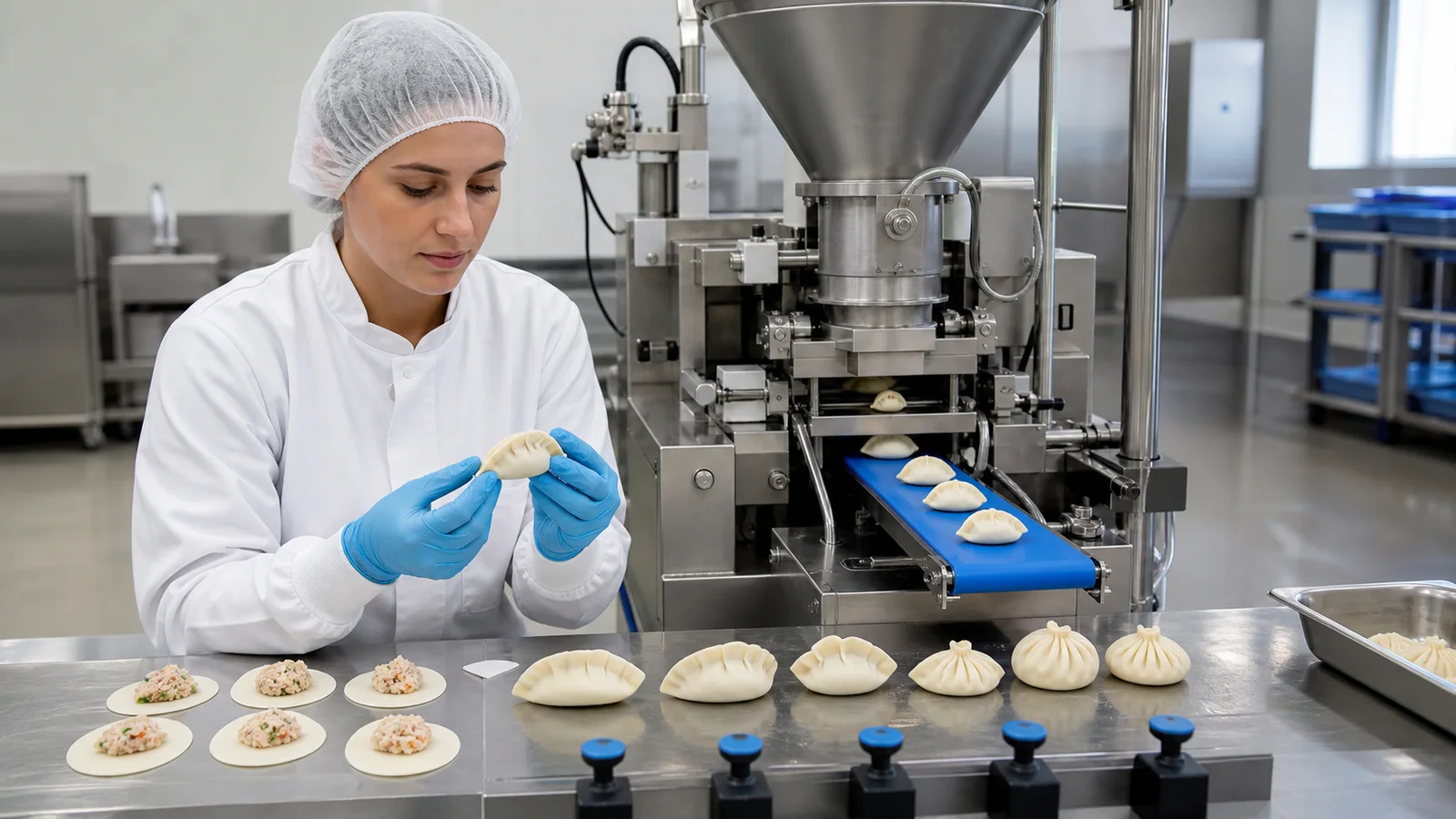
Dumpling machine enquiry checklist
- Name every required product.
- Provide photos and dimensional drawings.
- Define total, wrapper and filling weights.
- Provide wrapper recipe and thickness.
- Provide actual filling and temperature.
- State largest filling inclusion.
- Define seal and leakage criteria.
- State accepted pieces/min and kg/h.
- Define downstream cooking or freezing.
- State tray or package presentation.
- List required molds and change parts.
- Define changeover and sanitation needs.
- Provide representative trial materials.
- Agree sample and measurement methods.
- Set sustained-test duration.
- Define reject and pass/fail criteria.
Research sources and boundaries
- Codex CXC 8-1976, Code of Practice for the Processing and Handling of Quick Frozen Foods. Use with current general hygiene principles and applicable product or market requirements. Accessed 7 August 2026.
- Liu et al., Effects of vacuum degree on fast frozen dumpling wrappers. International Journal of Food Science & Technology (2019), DOI 10.1111/ijfs.14108. The study links vacuum mixing conditions with wrapper water state, microstructure and storage behavior.
- The Effect of Freeze-Thaw Cycles on the Microscopic Properties of Dumpling Wrappers. Foods 12 (2023). The study supports evaluating frozen-storage and temperature-cycle effects rather than treating forming quality as final quality.
- Effect of packaging and storage conditions on quick-frozen dumpling skin. Transactions of the Chinese Society of Agricultural Engineering 30 (2014). The study examined packaging, storage duration and freeze-thaw cycles.
- ISO 14159:2002, Safety of machinery - Hygiene requirements for the design of machinery. Apply hygienic design review to wrapper, filling and forming zones and monitor the standard's revision status. Accessed 7 August 2026.
Research date: 7 August 2026. This guide supports preliminary equipment selection. Product formulation, raw-meat controls, cooking lethality, freezing process, shelf life, allergen controls and legal compliance require product-specific validation.
Dumpling machine selection FAQ
What information is needed to select a dumpling machine?
Define product geometry, wrapper recipe and thickness, filling composition and particle size, finished weight, filling ratio, accepted output, downstream process and trial criteria.
Can one machine make gyoza, wonton, shumai and khinkali?
Not automatically. These products use different wrapper handling, folding, pleating, closure and support requirements. Confirm specific tooling and the tested operating range.
How should dumpling machine capacity be compared?
Compare accepted pieces and kilograms per hour at the specified product weight and quality, after efficiency and rejects, using representative dough and filling.
Should a frozen dumpling trial include freezing?
Yes. Forming performance alone does not establish frozen-product quality. Evaluate freezing, representative storage exposure, cooking and seal integrity as appropriate.
Match your dumpling format to a machine direction
Use the selector to organize product shape, weight, output and downstream process before technical confirmation.
Open dumpling selector Calculate dumpling capacity