
Equipment route: When the product definition is clear, continue to the Youtiao Production Equipment Hub for forming, frying and line-planning options.
The basic route has six connected stages
- 1 · Dose and mixCombine flour, water, salt and the selected leavening system to a repeatable dough condition.
- 2 · Rest and conditionAllow time for hydration, relaxation and leavening reactions required by the formula.
- 3 · Divide and handlePrepare blocks or bands that can move through cold resting and forming without damage.
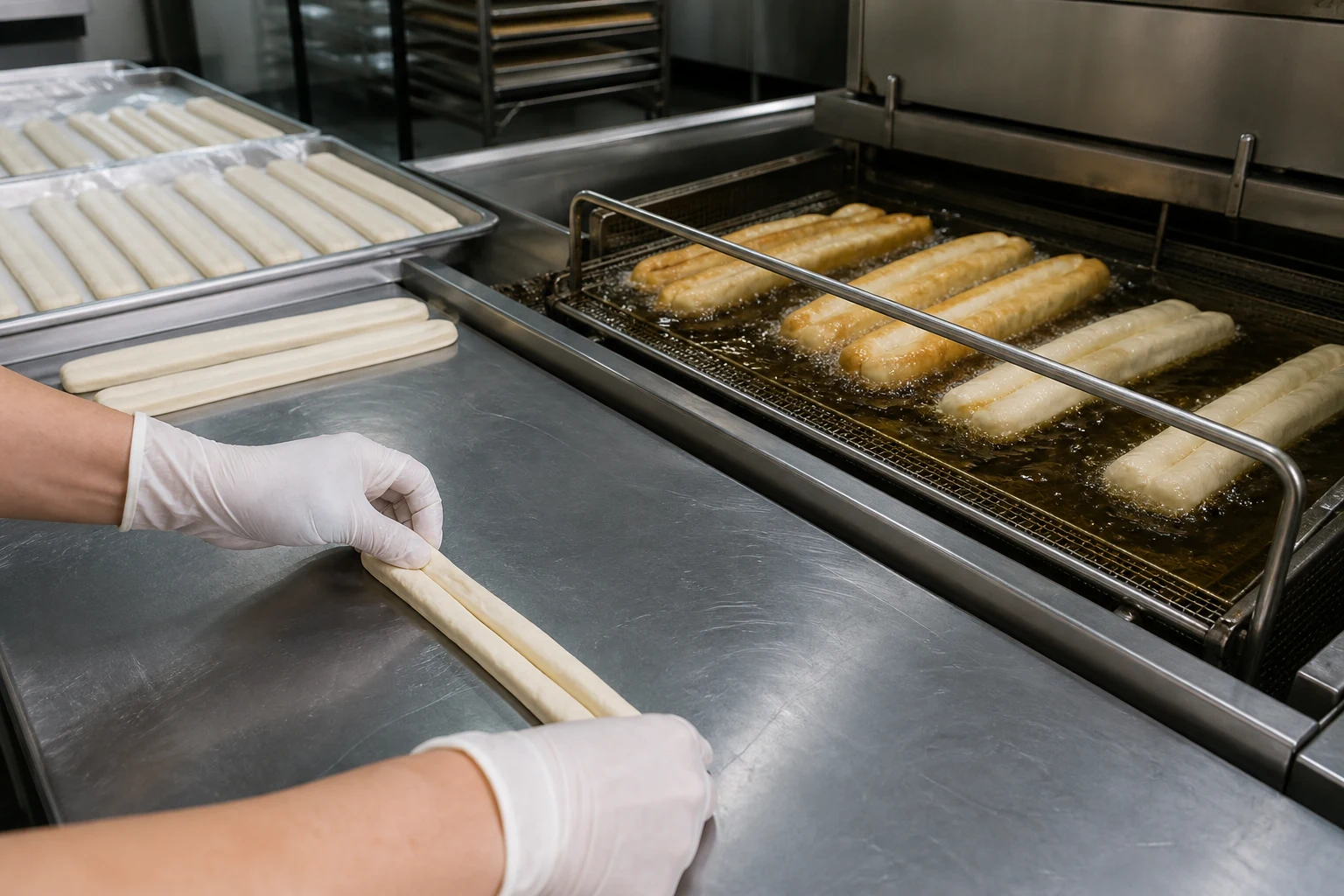
- 4 · Form and pairRoll, slit or cut, overlap or join and stretch pieces to the specified geometry.
- 5 · FryControl oil condition, time, temperature, product movement and expansion.
- 6 · FinishDrain or de-oil, cool, inspect and send the product to serving, freezing or packaging.
External process demonstration · 5:24
Watch the manual forming and frying sequence
This demonstration from Chinese Cooking Demystified makes three transitions easier to see than a static process chart: how rested dough is handled, how two strips are joined, and how the piece expands after it enters the oil.
What this adds to the process map
The home-scale method is not an industrial line model, but it exposes the physical sequence behind the six stages above. The rested dough is flattened and divided without heavy reworking; two pieces are stacked and pressed through the centre; the joined strip is lengthened immediately before frying; and turning in the oil supports more even expansion and colour.
Source and limit: External educational video published by Chinese Cooking Demystified on 8 May 2019. It shows a southern-style, manual home-cooking method—not HELPER equipment, an industrial production specification, or a universal formula. Use the written sections below for production variables and validation boundaries.
Open the original video on YouTubeMixing establishes the dough—not the final shape
The formula and flour properties determine how much water is absorbed and how the dough responds to work. Mixing must distribute ingredients and develop a dough that can survive resting, sheeting and stretching. Excessive or insufficient development can both create problems. Record ingredient temperature, water addition, batch size, mixing time, energy or current trend where available, and discharge temperature.
Leavening systems vary. Published studies examine chemical leavening, yeast fermentation and alternatives to traditional aluminium-containing agents. The correct choice depends on product quality, processing time, destination-market rules and label requirements. It is a formulation decision, not a universal machine setting.
Resting changes machinability
Resting allows water distribution, dough relaxation and leavening reactions to continue. Traditional processes can use long rest periods; industrial routes may use trays, controlled cold rooms or other conditioned holding systems. Time alone is not enough: dough temperature, block size, covering, humidity, stacking and first-in/first-out control affect the condition arriving at the former.
A block divider can prepare consistent pieces before cold rest, while the forming line may receive conditioned blocks afterward. The interface between these steps needs a WIP calculation: pieces per tray, trays per rack, rack dwell time and maximum delay before forming.
Paired strips must stay joined while they expand
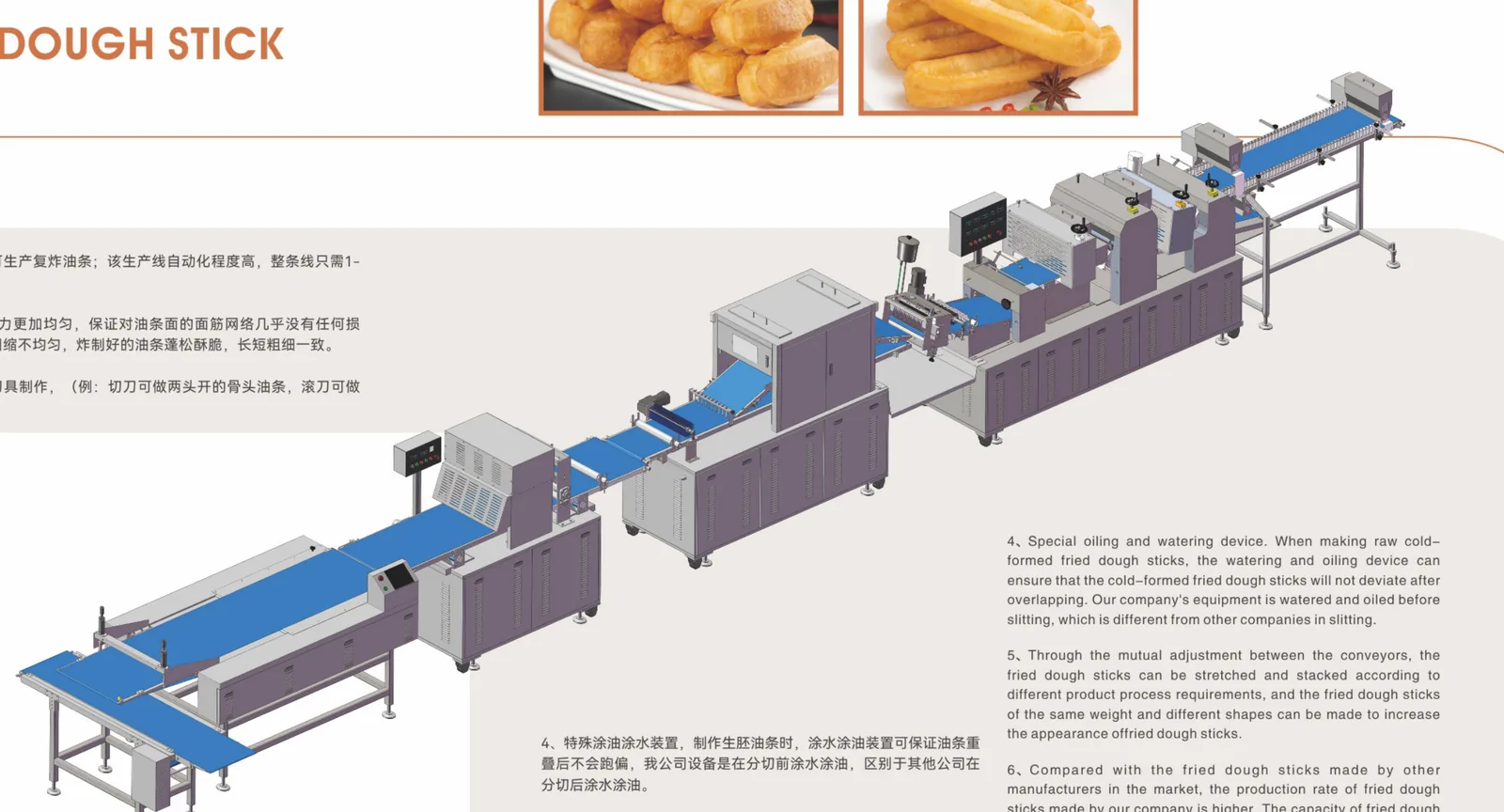
Forming can involve pre-rolling, thickness control, surface treatment, longitudinal slitting, cross-cutting, pairing or overlapping, pressing, stretching and transfer. The joined centre and the two layers influence how the piece opens during frying. Tooling must be confirmed against target length, end shape, weight and the desired internal structure.
Frying sets expansion, colour, texture and oil uptake
Frying is a coupled heat-and-mass-transfer step. Water turns to vapour, the product expands, the surface sets and colour develops. Published research shows that frying time, temperature and dough pH affect acrylamide formation; other studies discuss oil content and sensory differences under different frying methods. This is why “hot oil” is not a useful industrial specification.
Define oil type, operating temperature window, residence time, loading, turnover or product control, oil replenishment, filtration, cleaning and rejection rules. After frying, the line may need draining or de-oiling, cooling, inspection, freezing and packaging. These are project modules and should be identified individually in the quotation.
Industrialisation means controlling interfaces
For acceptance, measure more than nominal capacity. Agree the raw-material basis, piece weight, product state at measurement, warm-up and stoppage rules, run duration, yield, rejects, colour and texture window, oil condition and sanitation state. The useful number is accepted output under stated conditions.
Frequently asked questions
How long should youtiao dough rest?
There is no single time for every formula. Published traditional and experimental processes use different rest or proof periods. Validate time together with dough temperature, leavening system, block size and target machinability.
What controls whether youtiao becomes hollow and light?
Flour properties, hydration, dough development, resting, leavening, paired-strip geometry and frying conditions work together. A forming machine cannot compensate for an unsuitable dough or uncontrolled fryer.
Does an automatic line include mixing and frying?
Not automatically. Each module must be named in the quotation. Forming, upstream dough preparation and downstream frying or packaging may be supplied in different project boundaries.
Research sources and boundaries
- Zhu, Youtiao: Effect of ingredients and processing on quality attributes, Cereal Chemistry (2024). Review of ingredients, processing and quality relationships.
- Bai et al., Effect of freeze-thaw cycles on frozen youtiao dough, Food Chemistry 386 (2022), 132854.
- Huang et al., Effects of frying conditions and yeast fermentation on acrylamide in you-tiao, Food Research International 41 (2008), 918–923.
- Shyu et al., Frying methods, sensory properties, acrylamide and oil content of youtiao, Applied Sciences 11 (2021), 549.
Research reviewed 12 August 2026. Cultural descriptions support product and market orientation. Recipe, food-safety, labelling, frying, shelf-life and equipment decisions require product- and destination-specific validation.