
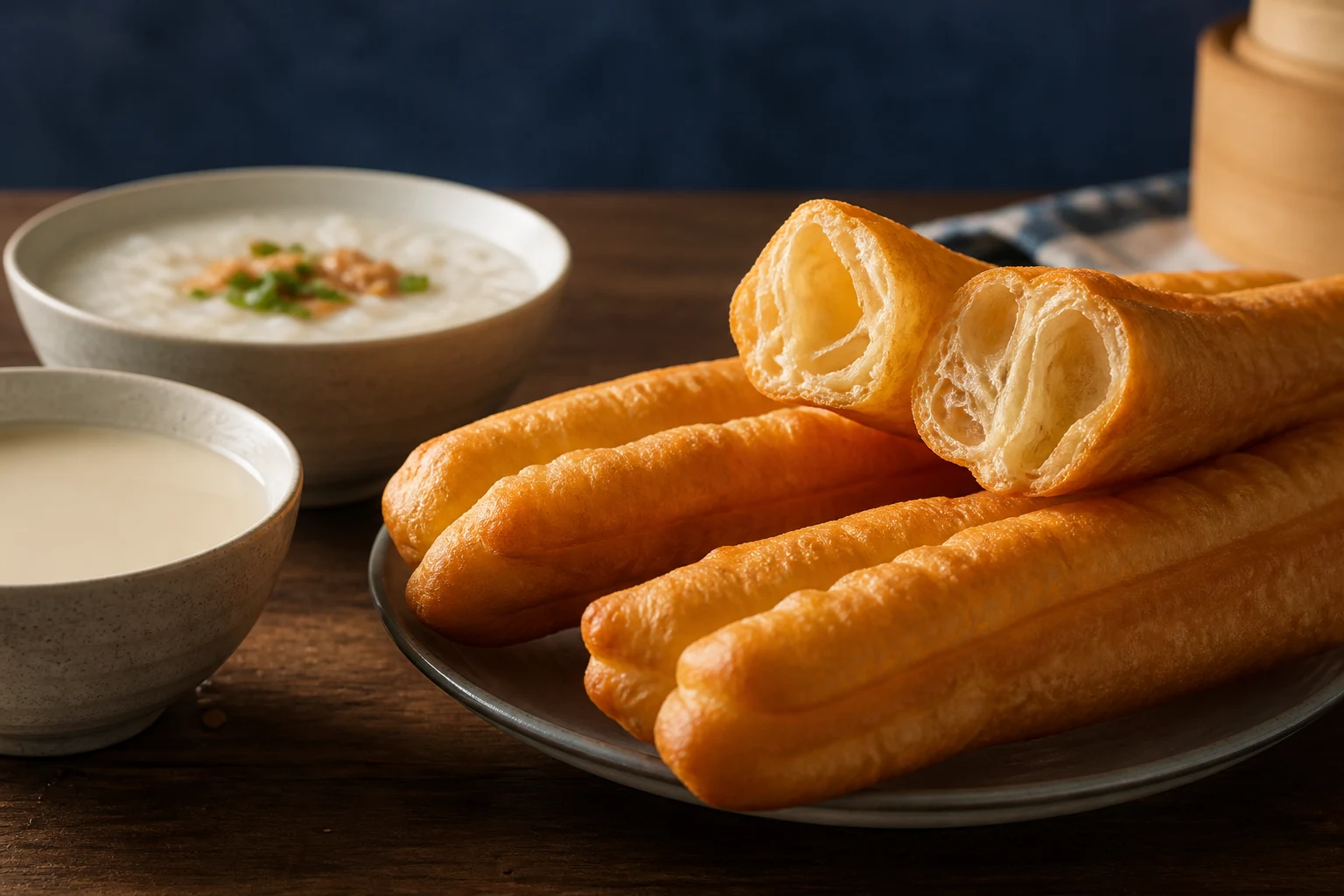
Equipment route: When the product definition is clear, continue to the Youtiao Production Equipment Hub for forming, frying and line-planning options.
Youtiao is a leavened, deep-fried wheat-dough stick
English buyers may encounter the names Chinese fried dough stick, Chinese cruller, Chinese doughnut stick or oil stick. These are search and trade names for orientation. A name alone is not a production specification: length, weight, joined-strip shape, internal cell structure, surface colour and final product state can differ significantly.
One food family, many names and nearby products
Youtiao is the Mandarin romanisation of 油条, literally “oil strip”. Cantonese-speaking markets commonly use spellings related to yau char kwai. Southeast Asian names include you tiao, Indonesian cakwe, Vietnamese quẩy and Thai pathongko. Local usage is not perfectly standard: the same word can refer to different lengths, joined or unjoined pieces, or nearby fried-dough products.
Youtiao should not automatically be treated as churros, doughnuts, fried bread rolls or sweet fritters. Churros are normally extruded through a shaped die; many doughnuts are sweetened and may use yeast; youtiao is commonly sheeted or rolled, cut into strips, paired, stretched and fried. A factory should therefore send photographs and samples rather than relying on an English category name.
The basic formula is short; the process is not
The 2024 Cereal Chemistry review describes the basic ingredients as wheat flour, water, leavening agent and frying oil. Salt is common, and sugar or other formulation ingredients may be used. The choice of flour and leavening system affects dough handling, expansion, texture and oil uptake. Commercial formulas can also differ according to local regulations, label requirements and whether the product is sold fresh, chilled, frozen, pre-fried or re-fried.
External breakfast-production documentary · 9:14 · 1080p
See the paired shape, hollow expansion and serving context of fresh youtiao
Bon Appétit's visit to a high-volume Taiwanese breakfast shop gives a clear moving reference for the product described above. The youtiao station shows portioning, paired-strip geometry, frying expansion, a hollow center and the freshness cues that a factory product brief should name.
What the documentary makes easier to specify
“Youtiao” is not enough as a production target. Buyers still need a reference for strip dimensions, pairing, surface character, expansion, hollow structure, color, crispness and acceptable holding time. Those observable attributes can then become measurable project criteria.
Source and limit: External Bon Appétit editorial footage of Fuhang Soy Milk in Taiwan, published 20 February 2025. It is not HELPER footage, a HELPER customer case, a universal youtiao specification or evidence of industrial-line output.
Open the original video on YouTubeWhat makes a recognisable youtiao?
- Shape: usually a long or short paired stick, with the two strips remaining connected while expanding.
- Exterior: an even golden surface with a crisp bite, without excessive scorching or greasy patches.
- Interior: an open, expanded structure rather than a dense bread-like crumb.
- Eating quality: crispness and tenderness at the intended serving time, with oil level and flavour appropriate to the market.
- Repeatability: controlled weight, dimensions, colour and rejection criteria across the agreed production run.
When and how is youtiao eaten?
Youtiao is strongly associated with breakfast in China and several East and Southeast Asian food cultures, but it can also appear as a snack or as a component in another dish. Common pairings include soy milk, rice congee, coffee, tea and savoury soups. It may be cut into pieces, dipped, wrapped in rice noodle rolls, enclosed in flatbread or glutinous rice, or served beside porridge. These uses create different commercial requirements: a dipping stick may prioritise length and crispness, while a cut inclusion may prioritise cross-section, breakage control and pack consistency.
Turn the food idea into a factory product brief
- Reference productProvide whole-product and cross-section photographs, samples and the local market name.
- DimensionsDefine raw piece weight, fried weight, length, width, thickness and joined-end shape.
- Product stateState whether output is fresh, chilled, frozen, pre-fried or re-fried and where it is packed.
- Quality windowAgree colour, texture, oil target, acceptable variation and how rejects are counted.
- Demand basisSpecify accepted pieces/h and kg/h, run duration, shifts and seasonal variation.
Frequently asked questions
Is youtiao the same as a Chinese doughnut?
Chinese doughnut is a useful English search name, but it can be misleading. Youtiao is normally a lightly seasoned paired fried-dough stick with its own forming and expansion process. Define the actual product rather than selecting machinery by that nickname.
Is youtiao always eaten at breakfast?
Breakfast is the best-known occasion, especially with soy milk or congee, but youtiao can also be a snack or an ingredient in wrapped, rice-roll, porridge and soup dishes.
Can one machine make every regional version?
No such assumption should be made. Length, weight, pairing, cutter style, stretching, resting and frying conditions can require different tooling and process settings.
Research sources and boundaries
- Zhu, Youtiao: Effect of ingredients and processing on quality attributes, Cereal Chemistry (2024). Review of ingredients, processing and quality relationships.
- Bai et al., Effect of freeze-thaw cycles on frozen youtiao dough, Food Chemistry 386 (2022), 132854.
- Huang et al., Effects of frying conditions and yeast fermentation on acrylamide in you-tiao, Food Research International 41 (2008), 918–923.
- Shyu et al., Frying methods, sensory properties, acrylamide and oil content of youtiao, Applied Sciences 11 (2021), 549.
Research reviewed 12 August 2026. Cultural descriptions support product and market orientation. Recipe, food-safety, labelling, frying, shelf-life and equipment decisions require product- and destination-specific validation.