
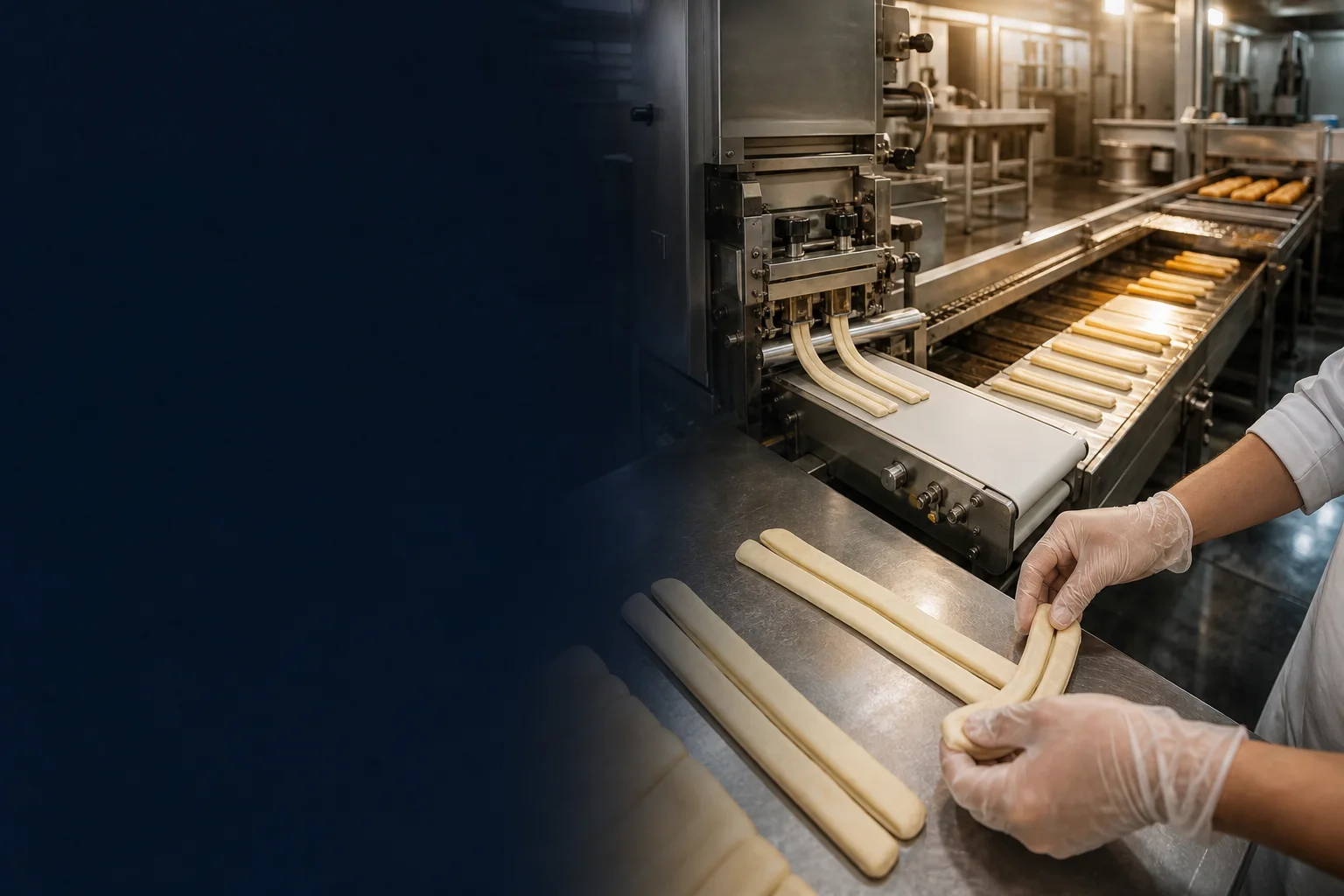
Automate the unstable constraint, not the tradition
Manual production contains valuable product knowledge. Observe where experienced operators correct dough condition, thickness, pairing, stretch and frying. Automation should convert repeatable judgement into a controlled method while keeping product and safety acceptance visible.
A four-stage migration
- Standardise. Establish product samples, formula control, batch records, rest windows and reject definitions.
- Mechanise a constraint. Add mixing, block dividing, pre-rolling or forming where labour and variation are greatest.
- Connect interfaces. Control WIP, transfer, fryer loading, drainage and cooling instead of creating isolated fast machines.
- Integrate and measure. Use defined recipes, alarms, traceable settings and accepted-output reporting.
Readiness questions
Product
Is the reference product stable enough to encode dimensions and an acceptance window?
Dough
Can mixing, temperature, rest time and block presentation be reproduced?
Demand
Is sustained accepted demand high enough, or is flexibility more valuable?
Factory
Are space, utilities, drainage, exhaust, hygiene zoning and maintenance support ready?
Operator work changes rather than disappears
Automated lines still require trained staff for pre-start inspection, recipe verification, feeding, quality sampling, oil and fryer control, cleaning, changeover and maintenance escalation. Define roles and training before commissioning.
External manual-production documentary · 8:03 · 1080p
Use a real handmade youtiao process as the automation acceptance benchmark
Goldthread documents a family-run handmade youtiao operation in Sydney. The footage supplies a practical reference for the product identity, hand movements and visual acceptance cues that an automation project should define before replacing manual steps.
What the manual reference adds
Automation acceptance should preserve named product characteristics rather than an abstract idea of “traditional quality.” Use the footage to discuss dough handling, paired-strip geometry, surface condition, expansion, color and the operator judgments that need measurable limits.
Source and limit: External Goldthread editorial documentary about an independent family business, published 6 September 2022. It is not HELPER content, a HELPER customer case, an automatic-line demonstration or evidence of quantified production performance.
Open the original video on YouTubeProtect product identity during acceptance
Run the manual reference and automated trial under comparable raw-material conditions. Compare weight, dimensions, paired shape, cross-section, colour, texture at serving time, oil behaviour, rejects and labour touchpoints. Approve the line against the product window, not appearance alone.
Frequently asked questions
Does this guide replace an engineering proposal?
No. It structures the information needed for product trials, equipment selection and a project-specific proposal.
Can capacity be guaranteed from a web page?
No. Capacity must name the product state, accepted quality, run conditions, yield and contractual test method.
Where can I review the actual machinery route?
Use the linked Youtiao Production Equipment Hub, then provide samples, formula, output and factory constraints.
Research and evidence boundary
Food-process context is supported by Zhu, Cereal Chemistry (2024) and Shyu et al., Applied Sciences (2021). HELPER model values and project boundaries must match the applicable catalogue and signed proposal. Reviewed 12 August 2026.