
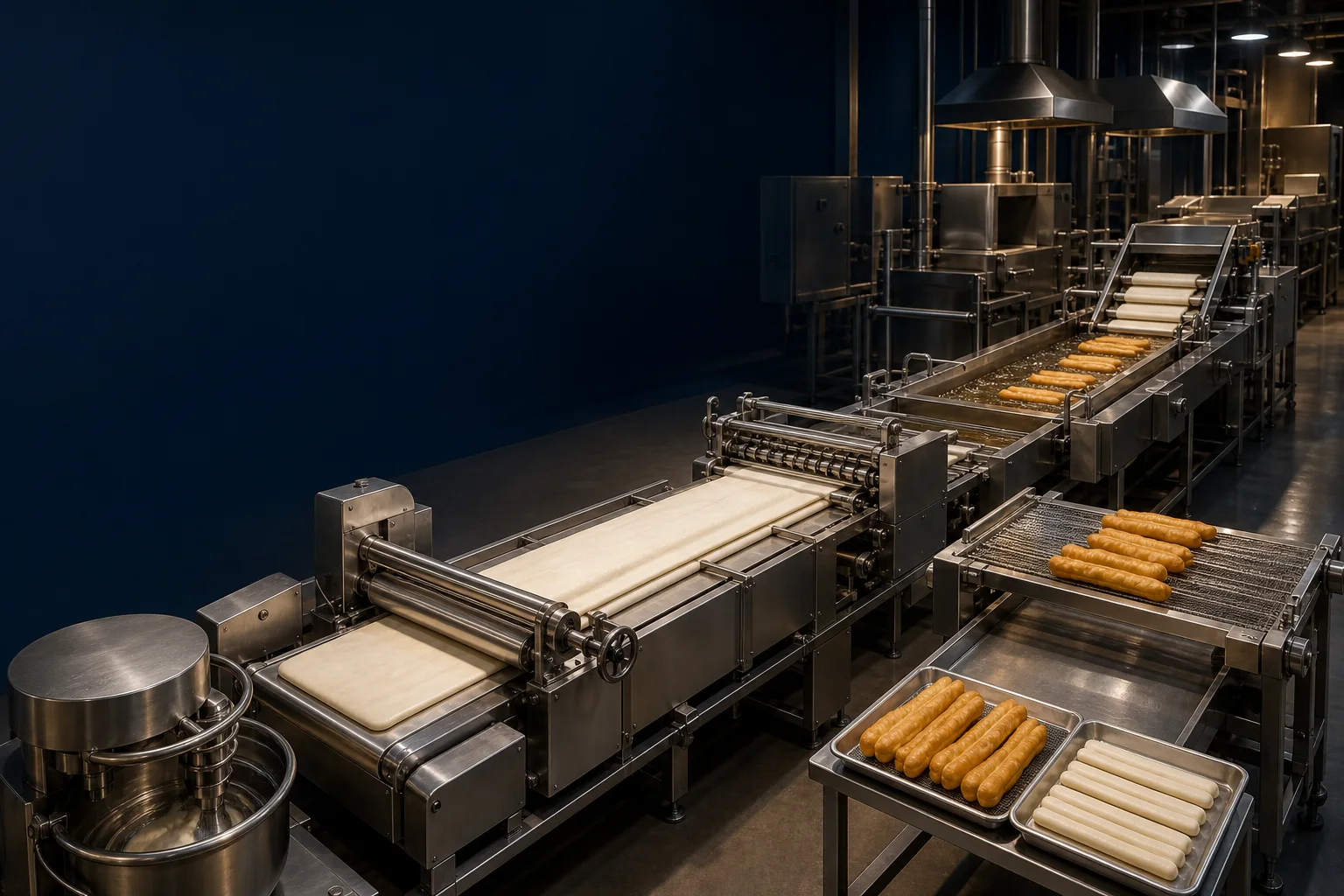
Start with the production route, not a model number
A youtiao project connects food preparation, controlled resting, forming, frying and finishing. The correct equipment boundary depends on the product state at sale and the work the factory already performs. A forming machine may be the right purchase for one factory; another may require mixing, tray handling, cold conditioning, frying, oil management, cooling and packing.
The six equipment zones
Dough preparation
Ingredient dosing, mixing and discharge must create a repeatable dough condition.
Resting and WIP
Blocks, trays, racks and temperature-controlled holding connect batch mixing to continuous forming.
Pre-forming
Dividing, pre-rolling and thickness reduction prepare conditioned dough for stable feeding.
Forming
Sheet control, slitting, cross cutting, pairing, pressing, stretching and transfer define geometry.
Frying
Oil temperature, residence time, loading, product movement and filtration determine the thermal process.
Finishing
Draining, cooling, inspection, freezing and packaging depend on the intended sales state.
External adjacent fried-dough line · 2:58 · 1080p
Watch an adjacent fried-dough line hand product from one zone to the next
Food Network's Krispy Kreme segment shows mixing, dough checks, forming transfer, frying and finishing as one connected route. Although the product is a doughnut rather than youtiao, the moving line makes the interface question visible: every zone must deliver the right material state and timing to the next operation.
Use the sequence to ask interface questions
For a youtiao project, define who owns dough release, rest or buffer time, feeding, paired-strip geometry, fryer entry, oil recovery, discharge and downstream cooling or packing. A machine list without those handoff conditions is not yet a production route.
Source and limit: External Food Network editorial footage of Krispy Kreme production, published 22 August 2021. It shows doughnut—not youtiao—production and is not HELPER equipment, a HELPER customer case or a recommended project configuration. Use it only to understand line zones and interfaces.
Open the original video on YouTubeInterfaces decide whether the line performs
Machine-to-machine compatibility is not only a conveyor width. Confirm batch cadence, dough temperature at transfer, block dimensions, tray pitch, forming infeed rate, fryer loading, oil recovery, cooling time and packaging accumulation. The slowest qualified step limits accepted output.
Separate published equipment from project scope
| Evidence | Safe use | Do not assume |
|---|---|---|
| Catalogue model data | Reference for the named machine under its stated basis | That it describes the total installed line |
| Integrated line illustration | Process-orientation aid | That every shown module is quoted |
| Project proposal | Contract-specific equipment and responsibility list | Anything omitted is included |
Inputs for an equipment recommendation
- Reference product. Provide samples, photos, cross-section, local name and intended serving method.
- Target geometry. State raw and fried weight, length, width, thickness and joined-strip form.
- Accepted output. Define pieces/h and kg/h, product state, run duration, yield and rejects.
- Process boundary. Identify formula, resting route, fryer, cooling and packing already available.
- Factory conditions. Provide layout, access, voltage, water, drainage, ventilation and fuel constraints.
Frequently asked questions
Does this guide replace an engineering proposal?
No. It structures the information needed for product trials, equipment selection and a project-specific proposal.
Can capacity be guaranteed from a web page?
No. Capacity must name the product state, accepted quality, run conditions, yield and contractual test method.
Where can I review the actual machinery route?
Use the linked Youtiao Production Equipment Hub, then provide samples, formula, output and factory constraints.
Research and evidence boundary
Food-process context is supported by Zhu, Cereal Chemistry (2024) and Shyu et al., Applied Sciences (2021). HELPER model values and project boundaries must match the applicable catalogue and signed proposal. Reviewed 12 August 2026.