
Equipment route: When the product definition is clear, continue to the Youtiao Production Equipment Hub for forming, frying and line-planning options.
Cultural presence is not the same as a sales ranking
Published food research describes youtiao as popular across East and Southeast Asia and names several countries where it is eaten. That evidence supports a regional cultural map. It does not reveal annual consumption, factory investment, frozen-product volume or HELPER sales. Those questions require distributor interviews, import and retail data, keyword demand, competitor mapping and customer enquiries.
Common regions, names and product cautions
China, Hong Kong and Taiwan
Names include youtiao and Cantonese spellings related to yau char kwai. Common uses include soy milk, congee, shaobing, rice rolls and glutinous-rice wraps. Product dimensions and crispness can differ by use.
Singapore and Malaysia
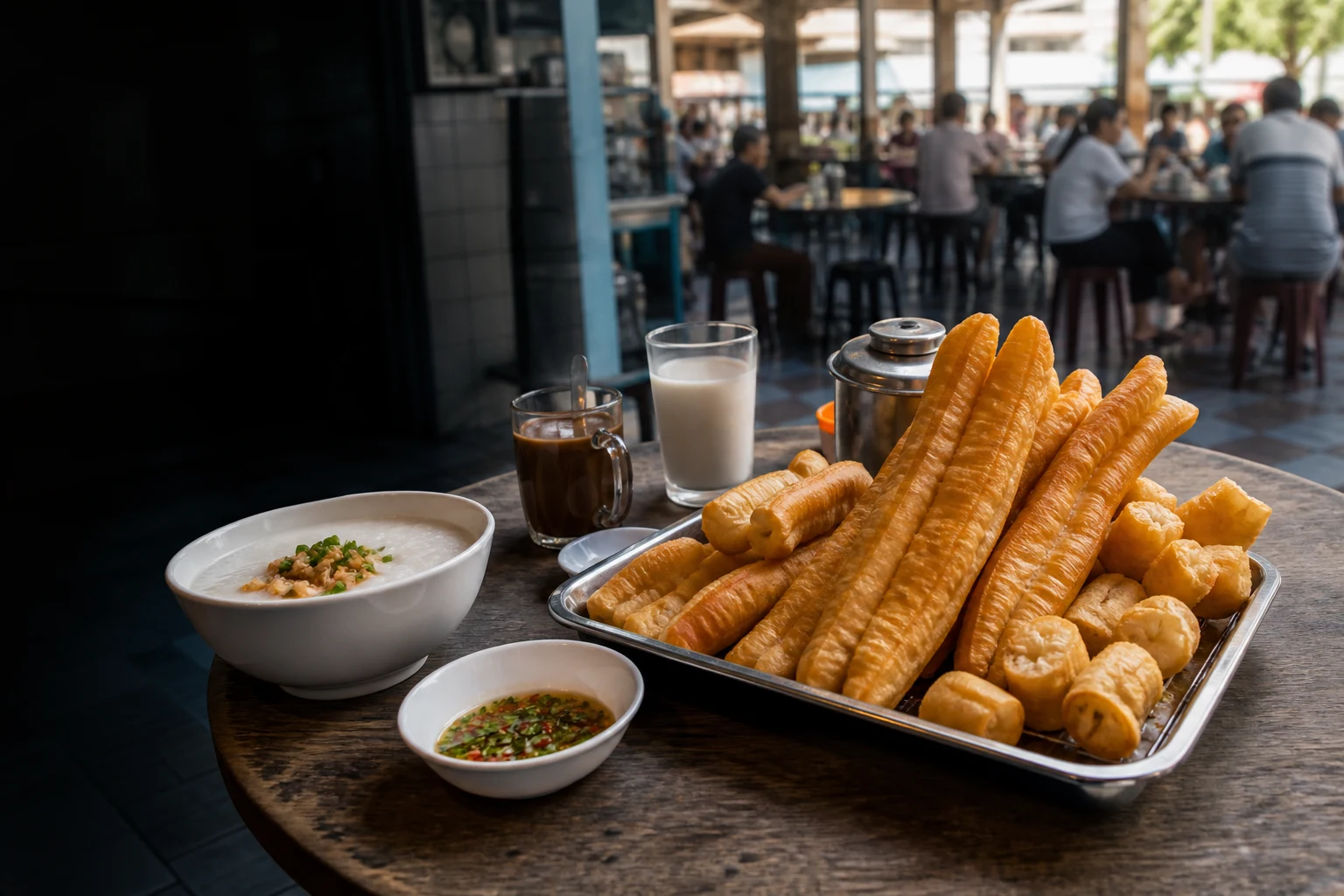
You tiao and regional spellings are familiar in hawker, kopitiam and breakfast settings. Pairings include soy milk, coffee and porridge; pieces can also be used in savoury dishes.
Indonesia
Cakwe is a familiar local name. It may be eaten as a snack, with porridge or cut into other dishes. Local dimensions, sauces and texture expectations should be sampled directly.
Thailand
Pathongko is widely used for fried-dough breakfast foods, often with soy milk, coffee, porridge or sweet dipping accompaniments. The name can cover shapes that are not identical to long Chinese youtiao.
Vietnam
Quẩy is commonly associated with breakfast and can accompany porridge or noodle soups. Shorter pieces and soup use can change the target length, bite and holding quality.
Myanmar and neighbouring markets
Related fried dough sticks appear under local names and breakfast traditions. Treat spelling lists as discovery tools, then verify the actual reference product with local buyers.
When is it eaten?
Breakfast is the dominant cross-market occasion in the published descriptions, particularly with a hot drink, soy milk, congee or soup. Youtiao can also be an all-day snack, an accompaniment or an ingredient. Foodservice production may therefore have a sharp morning peak, while frozen or pre-fried distribution shifts output to a central factory and final frying or reheating closer to sale.
How is it eaten and what is it paired with?
- Dipped: soy milk, coffee, tea or savoury liquid.
- Beside porridge: whole or cut pieces provide crisp contrast to congee.
- Inside a wrap: shaobing, rice noodle roll or glutinous rice adds another texture and controls portion size.
- With soup or noodles: shorter cut pieces absorb liquid while retaining some structure.
- As a snack: eaten plain or with savoury or sweet dips depending on the market.
What international variation changes in a production project
Before quoting a line, collect the local product name, photographs, sample, dimensions, piece weight, sales state, serving time and pairing. A factory selling long fresh breakfast sticks needs a different output and distribution model from a central plant shipping frozen short pieces for soup shops.
A defensible market assessment should combine cultural fit with measurable evidence: local search terms, retailer and foodservice interviews, frozen-food listings, distributor capability, import rules, ingredients and leavening regulations, electricity and oil costs, labour conditions and the required after-sales model. The cultural map tells the sales team where to investigate; it does not replace market research.
Frequently asked questions
Which country buys the most youtiao machinery?
No reliable public country ranking was found, and current HELPER page-level search data is too small to answer. Cultural familiarity is strongest across China and several East and Southeast Asian markets, but machinery demand must be measured separately.
Are cakwe, quẩy and pathongko exactly the same as youtiao?
They belong to the same or closely related fried-dough family, but local shape, size, formula, pairing and name usage can differ. Use samples and photographs before selecting tooling.
What is the most common serving occasion?
Breakfast is the most consistently documented occasion, often with soy milk, congee, coffee or soup. Snack and ingredient uses are also common in particular markets.
Research sources and boundaries
- Zhu, Youtiao: Effect of ingredients and processing on quality attributes, Cereal Chemistry (2024). Review of ingredients, processing and quality relationships.
- Bai et al., Effect of freeze-thaw cycles on frozen youtiao dough, Food Chemistry 386 (2022), 132854.
- Huang et al., Effects of frying conditions and yeast fermentation on acrylamide in you-tiao, Food Research International 41 (2008), 918–923.
- Shyu et al., Frying methods, sensory properties, acrylamide and oil content of youtiao, Applied Sciences 11 (2021), 549.
- Indonesia Travel, Singkawang cuisine. Official tourism content documents the local use and spelling “cakwe” as a fried-dough component.
- Tabla, Nine Types of Dough Fritters (2026). Documents Singapore serving with coffee, soy milk and congee.
Research reviewed 12 August 2026. Cultural descriptions support product and market orientation. Recipe, food-safety, labelling, frying, shelf-life and equipment decisions require product- and destination-specific validation.