
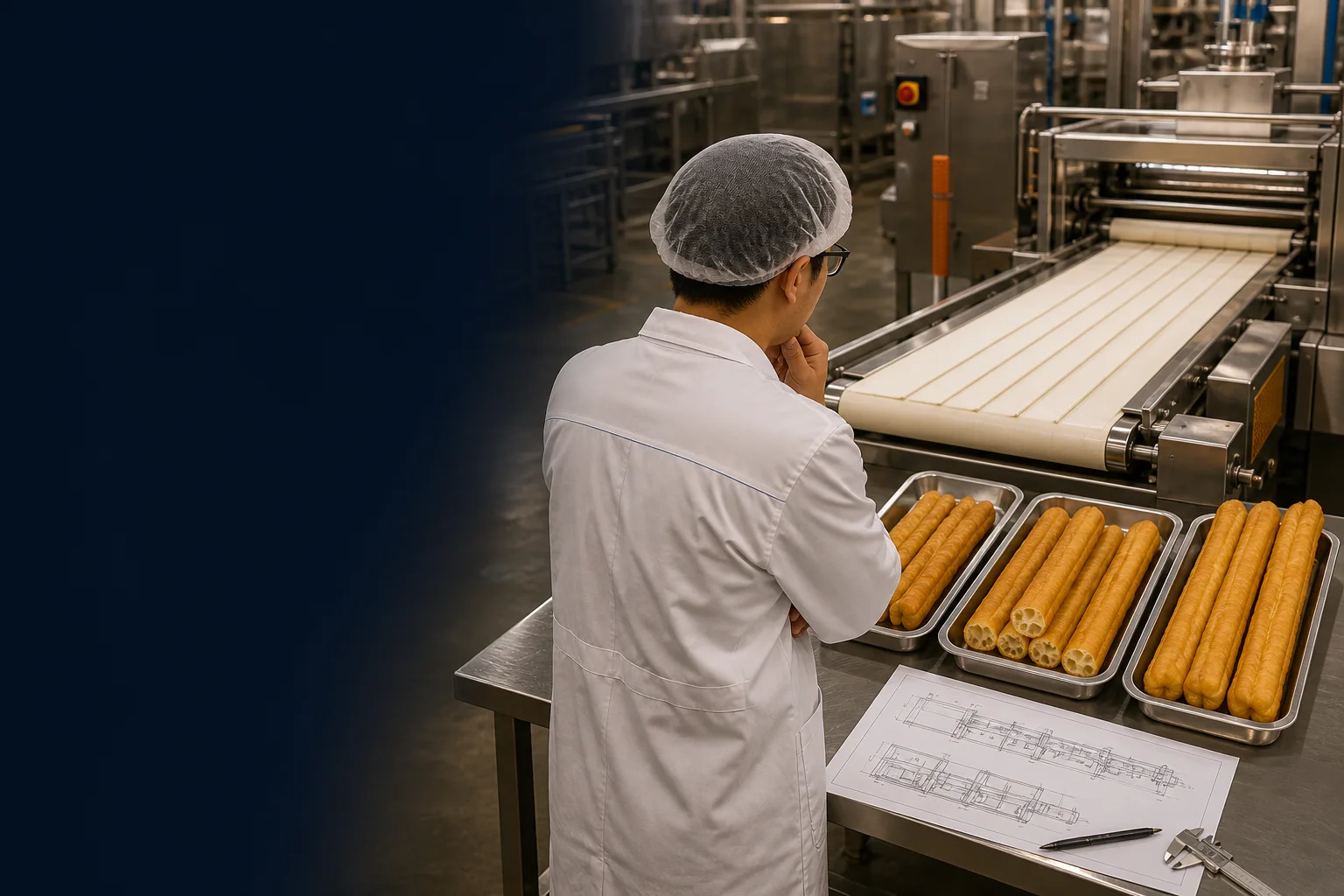
A reference product is the first selection document
Choose the line around a product that the market will accept. Record the local product name, whole and cut photographs, piece weight, dimensions, surface colour, internal cell structure, serving time and whether it is sold fresh, frozen, pre-fried or re-fried. Without that brief, machine comparison becomes a comparison of incomplete specifications.
Five decisions before comparing suppliers
- Product decision: what accepted youtiao leaves the process?
- Process decision: which mixing, resting, forming and frying route produces it?
- Output decision: how much accepted product is needed in the defined window?
- Automation decision: which tasks are variable, labour-heavy or hard to control?
- Factory decision: what space, utilities, hygiene zoning and service skills are available?
Compare proposals on the same basis
| Comparison item | Required evidence |
|---|---|
| Product range | Confirmed size and weight window, tooling and sample-trial result |
| Capacity | Product state, accepted output, run time, yield and stop rules |
| Scope | Named inclusions, exclusions, interfaces and customer responsibilities |
| Utilities | Voltage/frequency, connected and operating load, water, air, exhaust and fuel |
| Cleaning and safety | Access method, materials, guarding and destination-specific review |
| Acceptance | FAT/SAT sample, measurement method and sign-off criteria |
Use a trial to close product risk
A useful trial uses representative flour, formula and rested dough, not only a convenient demonstration dough. Record settings and environmental conditions; measure raw and fried weights, dimensions, rejects, colour and cross-section. If the fryer is outside the supplier scope, define how the forming result will be evaluated.
External factory-acceptance explainer · 6:27 · 4K
Use a documented FAT sequence to turn a supplier trial into evidence
RealPars explains factory acceptance testing through a control-panel example. The sequence shows why a buyer should agree the test scope, prerequisites, expected results and records before arriving at the factory—then extend that discipline to product quality, throughput, sanitation and restart behavior for a youtiao line.
What to carry into a food-line trial
An acceptance run should name the reference product, input state, operators, run duration, sampling points, pass/fail limits, permitted adjustments and final record. A visually successful run without those controls does not close product or capacity risk.
Source and limit: External RealPars engineering education video, published 5 April 2021. Its example is an electrical control-panel FAT, not a food-process trial or proof of any HELPER line. A youtiao project still needs agreed product, throughput, safety, hygiene, cleaning and restart criteria.
Open the original video on YouTubeTurn the winning concept into a contract boundary
The final proposal should name every module, interface, utility and responsibility. Drawings should show installed footprint and maintenance clearance. A brochure image, video or headline capacity is not a replacement for that project record.
Frequently asked questions
Does this guide replace an engineering proposal?
No. It structures the information needed for product trials, equipment selection and a project-specific proposal.
Can capacity be guaranteed from a web page?
No. Capacity must name the product state, accepted quality, run conditions, yield and contractual test method.
Where can I review the actual machinery route?
Use the linked Youtiao Production Equipment Hub, then provide samples, formula, output and factory constraints.
Research and evidence boundary
Food-process context is supported by Zhu, Cereal Chemistry (2024) and Shyu et al., Applied Sciences (2021). HELPER model values and project boundaries must match the applicable catalogue and signed proposal. Reviewed 12 August 2026.