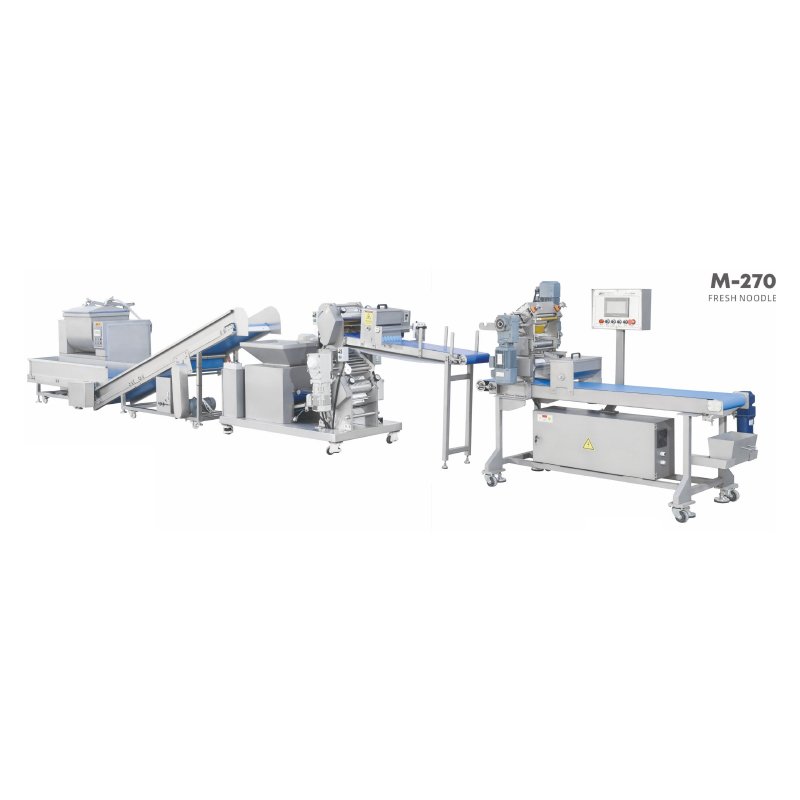
M-270 Automatic Asian Fresh & Dry Noodle Line
M-270 is a compact automatic line for factories developing fresh noodles, egg noodles and dry-fresh formats at 200–400 kg/h published project capacity. It combines dough preparation, continuous rolling and cutting, with optional drying configured around the target shelf-stable product. Its smaller working width reduces the footprint but does not remove the need to control dough development and downstream moisture removal.
Control every stage as one production system
Stable output requires repeatable raw materials, recipes, utilities and downstream handling. HELPER reviews the complete route before confirming equipment, controls and factory layout.
Why process conditions determine machine performance
Fresh and dried noodles can begin on the same forming platform, yet they are different finished processes. Fresh noodles prioritize strand separation, surface condition and short post-forming handling. Dry-fresh or egg noodles add a controlled drying curve: air temperature, humidity, velocity, hanging or belt loading and strand thickness influence cracking, color and final cooking behavior. The dryer must therefore be sized from water removal, not simply matched by nominal line width.
Provide ingredients, moisture, temperature, batch history and the acceptable finished-product standard.
State good finished output after trimming, cooking, drying or freezing—not only raw material input.
Confirm voltage, compressed air, water, steam, drainage, extraction and refrigeration where applicable.
Agree product samples, output duration, quality tolerances and changeover criteria before manufacture.
Interpret published data in the context of your product
The published 200–400 kg/h project range describes the configured forming route; the catalogue lists a maximum 8 m site requirement without packaging. Finished dry output is lower because moisture is removed, and the acceptable throughput may be limited by dryer residence time. Shelf life cannot be inferred from moisture alone; packaging barrier, hygiene, water activity and local food-safety validation are also required.
Final specifications are confirmed after HELPER receives the real recipe, product dimensions, required capacity, factory utilities and available floor plan. Where a source does not publish a value, the project quotation should identify it as a confirmed engineering parameter rather than an assumed catalog figure.
M-270 Automatic Asian Fresh & Dry Noodle Line FAQ
Is the published capacity guaranteed for every product?
No. It defines a reference equipment envelope. Contract capacity is confirmed from the actual recipe, format, acceptance standard and downstream process.
Can the line be customized?
Yes. Working width, cutters or tooling, controls, conveyors and downstream modules are configured after product and factory review.
What is required before quotation?
Provide product samples or photos, formula, dimensions, target output, destination voltage, utilities, floor plan and the required final process.
How is factory acceptance defined?
The order should state test material, run duration, accepted output, weight or dimension tolerances, sanitation checks and the responsibility for downstream equipment.
Specify M-270 Automatic Asian Fresh & Dry Noodle Line from the finished product backwards
A reliable quotation starts with the product and process target rather than a catalogue capacity alone. Provide sheet thickness, dough temperature, hydration, rest time, cutting format and downstream transfer. Samples, drawings and representative raw materials allow the supplier to identify the working configuration and any limits that should appear in the signed specification.
Published capacity is a reference condition, not an unconditional guarantee for every recipe. Sustainable performance must be measured as accepted product after normal rejects and interruptions. The acceptance plan should record sheet uniformity, product dimensions, moisture, texture, trim rate and accepted kilograms per hour. Agree the run duration, staffing, utility conditions and sampling frequency before the factory acceptance test so both parties evaluate the same result.
Confirm voltage and frequency, connected load, compressed air, water, drainage, exhaust or refrigeration where applicable. Check loading height, discharge direction, service clearance, floor loading and the real interface with upstream and downstream equipment.
Review flour dust, dough residue, roller access, belt release and recipe changeover. The sanitation method must suit the machine’s electrical protection and the factory’s documented food-safety program.
Use the intended material and product format. Record start-up loss, stable output, quality variation, alarms, downtime, cleaning time and changeover time. Repeat critical checks after installation with actual site utilities and trained operators.
Send product photos or samples, formula where relevant, target hourly output, shift pattern, pack or downstream format, factory layout and utility schedule. Mark mandatory requirements separately from optional future expansion.
Related decision path
Continue from this page
Configure the equipment around your real product
Send the recipe, sample, target output and factory conditions. HELPER will reconcile the model, modules, utilities and layout.
Ready to discuss your project?
Use our single online inquiry form to send your product, capacity, utility and layout requirements.
Go to contact form