
Which noodle production line should you choose?
Choose the line from the product sold to the customer: fresh chilled, frozen cooked, air-dried or instant. These formats can share mixing and sheeting principles, but their cooking, drying, freezing, cooling, hygiene, packaging and utility requirements are different. Define the recipe, strand geometry, final storage condition and accepted output before selecting equipment.
Who should use this guide?
Noodle manufacturers
Launching a format or replacing an inconsistent manual or semi-automatic process.
Food project teams
Defining complete line scope, utilities, layout and downstream interfaces.
Procurement teams
Comparing proposals on the same product, capacity and acceptance basis.
First choose the finished noodle route
Fresh or chilled noodles
Formed noodles proceed to portioning and packaging without a shelf-stabilizing drying step.
Selection focus: dough consistency, sheet control, cut accuracy, anti-sticking, hygiene, package format and validated chilled shelf-life.
Frozen cooked noodles
Noodles are cooked, cooled, portioned and frozen before cold storage and distribution.
Selection focus: cooking uniformity, cooling, water removal, portion control, freezing conditions, texture after reheating and cold-chain stability.
Air-dried noodles
Formed strands are dried to a specified endpoint, stabilized, cooled and packaged.
Selection focus: temperature, humidity, airflow, residence time, moisture uniformity, cracking, cooking quality and dryer capacity.
Instant noodles
Formed noodles are normally pregelatinized by steaming and dehydrated by frying or another method before cooling and packing.
Selection focus: steaming, block forming, frying or non-fried drying, rehydration, oil control where applicable, cooling and seasoning/packaging integration.
A noodle machine is not automatically a noodle line
Define the commercial scope clearly
A compact noodle machine may combine rolling, slitting and cutting. A complete production line coordinates raw-material dosing, mixing, dough resting, progressive sheeting, cutting, portioning and the required cooking, drying, freezing, cooling and packaging interfaces. If a supplier quotation excludes critical downstream modules, its stated line capacity may not represent saleable product output.
Before comparing quotations
Recognize the shared forming stages.
Use this short animation to identify the machine boundary from mixing through fresh-noodle cutting, then check which downstream modules each supplier includes.
Shared forming process and route-specific modules
Actual sequence varies by noodle and recipe. Equipment should be selected from trial evidence, not by assuming every flour behaves identically under the same vacuum, mixing time, roll reduction or line speed. Research on vacuum mixing shows it can change dough microstructure and texture, while the response also depends on flour strength and process conditions.
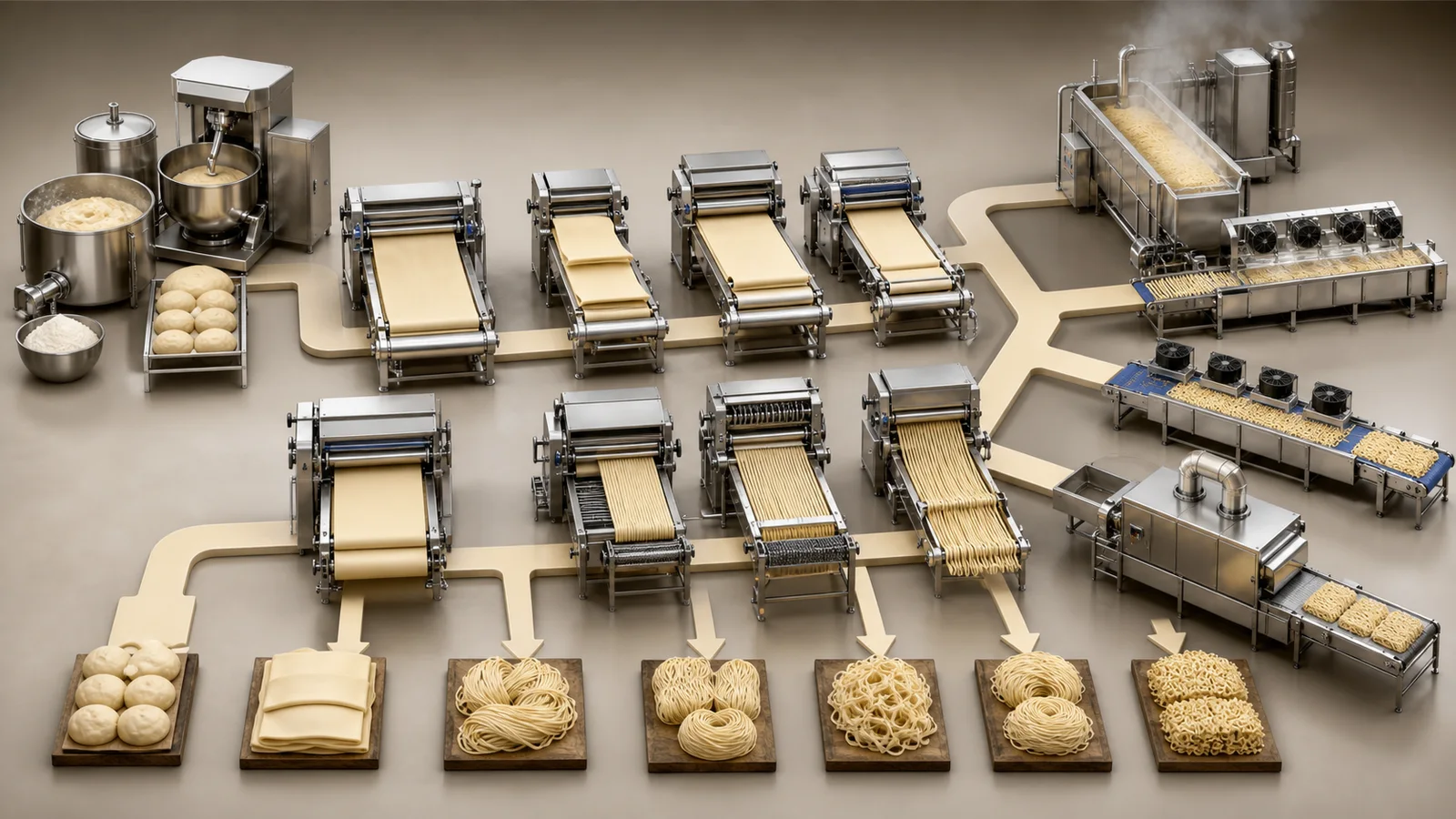
Minimum inputs for noodle-line selection
| Input | What to define |
|---|---|
| Finished product | Fresh, frozen cooked, air-dried or instant; straight, waved or other shape; final storage condition. |
| Recipe | Flour type and variability, water, salt or alkaline ingredients, egg, starch and approved additives. |
| Geometry | Sheet thickness, strand width, length, block or portion weight and acceptable tolerances. |
| Quality | Color, texture, elasticity, cooking loss, breakage, surface condition and reheating performance. |
| Capacity | Accepted kg/h and portions/min, daily output, shifts, product mix, changeovers and operating efficiency. |
| Downstream | Cooking, rinsing, cooling, oiling, freezing, drying, frying, seasoning, inspection and packaging. |
| Food safety | Hazard analysis, water and temperature controls, sanitation method, environmental exposure and shelf-life validation. |
| Factory | Available room, line flow, electrical supply, water, steam, drainage, cooling, refrigeration and exhaust. |
How each module affects line selection
| Module | Selection questions |
|---|---|
| Dosing and mixing | Batch or continuous basis, recipe accuracy, temperature control, vacuum requirement, hydration uniformity and batch traceability. |
| Dough resting | Required time distribution, temperature, humidity, first-in/first-out control and integration with mixer cycles. |
| Sheeting | Roll width, progressive reduction, compound-sheet arrangement, thickness control, edge trim and recipe operating window. |
| Slitting and portioning | Width range, cutter changes, strand length, block/portion mass, dusting or oiling and reject handling. |
| Cooking or steaming | Residence time, temperature profile, product loading, heat transfer, steam/water demand and process verification. |
| Drying or frying | Final endpoint, time, temperature, humidity or oil conditions, product uniformity, energy, exhaust and fire/safety controls. |
| Cooling or freezing | Product entry condition, target core temperature, dwell time, loading pattern, condensation, dehydration and cold-chain interface. |
| Packaging interface | Portion presentation, packs/min, buffer, seasoning, inspection, seal area, coding and secondary packing. |
Size the line from accepted packed output
Required nominal kg/h = accepted daily kg / productive hours /
                planned efficiency
Then test every module against both mass flow and piece or pack rate. A dryer, freezer or cooker must also meet the required residence time and loading profile; simply increasing conveyor speed can reduce process completion.
The constraint may be the mixer cycle, dough rest inventory, sheeter width, thermal residence time, freezer loading or packaging speed. Use accepted finished output after quality rejects, not the highest mechanical speed of the sheeter.
Three interfaces that commonly limit output
Mixing to sheeting
Mixer batch size, cycle time and resting capacity must feed the sheeter without starving it or sending under-rested dough.
Sheeting to treatment
Strand spacing, portioning and conveyor loading must match cooker, steamer, dryer or freezer distribution.
Treatment to packaging
Cooling, dewatering, separation and buffer design must present stable portions at the required pack rate.
What to prove in a noodle-line trial
Product and process evidence
- approved flour lots and actual recipe;
- dough and sheet temperature;
- mixing, resting and roll settings;
- strand dimensions and portion mass;
- cooking, drying or freezing conditions;
- finished and reheated quality.
Performance evidence
- sustained accepted kg/h and portions/min;
- start-up and steady-state rejects;
- operator interventions and stops;
- changeover and cleaning time;
- utility conditions during test;
- downstream acceptance and buffer behavior.
One short demonstration with a convenient flour does not establish the operating range. Include representative normal and difficult materials, defined test duration, sample frequency and pass/fail criteria.
Worked example: 500 kg/h fresh ramen project
Translate the sales target into a line specification
- Product
- Fresh alkaline ramen in two strand widths, packed in 150 g portions.
- Accepted output
- 500 kg/h good product, equivalent to about 55.6 portions/min before any multi-pack grouping.
- Shared process
- Controlled dosing, vacuum mixing if trials support it, resting, compound sheeting, progressive reduction and slitting.
- Downstream
- Length cutting, portion control, anti-sticking method, short buffer and primary packaging.
- Trial criteria
- Thickness and width tolerance, portion weight, appearance, cooking texture, reject rate and sustained accepted output.
- Open risks
- Flour variability, chilled shelf-life, sanitation method, package atmosphere and packaging-line speed require separate validation.
Common noodle-line selection mistakes
Do not change product meaning to fit a machine category
- Calling a sheeting/cutting machine a complete production line.
- Using fresh noodle output to size a frozen cooked or dried product project.
- Ignoring dough rest time and inventory between batch mixing and continuous sheeting.
- Assuming vacuum mixing always improves every flour at every setting.
- Sizing a dryer or freezer from belt speed without residence-time and loading checks.
- Leaving portioning and packaging outside the capacity guarantee.
- Accepting nominal speed without finished-product quality and reject criteria.
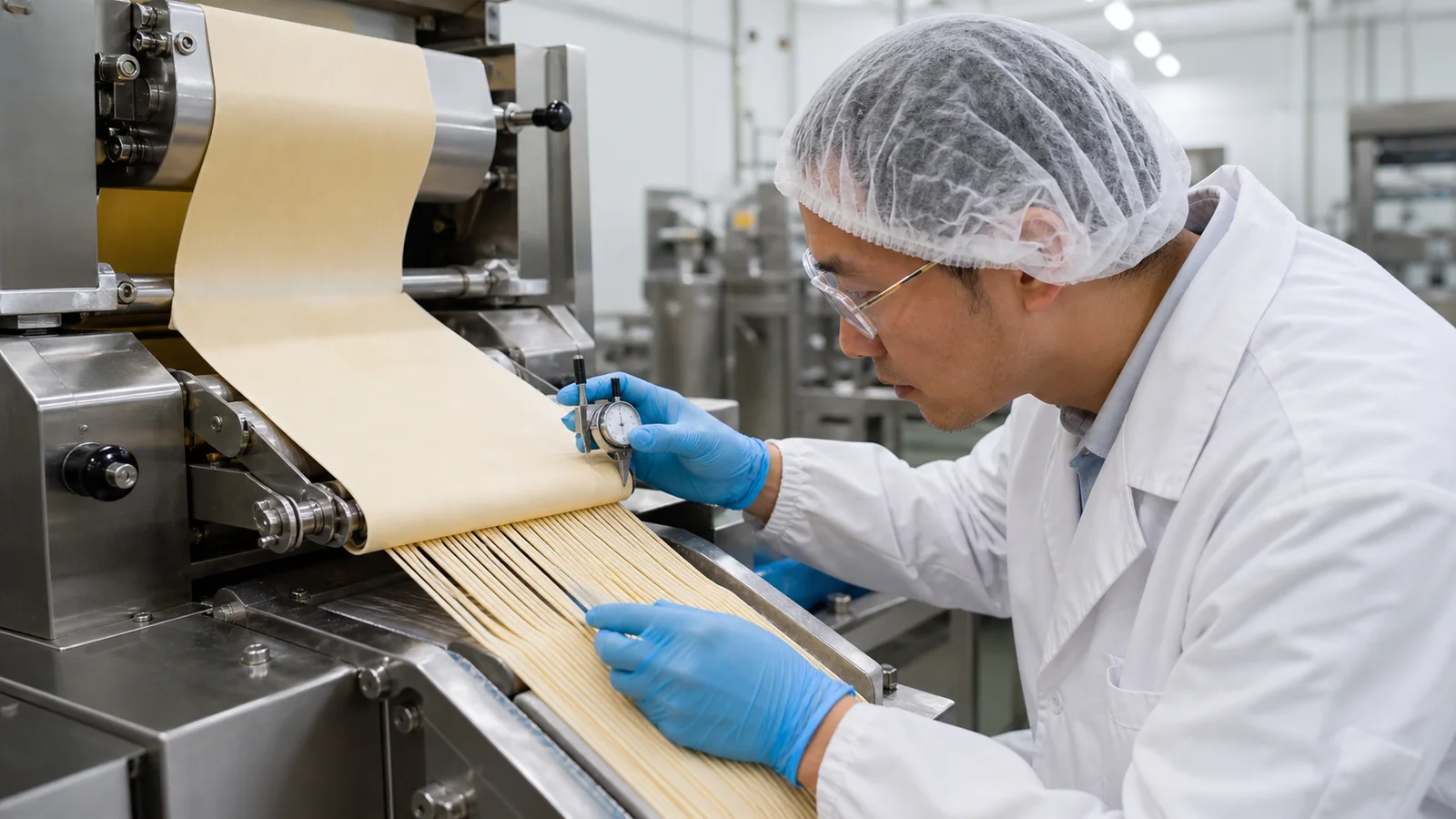
Noodle production line enquiry checklist
- Name the final noodle format.
- State chilled, frozen, dried or ambient storage.
- Provide flour and complete approved recipe.
- Define sheet and strand dimensions.
- Define portion or noodle-block weight.
- State accepted kg/h and portions/min.
- Provide daily schedule and changeovers.
- Define cooking or steaming requirements.
- Define drying, frying or freezing endpoint.
- State packaging format and pack speed.
- List utilities and factory constraints.
- Define sanitation and allergen controls.
- Provide representative trial materials.
- Agree finished-quality measurements.
- Define FAT duration and acceptance basis.
- Confirm downstream scope and exclusions.
How to compare noodle production line suppliers
Compare one defined scope
Give every supplier the same noodle format, recipe range, accepted output, downstream route, utilities, sanitation method and package interface. Record exclusions so a lower quotation is not mistaken for an equivalent complete line.
Require representative evidence
Compare trial material, sustained run duration, strand dimensions, cooking or drying result, reject criteria, cleaning access, FAT/SAT deliverables, training, manuals and spare-parts support.
Use the industrial noodle production line catalogue for available equipment routes, then send the same project brief for engineering review.
Research sources and boundaries
- Codex CXS 249-2006, Standard for Instant Noodles. The current Codex file records 2023 amendments to methods of analysis and sampling. Use it for products within its scope and check destination-market requirements separately. Accessed 7 August 2026.
- Liu et al., Influence of Vacuum Mixing on Structural Characteristics and Physical Properties of Noodle Dough, Cereal Chemistry 93 (2016), 226-233. The study shows vacuum level can affect dough structure and texture and that flour strength changes the response. DOI 10.1094/CCHEM-06-15-0114-R.
- Pan et al., Effects of Freezing Treatments on the Quality of Frozen Cooked Noodles. The study reports that freezing conditions and flour both affected frozen cooked noodle microstructure and texture. Journal of Food Science and Technology 57 (2020), 1926-1935.
- Moon et al., Effects of flour quality and drying rates controlled by temperature, air circulation, and relative humidity on dried white-salted noodles. Cereal Chemistry (2019), DOI 10.1002/cche.10206.
- Li et al., Critical conditions accelerating the deterioration of fresh noodles. The study addresses temperature, pH, water content and water activity, supporting the need for product-specific shelf-life validation. Journal of Food Processing and Preservation 41 (2017), e13173.
Research date: 7 August 2026. This guide supports preliminary process and equipment selection. Recipe safety, shelf life, thermal process, refrigeration, oil management, drying endpoint and legal compliance require product-specific validation by qualified teams.
Noodle production line selection FAQ
What information is needed to select a noodle production line?
Define noodle type, flour and recipe, final moisture or storage condition, strand dimensions, accepted output, package format, cleaning method, utilities and trial criteria.
What is the difference between a noodle machine and a noodle production line?
A noodle machine may perform limited forming operations such as sheeting and cutting. A production line integrates preparation, forming and the required downstream cooking, drying, freezing, cooling or packaging interfaces.
Can one line make fresh, dried and instant noodles?
Some preparation and sheeting modules may be shared, but downstream processes and controls are materially different. Select the complete line for defined products rather than assuming universal production.
How should noodle-line capacity be verified?
Verify sustained accepted output using representative flour and recipes, agreed dimensions and quality criteria, and the complete downstream process rather than only sheeter speed.
Identify the correct noodle-line direction
Use the selector to organize the finished format, target capacity and downstream process before requesting technical confirmation.
Open noodle line selector Estimate noodle output