
What makes food equipment hygienically designed?
Hygienic suitability is not a material label or a single surface value. It is a risk-based result of compatible food-contact materials, cleanable geometry, drainage, accessibility, separation of food from contamination sources and correct installation. Every judgment must be tied to the equipment's intended use, product hazards and validated cleaning method.
Who should use this guide?
Food safety teams
Translate product hazards, allergens and sanitation controls into equipment requirements.
Project engineers
Review design, installation and factory interfaces before equipment approval.
Procurement teams
Request evidence instead of accepting broad food-grade or stainless-steel claims.
Start with intended use and hygienic risk
The same construction is not equally suitable for every process. Define the product and operating conditions before reviewing details.
Document these conditions first
- Is food exposed, enclosed or fully packaged?
- Is the product raw, ready-to-eat, post-lethality or shelf-stable?
- Can the product support microbial growth, and what time/temperature exposure occurs?
- Are allergens, species changes or incompatible recipes processed?
- Is cleaning wet, dry, COP, CIP or a combination?
- Which chemicals, temperatures, pressures and mechanical actions are used?
- Can condensation, aerosols, lubricant, metal fragments or environmental water reach food?
- What inspection and verification access is required after cleaning?
A supplier cannot establish hygienic suitability without these inputs. The user and supplier should agree the intended use and operating limits in the equipment specification.
Five hygienic design principles
EHEDG describes five foundational principles in its fourth edition of Guideline 8. They should be evaluated together, not as independent marketing features.
Material compatibility
Materials remain suitable for food, product chemistry, cleaning agents, temperature and mechanical exposure.
Cleanability
Soil can be removed to the required level using the defined cleaning procedure.
Drainability
Product and cleaning liquids do not remain in unintended pools or hidden retention sites.
Accessibility
Surfaces can be reached, inspected, maintained and reassembled without creating new hazards.
Segregation
Food and food-contact zones are protected from contaminants and incompatible process areas.
What to inspect on the equipment
Food-contact materials
- documented material identity;
- compatibility with food and cleaning chemistry;
- migration or contact compliance where applicable;
- traceability of elastomers, plastics, belts and coatings;
- condition after repeated use and cleaning.
Geometry and joints
- smooth, continuous product-contact paths;
- no unintended gaps, laps or capillary crevices;
- hygienic weld and joint condition;
- protected threads and fasteners;
- controlled dead spaces in closed systems.
Drainage and retention
- self-draining product and cleaning surfaces;
- no hidden liquid traps in frames or guards;
- controlled condensate paths;
- drainable piping and valve arrangements;
- safe discharge away from food zones.
Access and dismantling
- visibility of critical surfaces;
- tooling removal without contamination;
- safe access for cleaning and inspection;
- repeatable seal and part reassembly;
- no unverified shadow zones.
Seals and moving interfaces
- seal design suited to movement and pressure;
- food protected from bearing and gearbox zones;
- controlled lubricant risk;
- wear debris considered;
- inspection and replacement intervals defined.
Non-product zones
- frames and covers do not collect soil or water;
- cables and hoses are cleanably routed;
- panels withstand the sanitation environment;
- hollow structures are controlled;
- maintenance does not contaminate food zones.
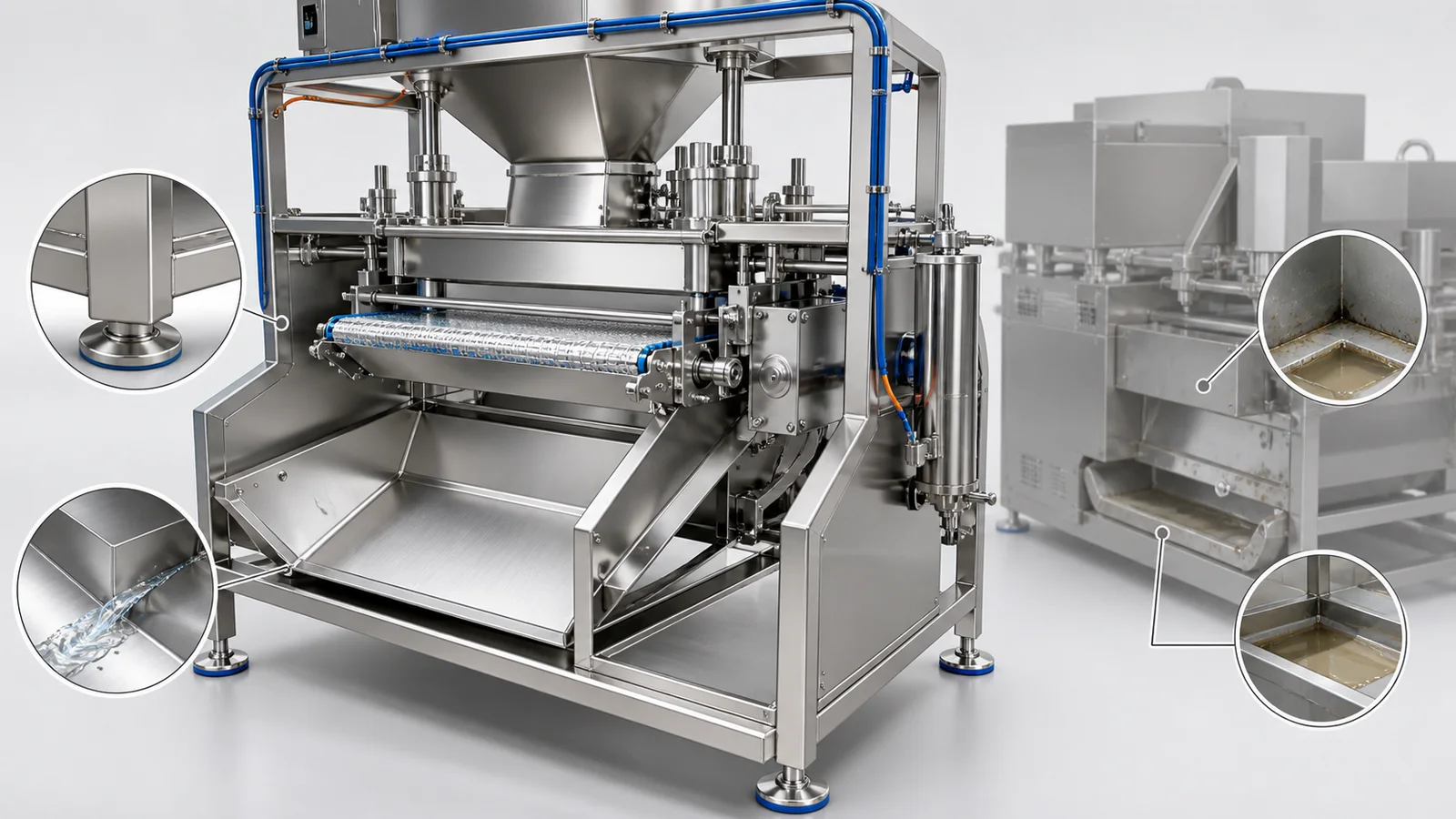
Define hygienic zones instead of calling the whole machine food grade
| Zone | Typical exposure | Review focus |
|---|---|---|
| Direct food contact | Surfaces intentionally contacting product or from which material can return to product. | Material compliance, cleanability, drainage, joints, residues and cleaning verification. |
| Splash or indirect transfer | Surfaces from which liquid, condensate, dust or fragments may reach food-contact zones. | Contamination paths, runoff, overhead structures, guards, fasteners and maintenance access. |
| Non-product zone | External frames, drives, supports and service areas without intended product transfer. | Soil accumulation, pest harborage, corrosion, washdown resistance and separation. |
| Factory interface | Floor, wall, platform, drain, conveyor, pipe, cable and ventilation connections. | Cleanable clearance, sealing, drainage, cross-flow, condensation and access after installation. |
Food-contact material compliance is use-specific
For EU markets, Regulation (EC) No 1935/2004 establishes the general framework for materials and articles intended to contact food, including food-processing equipment. The regulation's central principle is that materials should not transfer constituents to food at levels that endanger health or unacceptably change the food.
Do not write only "food-grade stainless steel" in a specification
Request the exact material, affected components, documentation, intended food/contact conditions and cleaning exposure. Also identify non-metallic contact components such as seals, scrapers, hoses, belts, plastics, adhesives and coatings. Legal requirements vary by destination market and material type.
Match equipment design to the cleaning method
| Cleaning approach | Design questions | Evidence required |
|---|---|---|
| Dry cleaning | Can dust and residues be removed without introducing water? Are ledges, hollow areas and inaccessible cavities controlled? | Access demonstration, vacuum or dry-cleaning procedure, visual inspection points and residue criteria. |
| Open wet cleaning | Can all wetted surfaces withstand chemistry and drain? Are electrical, bearing and frame zones protected? | Cleaning trial, drainage observation, chemical compatibility and post-clean inspection. |
| COP | Can removable parts be safely identified, removed, cleaned, inspected and correctly reassembled? | Part map, handling method, cleaning parameters, reassembly checks and loss/damage controls. |
| CIP | Are flow, temperature, chemistry, time and coverage measurable across the complete circuit? | Defined circuit, instrument points, recipe records, coverage evidence and validation protocol. |
Cleaning instructions describe how to clean. Cleaning validation demonstrates that the defined process consistently achieves the required result under stated conditions. Verification then confirms routine execution remains under control.
Installation can destroy a hygienic machine design
- Keep clearances sufficient for cleaning, inspection and maintenance.
- Seal or support floor, wall and platform interfaces so they do not create retention sites.
- Route cables, hoses and pipes cleanably and protect food from leaks or condensate.
- Manage slopes and drainage so water does not move from lower-hygiene to higher-hygiene zones.
- Avoid overhead contamination from utilities, structures, ventilation and maintenance work.
- Reassess hygienic risk when equipment is modified, connected or relocated.
How to verify hygienic design
Design review
Review drawings, zones, materials, joints, seals, drainage, access, cleaning method and installation interfaces before fabrication is frozen.
Factory inspection
Inspect actual construction, finish, welds, retention points, dismantling and cleaning access. Record deviations and closure evidence.
Site validation
Validate cleaning and contamination controls with installed utilities, products, soils, operators and routine procedures.
A certificate may support a review but does not automatically cover the complete machine, its final installation, every product or every cleaning method. Confirm scope, model, configuration, date and intended application.
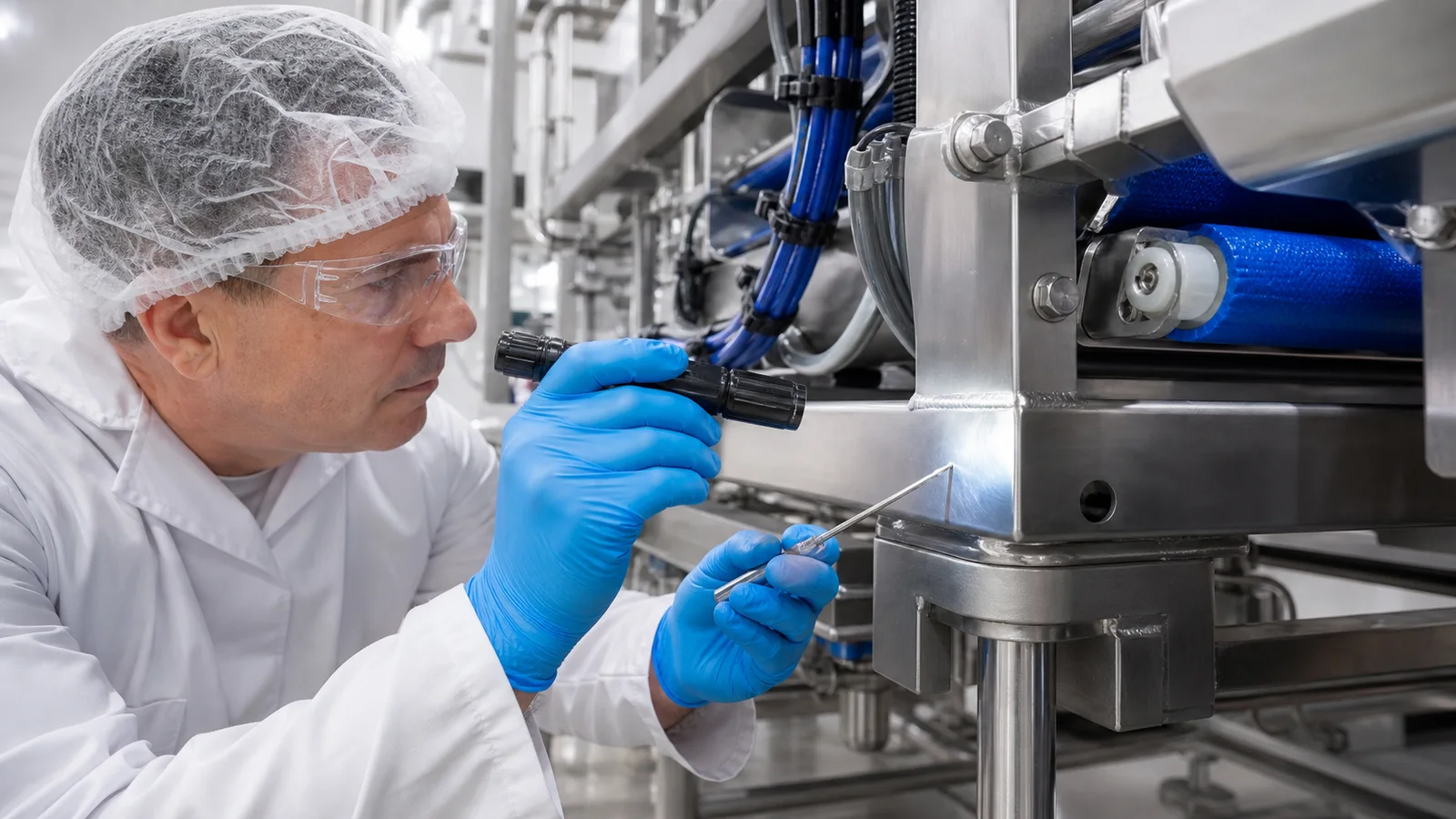
Hygienic equipment procurement checklist
- Define intended products and process limits.
- Identify direct and indirect food-contact zones.
- Document wet, dry, COP or CIP cleaning.
- List allergen and cross-contact scenarios.
- Request material identity and contact documentation.
- Review joints, seals, hollow sections and fasteners.
- Confirm drainage and condensate control.
- Demonstrate cleaning and inspection access.
- Review lubricants, bearings and wear risks.
- Check frames, panels, cables and hoses.
- Review floor, wall, drain and utility interfaces.
- Define dismantling and reassembly controls.
- Agree cleaning trial conditions.
- Set residue, allergen or microbial criteria as applicable.
- Define documentation and training deliverables.
- Reassess after site installation or modification.
Sources and edition control
- EHEDG Guideline 8, Hygienic Design Principles, Fourth Edition, December 2025. EHEDG identifies material compatibility, cleanability, drainability, accessibility and segregation as the foundational risk-based principles. Accessed 7 August 2026.
- ISO 14159:2002, Safety of machinery - Hygiene requirements for the design of machinery. ISO lists the 2002 edition as published but due for revision; ISO/DIS 14159 is under development. Project specifications should record the applicable published edition and monitor replacement status. Accessed 7 August 2026.
- U.S. FDA, Guide to Minimize Food Safety Hazards of Fresh-cut Produce. Its equipment section summarizes 21 CFR 117.40 requirements for adequate cleanability, maintenance and contamination prevention. Accessed 7 August 2026.
- Codex CXC 1-1969, General Principles of Food Hygiene. Codex lists the text with a 2022 revision and uses it as the international baseline for good hygiene practices and HACCP. Accessed 7 August 2026.
- Regulation (EC) No 1935/2004 on food-contact materials and articles. The framework applies to materials and articles, including food-processing equipment, intended or likely to contact food. Check current consolidated law and material-specific measures for the destination market. Accessed 7 August 2026.
Research date: 7 August 2026. This guide is a preliminary design-review aid. It does not certify a machine, establish legal compliance for a destination market or replace a documented hazard analysis, cleaning validation or machinery risk assessment.
Hygienic equipment design FAQ
What makes food processing equipment hygienically designed?
Hygienic suitability combines compatible materials, cleanable geometry, drainage, accessibility, segregation and correct installation for the defined product and cleaning method.
Does stainless steel make a machine hygienic?
No. Material is only one factor. Geometry, joints, seals, drainage, access, surface condition and cleaning validation also determine suitability.
Is one hygienic design suitable for every food process?
No. Requirements change with intended use, product risk, exposed or enclosed handling, wet or dry cleaning, allergens, temperature and post-lethality contamination risk.
How should hygienic design be verified before purchase?
Review drawings and materials, inspect construction, perform representative cleaning and product trials, and define measurable factory and site acceptance criteria.
Include hygienic requirements in equipment selection
Use the selection guide to connect intended use, hygienic risk, capacity and acceptance requirements in one procurement process.
Open equipment selection guide