
What is the correct way to select food processing equipment?
Define the finished product, raw-material range, process conditions and accepted output first. Convert them into a user requirement specification, then compare only technically compliant equipment for hygiene, safety, line integration, lifecycle cost and support. Complete representative product trials and agree measurable factory and site acceptance tests before purchase.
Who should use this guide?
Food manufacturers
Buying a first machine, expanding capacity or adding a new SKU.
Project engineers
Defining equipment interfaces, utilities, layouts and acceptance tests.
Procurement teams
Comparing supplier proposals against one controlled requirement set.
Eight-step food equipment selection framework
Define intended use
State products, raw materials, process limits, operators, cleaning regime, operating environment and foreseeable misuse. A machine suitable for dry dough may not be suitable for exposed ready-to-eat food or aggressive wet cleaning.
Describe accepted product
Specify weight, dimensions, shape, temperature, texture, fill ratio, appearance, tolerance and reject definition. Use accepted finished output as the commercial basis.
Map the complete process
Identify upstream supply, preparation, forming, thermal treatment, cooling, inspection, buffering and packaging. The selected machine must fit the process interfaces, not operate as an isolated catalogue item.
Calculate required effective capacity
Start from daily accepted demand and operating time. Include product changeovers, sanitation, planned stops, start-up loss, rejects and realistic operating efficiency.
Write the user requirement specification
Separate mandatory requirements, preferred features and supplier proposals. Define evidence for every mandatory item so compliance can be tested rather than assumed.
Screen hygiene, safety and integration
Review product-contact materials, cleanability, drainage, access and cross-contact risks together with mechanical, electrical, ergonomic and control-system risks.
Run representative product trials
Test difficult and normal products using representative raw materials. Record stable accepted output, quality, rejects, settings, operator interventions and cleaning observations.
Agree FAT, SAT and handover
Define test scope, duration, instruments, responsibilities, pass criteria, punch-list closure, training, documentation, spares and final site performance before the purchase order is released.
Minimum data for a useful equipment enquiry
| Requirement group | Information to provide |
|---|---|
| Product | Food name, recipe class, photos or drawings, target weight and dimensional tolerances. |
| Raw material | Temperature, moisture, viscosity, particle or inclusion size, variability and allergen status. |
| Process | Required operation, critical temperatures or times, infeed condition and discharge condition. |
| Capacity | Accepted kg/h, pieces/min or packs/min; daily target; shifts; operating days and peak demand. |
| Cleaning | Wet, dry, COP or CIP method; chemicals; temperature; frequency; changeover and validation needs. |
| Factory | Room dimensions, access route, floor loading, drainage, environmental conditions and zoning. |
| Utilities | Voltage/frequency, installed power limits, water, steam, compressed air, refrigeration and exhaust. |
| Interfaces | Upstream feed, downstream acceptance, conveyor heights, controls, communication and buffer policy. |
| Compliance | Destination-market regulations, company standards, guarding, documentation and certification needs. |
| Acceptance | Test product, duration, sample plan, capacity, quality, reject, sanitation and documentation criteria. |
Select capacity from accepted output
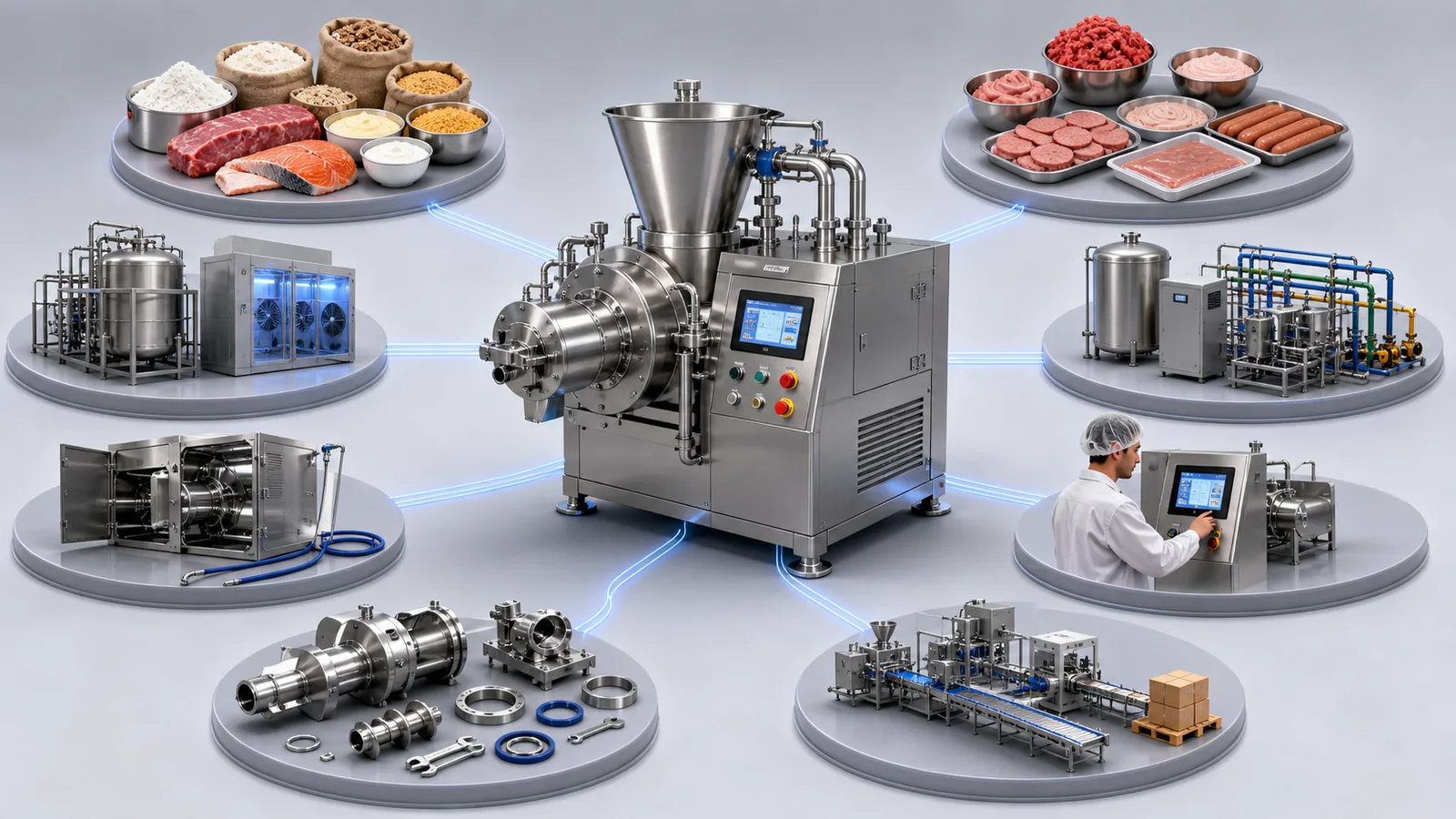
Required nominal output = accepted production target / planned operating efficiencyIf accepted demand is 500 kg/h and a defensible preliminary operating efficiency is 80%, the screening requirement is 625 kg/h nominal. This is only a starting point: batch timing, product behavior, rejects and the constraint machine must still be checked.
Do not apply one universal efficiency value. Establish assumptions from the product, process, shift pattern, sanitation schedule and comparable operating evidence. A line can only sustain the effective capacity of its constraint stage.
Compare compliance before price
Hygiene and safety are separate, mandatory reviews
Hygienic design protects food from contamination and supports effective cleaning. Machinery safety protects people across transport, installation, operation, cleaning, maintenance and foreseeable misuse. A machine can perform well and still fail one of these reviews.
Do not accept a material claim as a complete hygienic assessment
Stainless steel alone does not prove hygienic suitability. Review geometry, joints, seals, hollow sections, fasteners, drainage, surface condition, access, dismantling, cleaning method and installation interfaces for the defined intended use.
Define FAT and SAT before ordering
Factory Acceptance Test
Before shipment, verify agreed construction, controls, alarms, recipes, guarding, documentation and product performance that can be tested at the supplier's facility.
- approved test procedure;
- representative product and conditions;
- calibrated measurement method;
- pass/fail criteria and deviations;
- punch-list responsibility and retest.
Site Acceptance Test
After installation, verify equipment under the final utility, layout, line-interface and operating conditions. SAT does not replace commissioning or long-term process validation.
- installation and utility checks;
- upstream/downstream integration;
- safety and interlock checks;
- site product and performance test;
- training, handover and open-item closure.
IEC 62381:2024 specifically structures FAT, FIT, SAT and SIT for automation systems. For food equipment, adapt the test plan to the machine, product and contractual specification rather than claiming that this automation standard certifies food-process performance.
What should a supplier's trial video prove?
Trial-evidence guidance reviewed: 12 September 2026.
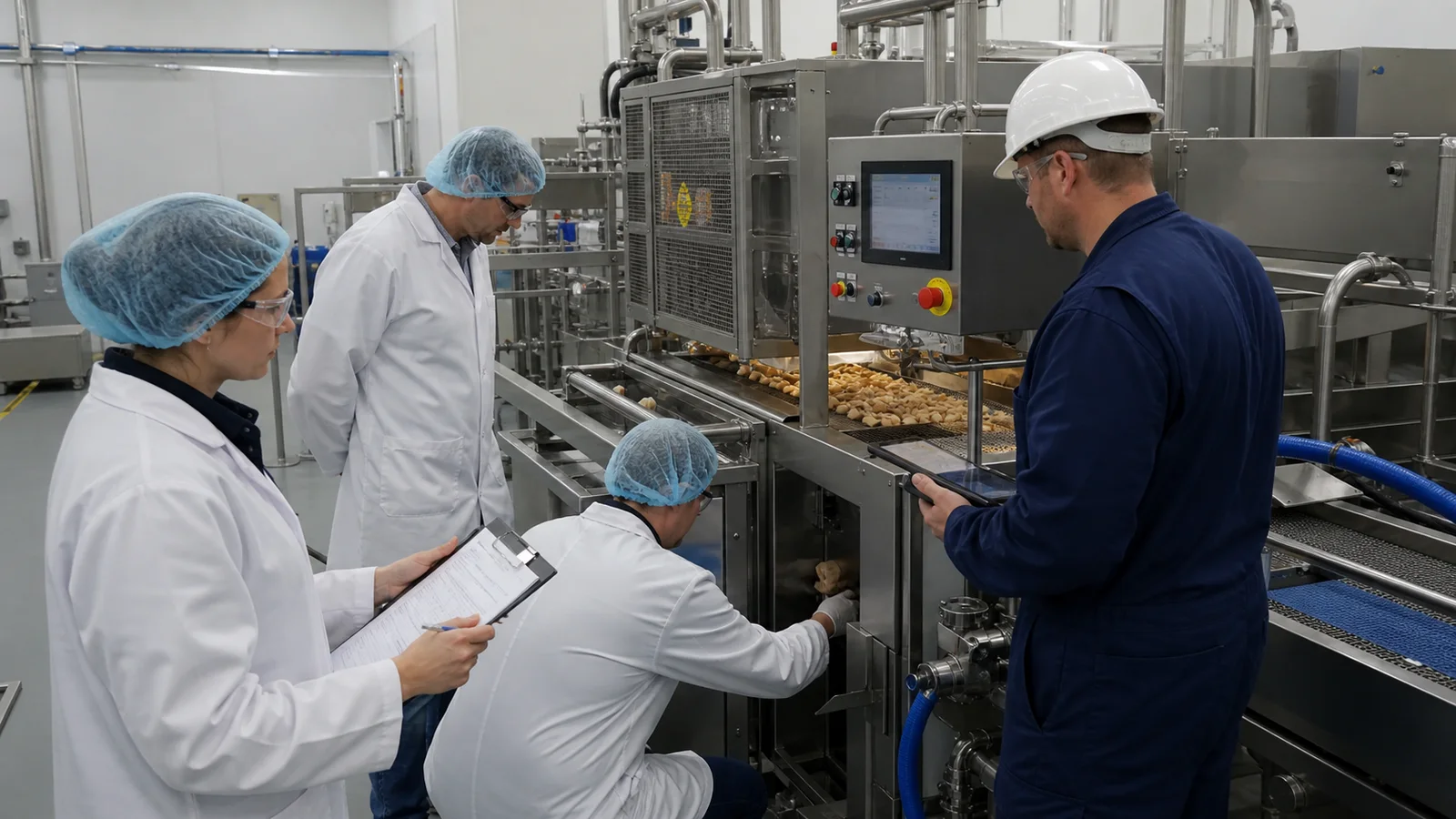
Use a demonstration to identify questions for the product trial. Before treating the result as acceptance evidence, ask the supplier to connect the recording to a named sample, machine configuration and measured result. Agree this evidence pack alongside the FAT procedure.
- Identify the input. Record the sample or batch ID, product variety, preparation and relevant measured condition. Link these details to the material shown entering the machine.
- Identify the setup. Record the machine model, installed tooling and agreed operating settings. Confirm whether the demonstrated configuration is the one included in the quotation.
- Show the agreed run. Request an uninterrupted record of the agreed test interval, supported by a run log for stops, adjustments and operator interventions. A highlight clip can accompany the record.
- Measure the result. Link the output sample IDs to dimensions, accepted quantity, rejects and elapsed time using the agreed sampling and measurement method. Keep close-up photographs with a scale where dimensions matter.
- Close the open points. Record deviations, exclusions, responsibilities and any retest required. Confirm separately what will be checked after installation during SAT.
For example, Urschel describes product trials with a written report and optional photographs or video, including remote attendance. Its cheese-dicing application guidance also identifies product temperature, moisture and speed settings as influences on the result. These are external examples supporting the need to document actual trial conditions; they are not HELPER service commitments or performance figures.
A caption stating a cut size and a close-up of finished pieces do not establish a measured tolerance or sustained accepted output. In the externally published Urschel Asia cheese-stick demonstration, the selected frame shows product and a size caption. Use that distinction when requesting the corresponding measurement sheet from your supplier. This is third-party footage, not a HELPER test; no capacity or dimensional compliance is inferred from it.
Watch the trial: from product input to finished pieces
Watch for the material presented at the feed area near 0:02 and the finished-product close-up with a size caption near 0:27. Compare what is visible with the evidence checklist above.
Clicking Load video connects to YouTube. Then press Play in the player. YouTube may use cookies and process device and usage information under its own privacy policy.
External video: Urschel Asia. This is not HELPER equipment or a HELPER acceptance test. The written explanation above remains the basis for interpreting the demonstration. Open on YouTube if the player is unavailable.
For a HELPER enquiry, review the relevant equipment family and attach your product targets, trial conditions and open acceptance questions to the project brief. Then discuss the proposed trial scope.
Worked selection example: filled dumpling line
Requirements translated into testable criteria
- Product
- 22 g filled dumpling, defined wrapper thickness, filling ratio and seal-quality limits.
- Accepted demand
- 12,000 good pieces/hour after rejects, with two planned product changeovers per shift.
- Process interfaces
- Controlled dough sheet and filling supply; tray loading before freezing.
- Hygiene
- Wet-cleaned food zone, allergen changeover, removable tooling and inspection access.
- Trial
- Actual dough and filling over a defined sustained run, recording good pieces, rejects and operator stops.
- Acceptance
- Agreed output and weight tolerance, seal integrity, changeover time, cleaning access and complete documentation.
The correct comparison is not simply machine A versus machine B in pieces per minute. It is which compliant system repeatedly produces the specified accepted dumpling within the actual factory constraints.
Common selection mistakes
- Choosing from machine name or maximum catalogue speed before defining the finished product.
- Comparing nominal output with accepted output without a common efficiency and reject basis.
- Assuming one successful sample proves the entire raw-material and SKU range.
- Reviewing stainless-steel grade but not equipment geometry, drainage or cleaning access.
- Leaving conveyors, cooking, cooling, packaging and control interfaces outside the supplier scope.
- Defining FAT after manufacturing is complete, when disagreements are expensive to correct.
- Comparing purchase price before confirming technical compliance and lifecycle effects.
Sources and current-edition notes
- U.S. FDA, Guide to Minimize Food Safety Hazards of Fresh-cut Produce. The equipment section summarizes 21 CFR 117.40 requirements for adequate cleanability, maintenance and protection against contamination. Accessed 7 August 2026.
- ISO 14159:2002, Safety of machinery - Hygiene requirements for the design of machinery. ISO lists the published edition as current but due for revision; ISO/DIS 14159 is under development. Accessed 7 August 2026.
- EHEDG Guideline 8, Fourth Edition, Hygienic Design Principles. EHEDG describes a risk-based approach linked to intended use and operating conditions. Published December 2025; accessed 7 August 2026.
- ISO 12100:2010, Safety of machinery - General principles for design - Risk assessment and risk reduction. ISO records the 2010 edition as published and confirmed in 2022, with a successor draft under development. Accessed 7 August 2026.
- IEC 62381:2024, Automation systems in the process industry - FAT, SAT and SIT. Used only as a structured reference for acceptance planning of automation systems. Accessed 7 August 2026.
Research date: 7 August 2026. This guide provides preliminary equipment-selection guidance and does not replace jurisdiction-specific legal review, food-safety validation, machinery risk assessment or a signed technical specification.
Food processing equipment selection FAQ
What information is needed before selecting food processing equipment?
Define the finished product, raw-material range, accepted output, process conditions, cleaning method, utilities, line interfaces and measurable acceptance criteria.
Is nominal machine capacity enough for equipment selection?
No. Use accepted output after realistic operating efficiency, rejects, changeovers, cleaning and upstream or downstream constraints.
What is the difference between FAT and SAT?
FAT is performed before shipment at the supplier or integration site. SAT is performed after installation to verify equipment in final site conditions and interfaces. The exact scope must be agreed in the contract.
Should the lowest-priced compliant machine be selected?
Price comparison begins only after technical compliance. Then compare installed cost, utilities, labor, yield, sanitation time, maintenance, spares, downtime risk and lifecycle support.
Turn the requirements into a preliminary equipment direction
Use the general selector to identify an equipment family, then organize the confirmed and open requirements in a project brief.
Open equipment selector Create project brief