
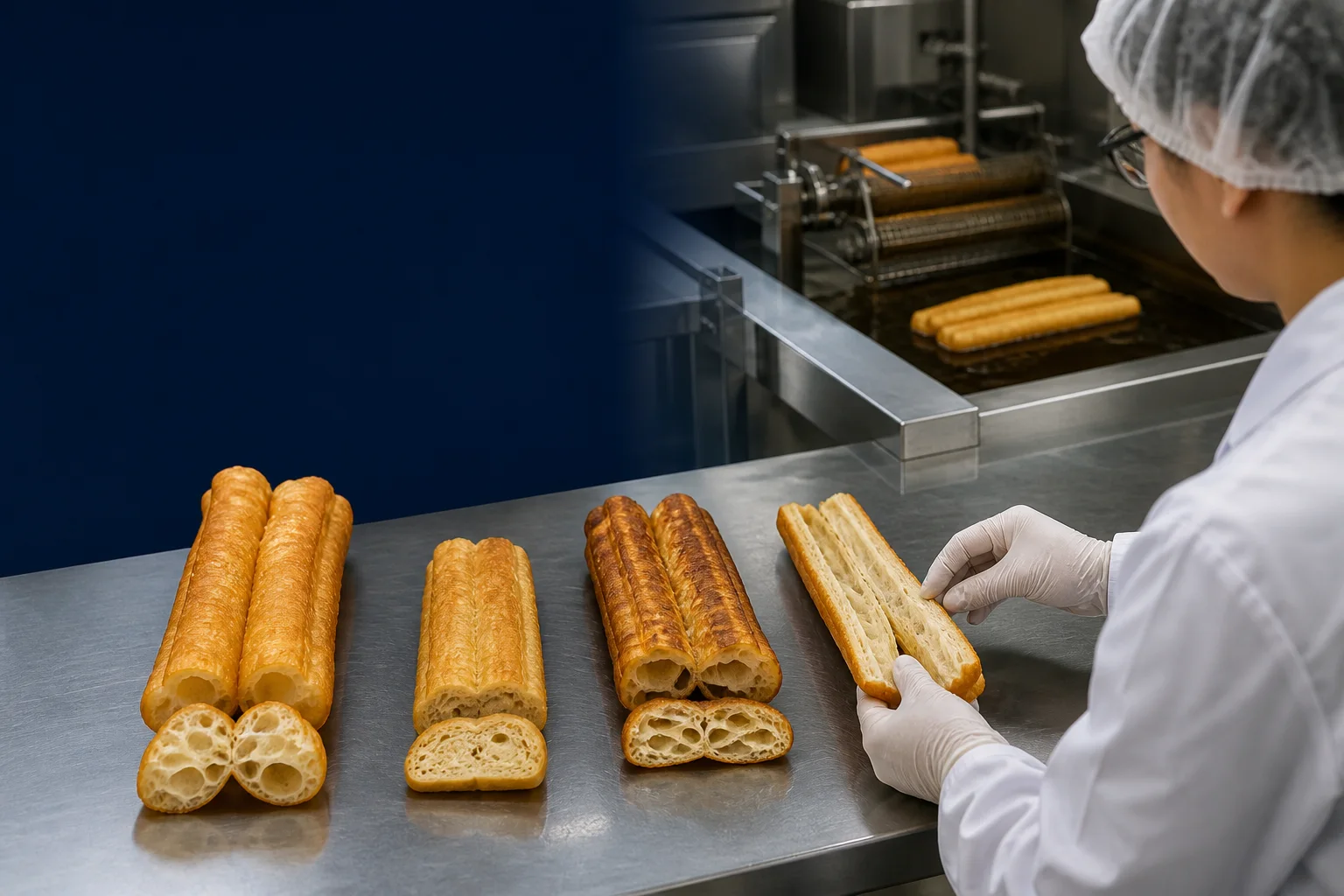
Change one controlled factor at a time
Record the symptom before adjustment: batch, flour lot, formula, dough and room temperature, mixing record, rest time, forming settings, oil condition, fryer temperature, residence time and sample photographs. First check material and process conditions, then tooling and machine condition. Isolate hazardous energy before entering guarded areas.
Symptom-to-check matrix
| Symptom | Check first | Then inspect |
|---|---|---|
| Dense, low expansion | Formula, dough development, rest condition and frying window | Thickness, joined geometry and stretching consistency |
| Strips separate | Pairing surface, press/contact and dough condition | Alignment, tooling wear and transfer disturbance |
| Uneven length or weight | Infeed block consistency and sheet thickness | Slitting/cutting timing, belt tracking and stretch control |
| Pale or dark product | Actual oil temperature, loading and residence time | Oil condition, product movement and sensor verification |
| Greasy product | Frying condition, drainage and product structure | Oil turnover, de-oiling and downstream cooling |
| Intermittent line stops | Where the first accumulation or starvation occurs | Sensors, interfaces, guards and qualified maintenance records |
External manual troubleshooting guidance · 11:44 · 4K
Watch how resting, stickiness and oil temperature change the youtiao result
Souped Up Recipes shows the manual sequence from dough preparation through forming and frying while calling out several observable process conditions. The footage makes the diagnostic principle above concrete: record dough feel, relaxation, stretch response and oil behavior before deciding which controlled factor to change.
Translate the observations into a controlled check
Stickiness, resistance to stretching, slow expansion and surface color are symptoms, not diagnoses by themselves. Preserve a sample and record formulation, rest history, dough temperature, dimensions, fryer setpoint and actual oil recovery before adjusting the next batch.
Source and limit: External Souped Up Recipes household-scale demonstration, published 14 April 2021. Its formula, rest schedule and fryer method are not a HELPER recipe, an industrial setting or a universal corrective action; verify the affected batch and machine conditions before changing production.
Open the original video on YouTubeUse samples as production evidence
Keep a labelled correct sample and representative defect samples or photographs. Compare raw geometry, fried cross-section, colour and weight. Trends across time often separate a formula or temperature drift from a fixed tooling problem.
Do not use process adjustment to hide a mechanical fault
If alignment, belts, bearings, cutters, guards or sensors are damaged or outside approved limits, stop and follow the model-specific manual. Do not bypass safety devices or compensate indefinitely with operator handling.
What to send for remote diagnosis
- Machine model, serial/configuration and exact process stage.
- Short videos from safe viewpoints plus close photographs of the symptom.
- Formula and timestamped process/settings record.
- When the issue began and what changed.
- Alarm text exactly as displayed and actions already attempted.
Frequently asked questions
Does this guide replace an engineering proposal?
No. It structures the information needed for product trials, equipment selection and a project-specific proposal.
Can capacity be guaranteed from a web page?
No. Capacity must name the product state, accepted quality, run conditions, yield and contractual test method.
Where can I review the actual machinery route?
Use the linked Youtiao Production Equipment Hub, then provide samples, formula, output and factory constraints.
Research and evidence boundary
Food-process context is supported by Zhu, Cereal Chemistry (2024) and Shyu et al., Applied Sciences (2021). HELPER model values and project boundaries must match the applicable catalogue and signed proposal. Reviewed 12 August 2026.