
Start with when the damage appears. Cracks at the cutter call for a product-condition and cutting review; folding after transfer calls for a handling comparison; intact slices that tear only on unpacking call for a pack-separation trial. The checks below help distinguish these cases before choosing a remedy.
Match your symptom to the first check
Observe the slicer outlet, transfer, fresh pack and stored pack. Find the first stage where intact slices become damaged. The likely contributors below are hypotheses to test, not diagnoses from appearance alone.



Original explanatory drawings. Compare like-for-like product and keep approved hygiene and temperature controls in force.
Scope: industrial pork-belly bacon. Use plant-approved controls for trials and model-specific service procedures for machinery. Other species, formed products and fully cooked bacon need separate review.
Product condition: what tempering actually means
Tempering prepares the slab for cutting by bringing it to a suitable, more uniform temperature and firmness. ASHRAE describes conditioning before bacon slicing, linking excessive hardness with shattering and warmer product with poor shingling. Shingling means arranging overlapping slices. [1]
Compare measured product condition, slab thickness, loading, equalisation history and waiting time with a satisfactory run. Record where measurements were taken. A room setting or one surface reading cannot describe the whole slab. Ask the refrigeration and slicer suppliers to test a compatible conditioning window; do not simply freeze harder or warm product outside approved controls.
Raw material also matters. A 1995 study associated belly thickness with slice integrity. Seman’s industry model includes firmness, dimensions, moisture, pressing and slicer setup, warning against evaluating fat alone. These sources do not define a universal belly grade or cutting setting. [2] [3]
Cutting and transfer: isolate the changed condition
Compare matched slabs on the same setup. Lot-dependent problems suggest a material or conditioning comparison; a repeatable lane or transfer-point pattern warrants supplier review of blade specification, product support, feed recipe and transport. Record thickness, speed and layout together. Photograph whether the slice was intact before transfer.
This is a comparison plan based on the multiple-factor model, not a worn-blade diagnosis. Machine adjustments and blade service belong to authorised personnel using the model-specific procedure. [3]
Comparing slice count and thickness? Read bacon slices per pound, cooked Style codes and pack quantities correctly →
Pack separation: compare the contact arrangement
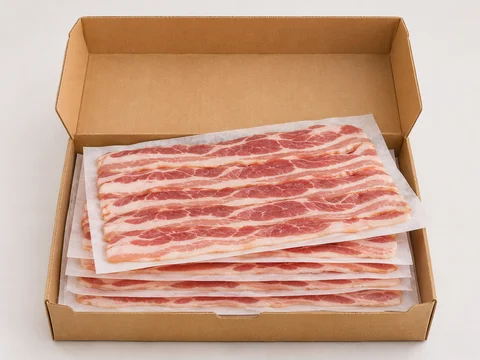
If the cutter delivers intact slices, investigate the pack-opening step separately. Weber describes paper or film between adhering or thin slices; GEA also describes sheets between slices. These mechanisms support an interleaving trial, not a guaranteed cure for every bacon product. [4] [5]
Trial approved food-contact interleaves or a different layout with the packaging supplier. Check coverage, sheet placement, missing sheets and the customer’s removal method. Paper under a whole portion is different from paper between every slice. Assess the finished pack after representative distribution and storage; a clean separation immediately after slicing is insufficient.
Verify a remedy with a controlled comparison
- Fix the baseline. Record lot, cut dimensions, formulation identity, conditioning history, slicer recipe, thickness, layout and packing materials.
- Change one factor. Compare matched material under an agreed supplier trial. Keep approved hygiene and temperature controls in force.
- Count the right losses. Record input weight, accepted slices, fragments, transfer damage and separation tears separately. State whether acceptance uses count or weight.
- Repeat the customer step. Evaluate removal after the specified storage scenario. Compare intact usable portions and handling effort, not appearance alone.
For example, compare matched portions in the current layout and an interleaved layout while holding the other recorded variables constant. Photograph opening and record intact removals, tears and handling effort. This proposed record is not a standard test method; agree quality criteria with the buyer.
Where HELPER equipment fits
The Bacon production guide connects these checks to the process. The linked machines cover upstream injection, optional tumbling and thermal processing. Their pages are not specifications for a specialist bacon slicer or interleaver. Confirm conditioning, slicing, packing and integration scope separately.
 ZN-120 injectorUpstream injection records.
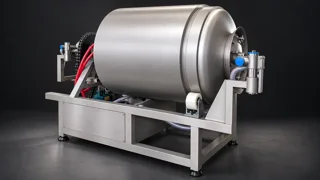 GR-1000 tumblerOptional tumbling records.
 QZX smokehousesThermal-process records.
AI-assisted equipment reference visualizations. Confirm the supplied configuration against the product documentation.
Send HELPER the product brief and stage-by-stage observations for a scoped equipment discussion.
Questions production teams ask
Should we freeze bacon harder to stop breakage?
Not automatically. Excessive hardness can promote cracking. Compare product uniformity and supplier-approved cutting conditions rather than changing the room setpoint alone. [1]
Why do intact slices tear when removed from the pack?
Slice contact and presentation may be involved. Compare pack-opening results with freshly sliced portions, then trial layout or interleaving under the intended storage conditions.
Will interleaving solve all sticking?
No. Coverage, sheet placement, material compatibility and product condition still need testing. Interleaving cannot repair slices already damaged during cutting.
Does changing the tumbler solve slicing defects?
Not by itself. First locate the defect and compare upstream records with conditioning, cutting and packing. No HELPER slicing improvement is claimed without a relevant trial.
What temperature should bacon be sliced at?
There is no single setting for every product and slicer. Establish the product condition through supplier-supported trials, considering formulation, slab geometry and cutting system. Historical handbook examples are not factory instructions.
Does sticking mean the bacon is unsafe?
Sticking alone cannot establish safety or spoilage. Follow the plant’s food-safety and product-disposition procedures; this guide addresses physical slice quality, not release decisions.
Comparing finished-pack formats after resolving the slicing fault? Use the bacon packaging comparison and trial checklist →
Sources and scope
Reviewed 4 November 2026. Historical technical references support principles, not current machine settings. Supplier descriptions do not establish HELPER performance.
- [1] ASHRAE Handbook—Refrigeration, Meat Products (2018), bacon conditioning and slicing.
- [2] Brewer et al. (October 1995), belly thickness and bacon slice integrity; university-hosted abstract.
- [3] Dennis Seman, AMSA RMC presentation (19 June 2012), slides 31–35; industry conceptual model.
- [4] Weber interleaver description, undated; mechanism and supplier scope.
- [5] GEA DualSlicer II interleaver process (27 January 2022); official video-page description, not independent performance testing.