
Retail sliced bacon
Define slice thickness, length, count or pack weight, and stacked or shingled presentation. Check how portions enter the packaging machine.
Bacon processing equipment
Compare HELPER brine preparation, injection, vacuum tumbling and smokehouse equipment. Define your bacon product, production target and existing machines to build a clear equipment specification.
01 / Finished product
The starting scope is whole-muscle pork belly bacon. Specify the raw material and curing method separately from the final presentation: dry curing and liquid curing are different routes, while retail and food-service packs create different downstream requirements.
Define slice thickness, length, count or pack weight, and stacked or shingled presentation. Check how portions enter the packaging machine.
Specify bulk, layered or interleaved portions, sheet size and handling requirements. A retail pack layout may not suit restaurant supply.
Clarify whether slicing happens before final cooking. A slice-to-oven route requires different transfers from slicing a smoked, conditioned slab.
State the required dice, strip or crumble form and material condition. Ask for a dedicated cutting review rather than assuming a bacon slicer is suitable.
Back bacon, beef bacon, turkey and reformed products require a separate review. These formats describe project inputs, rather than confirmed capabilities of every HELPER machine.
02 / HELPER equipment & supply scope
Start with the HELPER equipment families below. Select the model and options against your belly dimensions, recipe, loading method and required output. A product-family listing is a starting point; bacon suitability and the final configuration need confirmation.
For reference, explore the ZN-120 injector, GR-1000 tumbler and QZX smokehouse range. Their individual specifications should be reviewed alongside your product requirements.
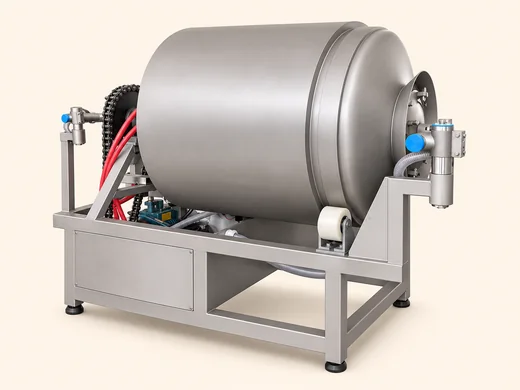
| Process duty | HELPER equipment starting point | Confirm before selection |
|---|---|---|
| Prepare the brine | Brine maker & mixing tank | Recipe, batch volume, ingredient dissolution, filtration and temperature-control arrangement. |
| Inject liquid cure | Meat brine injectors | Product clearance, needle coverage, belt loading, brine circuit and cleaning access. |
| Tumble where required | Vacuum tumblers | Usable batch load, drum action, vacuum, total cycle and unloading; preserve the intended texture. |
| Smoke / thermal process | Smokehouse configurations | Trolley loading, chamber arrangement, heating, airflow and process recording. |
| Cool, press, cut & pack | Separate project scope; review cutting categories | Specialist machine suitability, interfaces and who supplies each stage. A general cutting listing does not confirm bacon slicing capability. |
03 / Conditional process routes
A planning sequence for liquid-cured, smoked belly bacon sold as slices is shown below. It is a process outline, not a validated curing or cooking schedule.
Replace the liquid-injection stage with the defined dry-curing and holding sequence. Tumbling, pressing and smoke treatment are selected operations, not universal requirements.
Confirm where slicing, cooking and cooling occur. A pre-cooked product may be sliced and laid onto a cooking conveyor before its final thermal stage. Define hygienic transfers and packaging around the actual route.
04 / Project options
Identify the current limitation and send the existing machine specification, product sizes, actual output and transfer heights. Compare the replacement under the same operating conditions.
Share injector, tumbler, smokehouse, cooling and packaging drawings as relevant. Review batch timing, trolley movement, loading direction and the capacity of the receiving stage.
Define the finished product, shift target and factory layout. Request a machine list and an interface schedule that distinguishes supplied equipment, options and plant-provided systems.
05 / Capacity & factory conditions
Separate incoming material from accepted finished output. Batch processing, holding, cooling, loading and cleaning can determine the bottleneck even when an injector or slicer has a higher nominal rate.
| Planning input | What to provide | What the proposal should clarify |
|---|---|---|
| Product & output | Minimum/maximum dimensions, condition, incoming kg per shift and target accepted output. | Selection basis and agreed quality/reject criteria. |
| Batch & schedule | Usable load, full cycle, shifts, product changes and available production time. | Completed batches, buffers and downstream constraints. |
| Space & transfers | Layout, door clearances, loading height, trolley dimensions and access routes. | Machine footprint, service space and handover points. |
| Utilities | Voltage/frequency, heating and refrigeration availability, water, drainage and compressed air. | Requirements of the selected configuration and plant preparation work. |
Include sanitation in the operating schedule. Review access to brine-contact parts, needles, hoses, drum interiors and transfers, and request the selected machine's cleaning and maintenance instructions.
06 / Product trials & quality
Use the intended material, including the relevant size range, fat/lean variation and processing condition. Agree the sample quantity, selected configuration, run duration and trial arrangements before sending product.
Record material identity, settings, time, weights at agreed stages, accepted output and rejects. Include slice or portion criteria where cutting is in scope, plus cleaning, changeover and handling observations.
| Concern | What to investigate | Evidence to request |
|---|---|---|
| Pickup versus retained yield | Brine preparation, distribution, holding and later losses. | Defined weighing points and calculation basis. |
| Torn or variable slices | Core/surface condition, belly geometry, blade and feed settings. | Representative slices, accepted count and reject reasons. |
| Weight giveaway or waiting | Portion formation, batch timing and receiving equipment. | Pack weights, rework and stoppage records. |
There is no single slicing temperature for every bacon and slicer combination. Establish the condition with the selected cutting supplier. Injection pickup, retained weight, thermal yield and saleable slicing yield measure different outcomes; see the yield measurement guide.
Request a demonstration relevant to your product and proposed configuration. Confirm availability and test conditions with HELPER; equipment illustrations alone do not establish bacon trial results.
07 / Budget & quotation
Cost depends on the selected machines, loading capacity, product dimensions, automation, controls, heating/refrigeration arrangements and installation scope. A single-machine upgrade and a connected process section should be quoted against different equipment and interface lists.
08 / Buyer questions
Define the product route first. Liquid-cured smoked slices can involve brine preparation, injection, holding or selected tumbling, smoking, chilling, conditioning, slicing and packing. Dry-cured, pre-cooked and diced formats require a different scope review.
No. Dry curing follows a different sequence, and tumbling depends on the recipe and desired structure. Confirm the curing method before choosing either machine.
Yes. State which operation you want to replace or add. Provide the upstream and downstream equipment details so the proposed machine can be reviewed against existing transfers and production timing.
Request a project-specific supply list. HELPER lists brine preparation, injection, tumbling and smokehouse equipment. Cooling, pressing, specialized slicing and packaging need separate confirmation of compatibility, supply and integration responsibilities.
No universal requirement applies to every route. Review belly shape, the selected slicer and the required slice/pack presentation together. Confirm pressing and conditioning needs through product review and trials.
Pricing requires a defined machine configuration and project boundary. Send product dimensions, curing route, target accepted output, existing equipment and factory location. Ask the quotation to identify options, site work, delivery and support inclusions.
Share representative samples or photographs, size range, product state, curing route, target cut or pack format and accepted-output criteria. Confirm sample requirements and trial arrangements before dispatch.
09 / Your project brief
Use the checklist alongside this section when contacting HELPER. Identify this as a bacon project and include the page or equipment reference so the discussion starts with the right process duty.
For background on route differences, see GEA's bacon process overview, Grote's pre-cooked bacon slicing application and Urschel's bacon cutting formats. These describe other suppliers' configurations; their results do not establish HELPER performance.