
Start with the handling task: compact retail portions, tray presentation or sheets for kitchen use. Shortlist a pack format, then specify its atmosphere and distribution route. Compare matched product through the intended storage and preparation conditions; a demonstration pack alone cannot establish shelf life.
1. Separate the decisions before comparing packs
Retail and foodservice describe sales channels, not preservation systems. Interleaving means placing a separator between slices or layers; it does not identify the gas or barrier properties of the outer pack. These choices must appear separately in the specification.
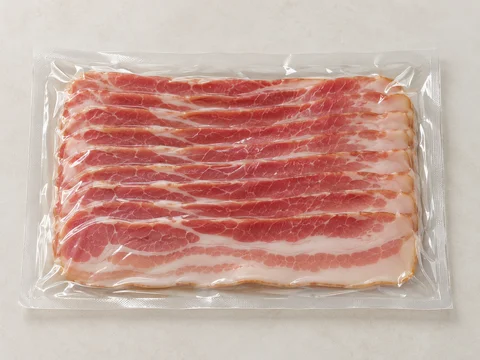
Shingled vacuum pack
Shortlist this for a compact portion of overlapping (shingled) slices. Check film compression, removal time and intact slices after storage. Confirm the material and outer seal specification.
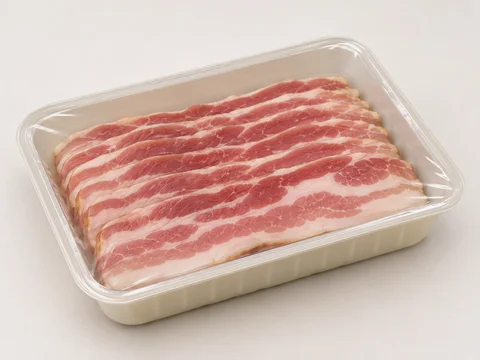
Lidded tray / specified MAP
Shortlist a tray when the buyer wants that presentation and loading format. Modified-atmosphere packaging (MAP) requires a specified gas, material and verification method. A tray alone does not define its atmosphere.
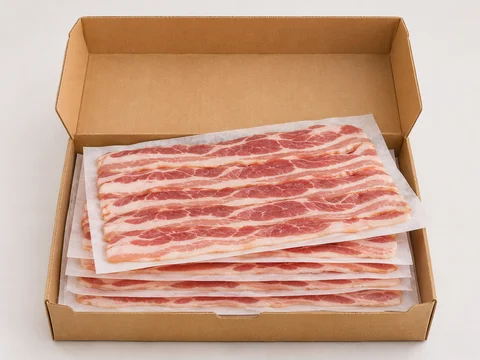
Foodservice layers
Shortlist lay-flat sheets when kitchen staff transfer whole sheets, or interleaved portions when they remove layers. Check separator removal, displaced slices and outer-pack protection after the intended storage route.
Does smoked mean ready to eat? Distinguish uncooked, heat-treated and ready-to-eat bacon before choosing the route or pack →
2. Test the customer's handling task
Ask whether staff remove individual slices, transfer sheets or empty measured portions. Record pack weight, slice count where specified, separator, loading orientation and preparation method. Compare removal after storage using the same task, operator instructions and measurement units.
Log torn slices, displaced layers and extra handling separately. Use the bacon slice-defect guide when the problem already occurs before packing; changing the pack cannot establish the cause of a slicing fault.
3. Include storage in the comparison
A 2015 Kansas State/National Pork Board experiment found greater lipid oxidation in aerobic foodservice layouts than vacuum packs under specified frozen conditions. Frozen storage still requires product-and-pack evaluation; experimental observation dates are not commercial expiry dates. [1]
A 2023 Iowa State report also studied oxidation in frozen foodservice bacon. Both reports apply to their studied products and conditions, not HELPER performance. [2]
4. Run the checks in a defined sequence
Assign pack and observation IDs. Before starting, agree the sample plan, measurement method, acceptance criteria, review dates and decision owner; these fields must not be invented after seeing the results.
- PrepareMatch product; approve the pack brief and test plan.
- Check packingRecord loading, seals and specified test results.
- Observe storageKeep condition records; check at agreed dates.
- ReviewCompare handling and reports; assign unresolved actions.
- Product and comparison
- Lot, product state, slice dimensions, portion and preparation history. Reference the raw-material record rather than copying it.
- Pack specification
- Variant ID, arrangement, separator, film/tray specification and supplier, atmosphere where applicable, recorded equipment settings and configuration.
- Packing observations
- Check loading, product in the seal, wrinkles and damage. Record the agreed seal/leak-test method, criterion and result. A visual seal check is different from a leak test; select methods for the actual pack with the supplier. [4]
- Distribution history
- Packing and observation dates, recorded storage/transport conditions, handling events and the stated opened-pack scenario.
- Results and follow-up
- Separation, presentation, liquid observations and defined quality measurements; photo references, test-report IDs, differences, owner and decision.
Example record: PACK-A / same lot / observation date / removal time (seconds) / intact slices out of slices assessed / seal-test report ID / follow-up owner. Repeat for PACK-B under matched conditions. These blank field examples define a comparison record, not tested results or pass limits.
For a packaging comparison, match the product and storage route while changing the defined packaging factor. If both packaging and temperature change, the result compares complete routes; it cannot isolate packaging alone. Leave missing measurements blank and assign follow-up rather than inventing a pass.
5. Separate three kinds of evidence
These checks answer different questions. A close-fitting pack, acceptable colour or satisfactory separation cannot establish microbiological safety. FSA guidance for England, Northern Ireland and Wales requires appropriate controls for reduced-oxygen chilled foods; it is not a global bacon storage schedule. [3]
QA should determine the relevant hazards, tests, acceptance criteria and disposition. Do not diagnose safety from purge or smell, or taste a suspect pack. Film performance, gas mixture and seal settings require supplier evidence for the actual configuration.
Buyer questions
Is interleaving the same as vacuum packaging?
No. Interleaving describes separators; vacuum describes the pack atmosphere. Specify both independently.
Is vacuum always better for foodservice bacon?
No universal choice follows from the channel. Compare handling, product quality, outer packaging and the intended route.
Can frozen bacon still oxidise?
Yes, under the conditions studied in the cited research. Freezing does not justify ignoring oxygen exposure or product-specific quality checks.
Does a tight-looking pack prove its shelf life?
No. Appearance cannot substitute for package-integrity evidence and a supported product-specific shelf-life assessment.
What should a packaging trial report contain?
Identified product and pack variants, agreed comparison conditions, methods, results, photographs and unresolved actions with an owner.
What if a pack fails a check?
Record and identify the affected samples, refer them to the designated QA decision owner, and investigate before changing one factor and repeating the agreed comparison. Follow plant procedures for disposition.
Continue with the bacon production guide to place packing after slicing. Send HELPER your product, intended pack and distribution brief to define project scope; bacon packer supply and integration require confirmation.
Planning accepted packs per shift? Calculate bacon batch rhythm and buffer mass with a worked timeline →
Sources and scope
Reviewed 4 November 2026. Pack comparisons and recording steps are a proposed buyer workflow. Illustrations show concepts, not actual packs, test results or shelf-life evidence. No gas mix, process setting or storage duration is prescribed.
- [1] Kansas State / National Pork Board, project 13-127, submitted 16 August 2015; experimental frozen packaging comparison.
- [2] Iowa State / National Pork Board, project 20-107 IPPA, submitted 2 August 2023; oxidation study in frozen foodservice bacon.
- [3] Food Standards Agency, Vacuum packaging, published 22 May 2018; guidance revised December 2020. Jurisdiction-specific safety context.
- [4] Emerson: leak detection in modified-atmosphere food packaging (undated manufacturer application note). Test-method context, not HELPER equipment evidence.