
Noodle Nest Forming Unit
Gather prepared noodle strands into separate compact noodle nests. Define the incoming strands, required nest shape and discharge arrangement around your finished product.
Discuss your noodle nest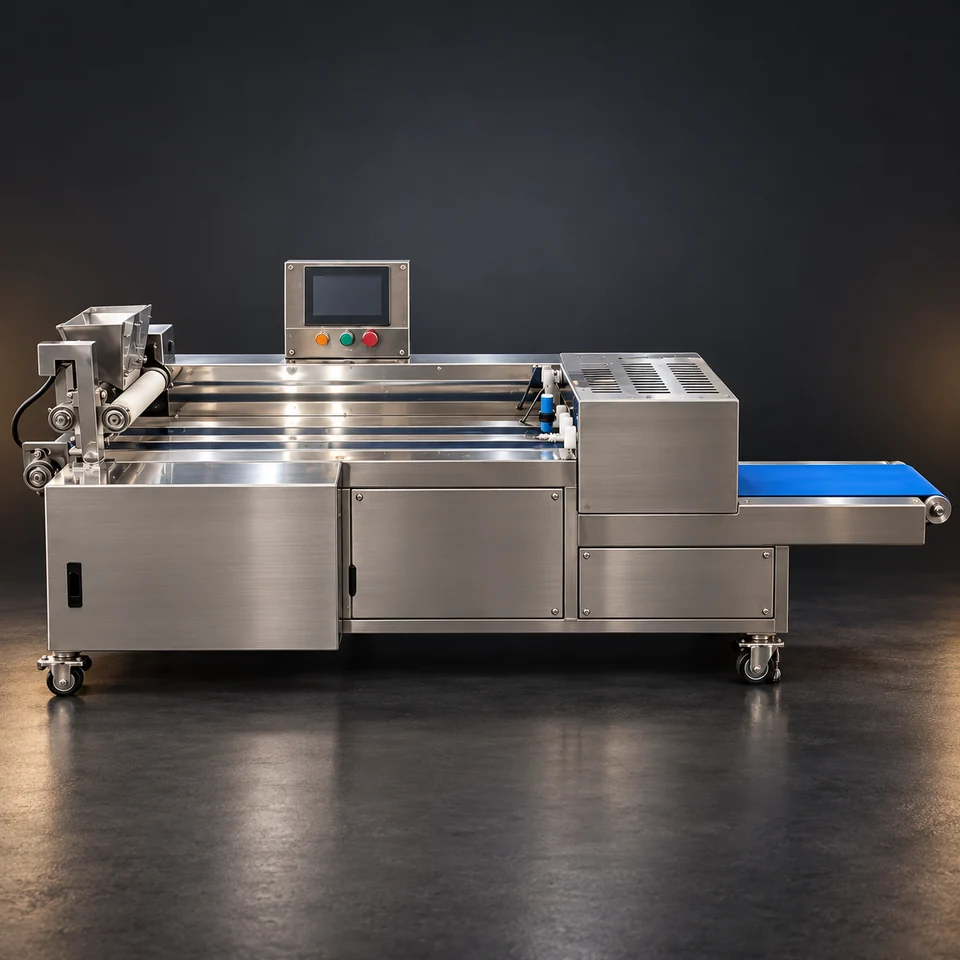
- Working function
- Prepared noodle strands to separate noodle nests
- Supply concept
- One nesting and discharge unit within the selected process route
Give the noodles a grouped presentation.
This unit brings prepared noodle strands together into individual noodle nests. It changes their arrangement for the next handling step while retaining the strands as noodles.
Agree the intended nest outline, degree of compactness and discharge condition using a product sample. The required arrangement depends on strand length, noodle dimensions, recipe and material condition at the inlet.
Review the working unit.
The machine view shows inlet rollers, a polished working channel, a screen with operator buttons, an enclosed forming section, front access panels and a short blue outfeed conveyor.
Confirm the installed internal arrangement, controls, guarding and cleaning access from the equipment specification. Neighboring conveyors and workshop equipment are separate from this unit.
Upstream: prepare the noodle strands.
The preceding equipment supplies noodles with the dimensions, length and condition required for nesting. Review whether strand forming, length cutting and feed presentation are completed before the inlet or included in the selected nesting configuration.
Match the material delivery rate, transfer height and strand orientation. Avoid assuming that a forming head or length cutter connects directly without checking the handover.
Downstream: handle each nest as required.
The outfeed belt transfers the nests toward the next agreed handling point. Specify nest spacing, support and transfer method so the arrangement can be maintained during the handover.
Depending on the product route, further processing or packaging preparation may follow. Confirm the required product condition and whether an intermediate conveyor or tray-handling arrangement is needed.
Information needed for selection.
- Noodle type, recipe and inlet condition
- Strand dimensions and supplied length
- Target nest shape, size and compactness
- Required quantity per nest, if applicable
- Feed pattern, discharge spacing and next machine
- Layout, utilities, cleaning and service access
Confirm dimensions, power, operating range, capacity and product limits in the selected technical specification. No fixed nest weight or output rate is specified here.
Check the nest with your own noodles.
Use representative noodles to inspect grouping, strand damage, sticking, release and nest consistency. Check whether the nests keep the required arrangement as they leave the outfeed and enter the following stage.
Record inlet condition, strand length, settings and observations together. Define acceptance criteria for appearance and handling, and for quantity per nest where that is part of the agreed requirement.
Common planning questions.
Does this machine make dough balls?
No. Its stated task is gathering noodle strands into noodle nests. Dough-ball forming is a different operation.
Does nesting guarantee an exact weight?
A nest shape does not by itself establish a weighing function. Confirm any length control, portioning or weighing equipment and the agreed tolerance separately.
Does it cut noodles or pack the finished nests?
Confirm the supplied configuration. This page describes nesting and discharge; integrated length cutting, additional conveying and packaging must be identified separately in the quotation.
Show us the noodle nest you want to make.
Send a product photo or sample, strand dimensions and length, inlet condition and the next handling step.
Request a noodle nesting configurationSee this unit in the 270 line.
Review how the sheeting, sheet-transfer, noodle-forming and nesting units are arranged together.
Explore the 270 line →