
Direct answer
Dough hydration is total formula water divided by total flour mass, multiplied by 100. Total water means directly added water plus the measured water contribution from eggs, brine, liquid starter or other liquid ingredients. The percentage is a formula descriptor, not a guarantee of dough consistency. Industrial production must verify the result against the actual flour lot, mixer, final dough temperature and downstream forming response.
hydration (%) = total formula water (kg) / total flour (kg) x 100State which powders belong to the flour basis and which liquid ingredients contribute water before comparing formulas.What belongs in total flour and total water?
Total flour basis
Include every flour fraction used as the denominator under the approved formula convention, including flour present in a preferment when applicable. If starch, gluten or another powder is treated separately, keep that convention explicit and unchanged between batches.
Total formula water
Include direct water and the water fraction of liquid ingredients. Do not count the full weight of egg, brine, puree or starter as water. Use controlled supplier or laboratory moisture values rather than an assumed universal value.
As-is versus dry basis
Routine baker's percentage normally uses ingredient weights as dosed. Flour-moisture correction is a different calculation. If a laboratory method reports flour on a fixed moisture basis, label it and do not mix that result with an as-is production formula.
Formula hydration versus absorption
Formula hydration is a mass ratio. Flour water absorption is a measured material response under a specified test method and consistency endpoint. The two terms should not be treated as interchangeable.
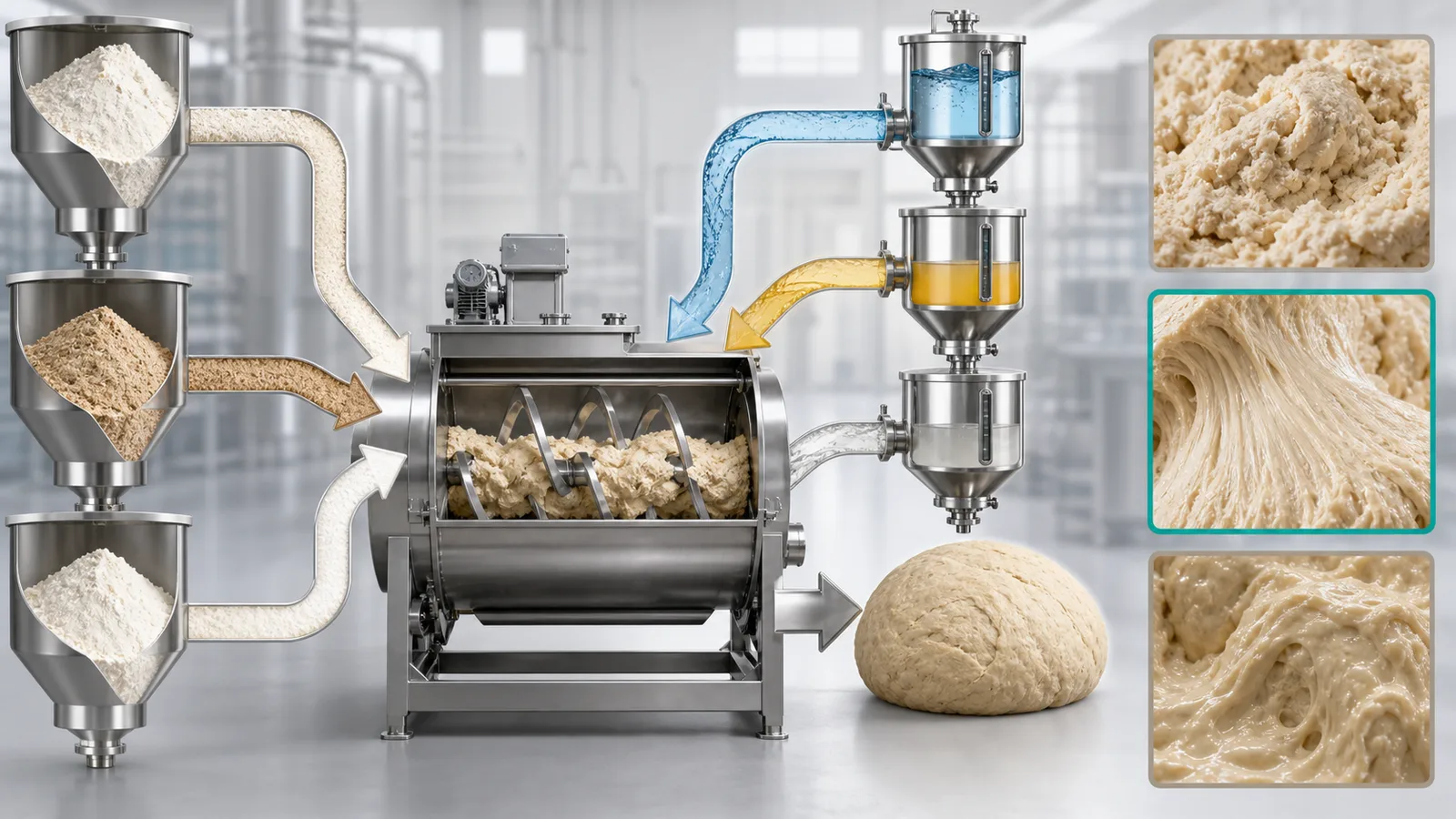
Example: calculate effective hydration, not only added water
Consider a noodle or wrapper dough using 500 kg flour, 145 kg direct water, 40 kg liquid egg at 75% moisture, 10 kg brine at 80% moisture and 8 kg dry minor ingredients.
| Ingredient | Dosed mass | Controlled moisture | Water contribution |
|---|---|---|---|
| Wheat flour | 500 kg | Not counted in formula-water numerator | 0 kg |
| Direct process water | 145 kg | 100% | 145 kg |
| Liquid egg | 40 kg | 75% | 30 kg |
| Prepared brine | 10 kg | 80% | 8 kg |
| Dry minor ingredients | 8 kg | 0% for this example | 0 kg |
| Total | 703 kg dough | Total formula water | 183 kg |
effective hydration = 183 / 500 x 100 = 36.6%Using direct water alone would report 29.0%, understating formula water by 7.6 percentage points.Eight steps from formula to controlled batch
Name the flour denominator and identify every source of ingredient water.
Record flour lot, flour moisture or absorption test where used, and moisture values for liquid ingredients.
Convert each liquid ingredient into water and non-water solids, then calculate effective hydration.
Use the approved nominal water quantity and reserve only an authorized adjustment allowance if the process requires one.
Select water temperature from the validated target final dough temperature and the measured heat contribution of the actual mixer cycle.
Hold load, sequence, speed, time and vacuum conditions constant while evaluating a water change.
Record final dough temperature, mixer load or energy where available, appearance, sheet behavior, forming stability and accepted product.
Update the controlled formula only after review; do not let undocumented operator additions become the new standard.
Hydration does not remove flour-lot variation
Research consistently identifies flour composition and milling condition as major influences on water absorption. Protein and damaged starch are important, while recent work also identifies arabinoxylan-related properties as useful predictors. This means a nominal 36.6% formula can behave differently after a flour supplier, wheat crop, extraction rate or milling condition changes.
Protein quantity and quality
Protein content alone does not describe gluten performance, but changes can alter development, strength and the amount of water needed at a chosen consistency.
Damaged starch
Milling damage changes water binding. Published cereal studies show substantial changes in measured water absorption and dough properties as damaged starch changes.
Arabinoxylans and fibre
Minor flour components can materially affect water distribution and viscosity, especially when wholemeal, bran or fibre-rich materials are present.
Flour moisture and storage
As-is flour mass includes its native moisture. Incoming moisture, storage temperature and conditioning therefore belong in lot review when tight process repeatability is required.
Calculate hydration and water temperature separately
Hydration controls the mass ratio. Water temperature is an operating variable used to approach an approved final dough temperature. Mechanical mixing adds heat, and that heat depends on mixer design, batch load, speed, time, dough resistance and jacket conditions.
measured mixer temperature rise = actual final dough temperature - predicted ingredient-temperature resultDetermine the correction from repeated batches on the actual mixer. A generic friction factor is not a commissioning result.For production, record flour temperature, water temperature, room condition, start and final dough temperature, mixer speed and mixing time. If a preferment or other large-temperature ingredient is used, include its mass and temperature in the plant's validated heat-balance method.
Use downstream evidence to judge the water setting
Horizontal or vacuum mixing
Watch powder incorporation, agglomeration, motor load, vacuum stability, wall build-up, discharge completeness and final temperature.
Resting and maturation
Water continues to redistribute after mixing. Hold rest time and conditions constant before comparing dough from two hydration settings.
Sheeting and reduction
Track sheet continuity, edge cracking, roll adhesion, thickness stability, reduction load and scrap rather than relying on hand feel alone.
Forming and sealing
For dumplings and wrappers, monitor cutting, filling contamination at seals, closure integrity, dimensional stability and reject rate.
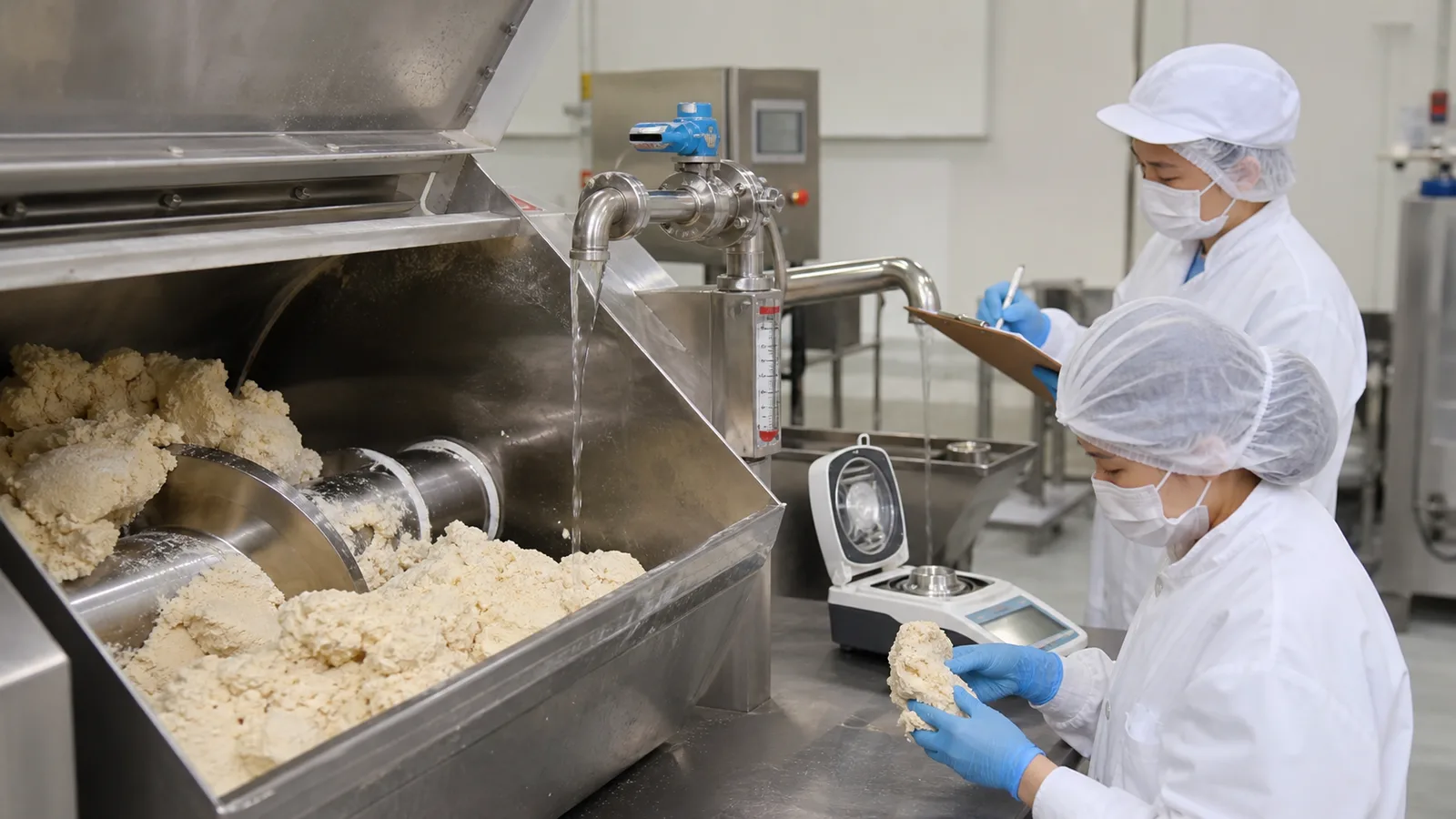
A practical water-correction rule
Define the correction as a percentage point change on the same total-flour basis. With 500 kg flour, each 0.1 hydration point equals 0.5 kg water.
water correction (kg) = flour mass (kg) x hydration-point change / 100Example: 500 kg flour x 0.4 / 100 = 2.0 kg additional water.Additions should remain inside an approved operating range, be weighed, timed and recorded, and be assessed against objective dough and product criteria. Account for water left in pipes, vessels or dosing systems where that residue is material.
Minimum hydration and mixing record
What the calculator cannot approve
A hydration calculation does not establish microbial safety, allergen control, additive legality, shelf life, cooking lethality or label compliance. Water changes can affect handling, thermal response and final product properties, so significant formula or process changes must enter the site's food-safety and change-control system. Codex states that control measures essential to food safety should be validated and that systems should be reviewed when ingredients, products, processes or equipment change.
Dough hydration FAQ
Is egg counted entirely as water?
No. Count only its measured or specified water fraction. The remaining egg mass contributes solids.
Should flour moisture be added to the hydration numerator?
Not in the usual as-is baker's percentage convention. If the plant uses a dry-matter or fixed-moisture laboratory basis, calculate and label it separately.
Does a higher hydration always improve dough?
No. The useful range depends on the flour, product, mixing system and forming process. Excess available water can cause adhesion, weak sheets, poor cutting or sealing defects.
Can two formulas be compared by hydration alone?
Only as a first comparison. Salt, fat, sugar, egg, starches, hydrocolloids and process conditions can change water availability and dough rheology.
How often should the water target be reviewed?
Review it when flour or ingredient lots show a meaningful specification shift, when equipment or process settings change, or when recorded dough and product results move outside the approved operating window.
Calculate the formula before the mixer trial
Enter flour, direct water and the moisture contribution of liquid ingredients to establish a transparent starting point for production review.
Open Dough Hydration CalculatorSources and technical references
- Rezette et al., Food Chemistry (2025) - investigation of protein, damaged starch and arabinoxylan-related predictors of wheat-flour water absorption.
- Dexter et al., Journal of Cereal Science (1994) - effects of protein content and starch damage on dough properties and measured water absorption.
- Functional characterization of whole wheat flours - observed variation in water absorption, development time and stability among flour samples.
- Two-stage dough mixing study - evidence that ingredient sequence and competitive water absorption affect dough development.
- Codex CXC 1-1969, General Principles of Food Hygiene - validation, monitoring, verification, documentation and review after significant change.