
Direct answer
To scale a food recipe, divide the target gross batch mass by the approved reference gross batch and multiply every ingredient by that one factor before rounding. Then reconcile concentrations and total mass, match quantities to calibrated weighing devices, confirm equipment working limits and develop production process settings through trials. Ingredient ratios scale mathematically; mixing, heat transfer, aeration, discharge and food safety do not automatically scale linearly.
What scales linearly and what does not?
Linear starting calculation
Approved ingredient mass ratios, target gross batch, formula percentages and active concentration can be preserved through mass balance.
Requires engineering and trials
Mixing time, agitator speed, power, vacuum, heating and cooling, order of addition, hold time, discharge, yield and sanitation.
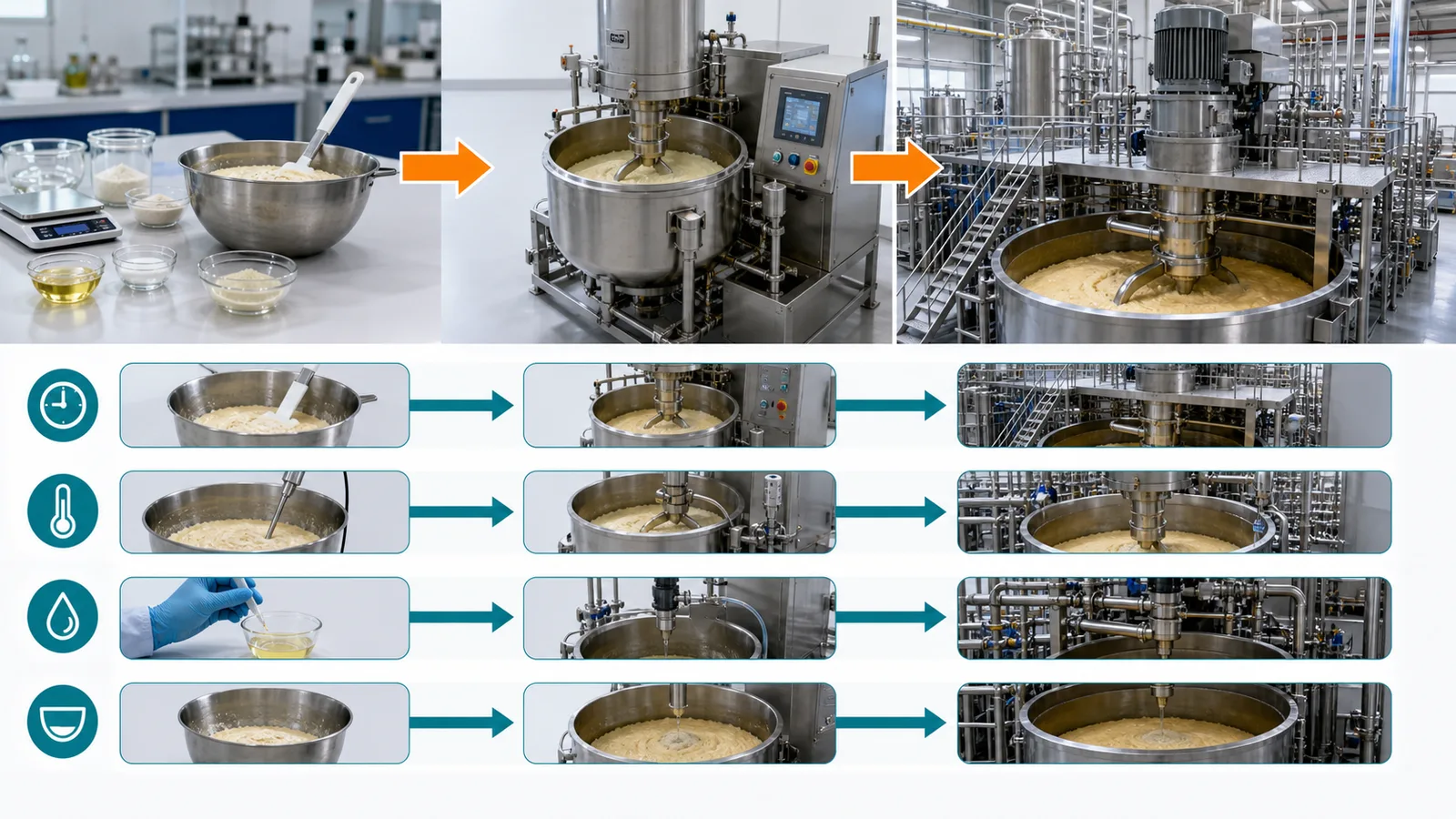
Freeze the source formula and denominator
A controlled source should identify the product, formula revision, owner, approval status, reference batch total, ingredient specifications and formula basis. The denominator may be total batch, flour, meat block, liquid phase or another defined basis. Do not convert between bases without a reconciliation table.
Scale factor = target gross batch mass / reference gross batch mass
Scaled ingredient mass = reference ingredient mass x scale factor
Use one mass unit throughout the calculation. Convert purchase units only after exact formula quantities are established.
Required gross charge = target accepted output / demonstrated process yield
If the target is 576 kg of accepted product and demonstrated yield is 96%, required gross charge is 600 kg.
Eight-step scale-up method
Worked example: 20 kg trial formula to 600 kg production batch
| Illustrative ingredient | Reference kg | Formula % | Exact production kg |
|---|---|---|---|
| Main ingredient | 10.00 | 50.0% | 300.0 |
| Secondary ingredient | 3.00 | 15.0% | 90.0 |
| Process water | 3.00 | 15.0% | 90.0 |
| 10% brine solution | 2.00 | 10.0% | 60.0 |
| Binder | 1.00 | 5.0% | 30.0 |
| Oil | 0.50 | 2.5% | 15.0 |
| Seasoning blend | 0.40 | 2.0% | 12.0 |
| Approved minor premix | 0.10 | 0.5% | 3.0 |
| Total | 20.00 | 100.0% | 600.0 |
600 kg / 20 kg = 30
Each ingredient = source ingredient x 30
This table demonstrates arithmetic only. Ingredient names and percentages are generic and are not a product recommendation.
Recalculate solutions by active mass
Supplier strengths can change. Multiplying the delivered solution quantity without accounting for concentration changes the formula.
Replace 60 kg of 10% brine with 20% brine
Original active = 60 kg x 0.10 = 6 kg
New solution = 6 kg / 0.20 = 30 kg
Carrier-water difference = 60 - 30 = 30 kg
Use 30 kg of 20% brine and increase separate process water from 90 to 120 kg to preserve both salt active and total batch mass, assuming no other compositional differences.
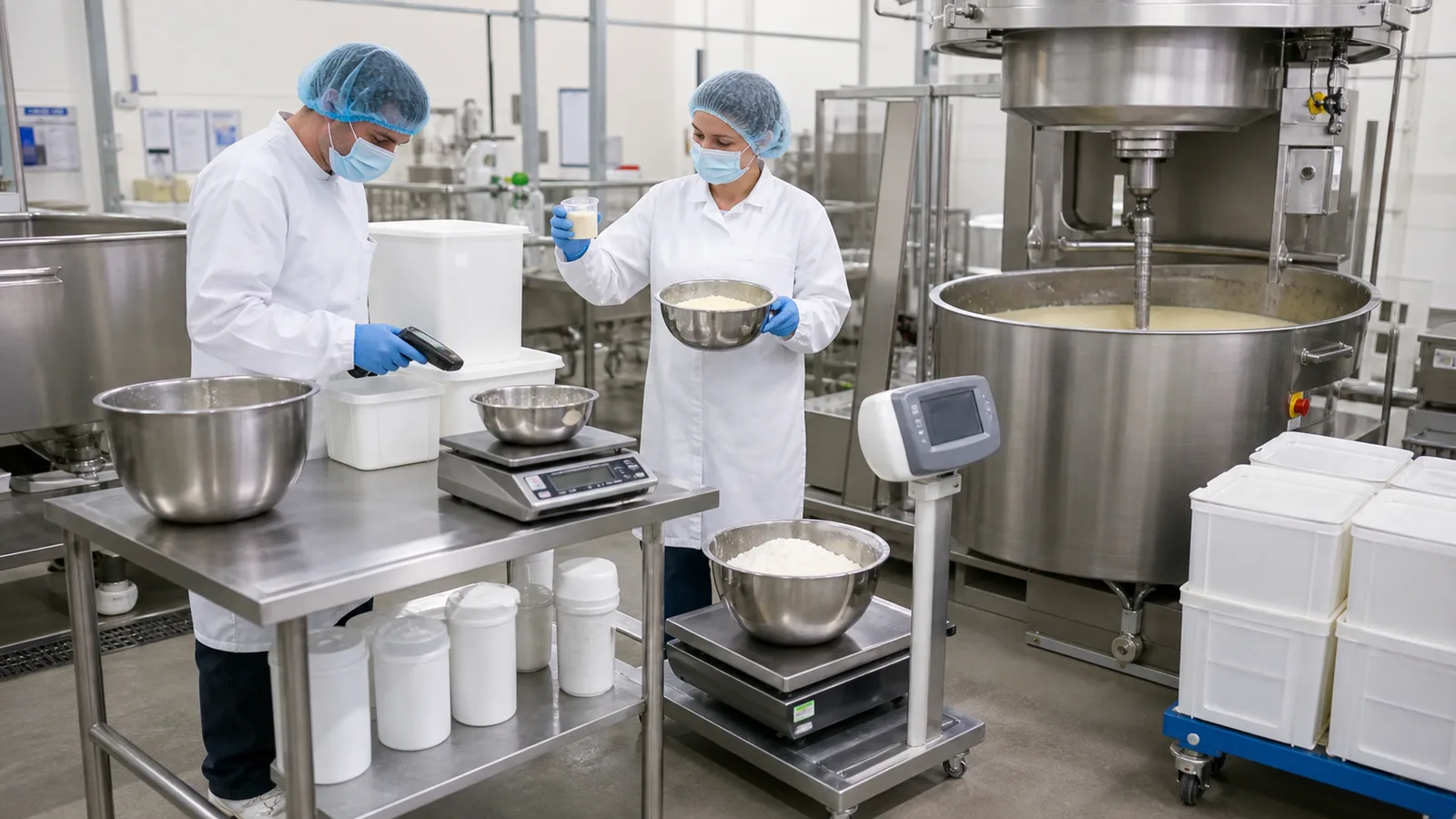
Match rounding to the weighing system
Do not use one floor scale for both a 300 kg ingredient and a 3 kg premix unless its approved range, resolution and process tolerance support both. NIST Handbook 44 provides device-specific specifications and tolerances for weighing systems; the current edition is 2026. Internal recipe control also needs calibrated equipment, suitable range and documented checks appropriate to the plant and jurisdiction.
Check equipment mass, volume and fill limits
Batch mass does not identify vessel volume without representative bulk density. The loaded product can also expand, aerate, foam, move under vacuum or require free space for circulation.
working product volume = batch mass / representative bulk density
gross vessel volume = working product volume / validated fill fraction
For a 600 kg batch at 0.95 kg/L and 75% maximum working fill, preliminary gross volume is about 842 L. This is not a model recommendation.
Why production process settings are not linear
Mixing and shear
Vessel geometry, agitator size, speed, power, product viscosity, loading and circulation determine ingredient distribution and product damage.
Heat transfer
Surface area does not grow at the same rate as volume. Heating, cooling and temperature uniformity can change significantly.
Addition time
A liquid added in 20 seconds to a trial batch may need a different controlled rate and distribution method at production scale.
Air and vacuum
Headspace, product depth, foam, entrained air and vacuum removal change with equipment and filling level.
Hold and reaction
Hydration, dissolution, extraction, fermentation or functional development depends on time and conditions, not only ingredient ratio.
Discharge and residue
Larger equipment may retain more product, create longer transfer time or change temperature before the next operation.
Develop a production procedure around measurable product outcomes. Examples include ingredient uniformity, temperature, moisture, viscosity, particle integrity, emulsion stability, pH or another approved specification. Do not shorten or extend a process solely to make the schedule fit.
Review food safety and legal controls after scale-up
Codex CXC 1-1969 defines validation as obtaining evidence that control measures are capable of controlling hazards. It calls for HACCP validation, verification, documentation and record keeping, and identifies a new process, ingredient, product or equipment as a reason for review. U.S. 21 CFR 117.80 requires operations to be conducted under adequate sanitation principles and appropriate quality-control operations.
Production batch and change-control record
Food recipe scale-up FAQ
How do I scale a food recipe to a larger batch?
Divide target gross batch by reference gross batch, then multiply every ingredient by that factor before rounding. Reconcile concentration and final total afterward.
Should ingredients be scaled by volume or weight?
Mass is usually the clearer production basis. Volume requires ingredient-specific density at actual temperature and concentration. Liters and kilograms are not automatically interchangeable.
Does mixing time increase in direct proportion to batch size?
No. Geometry, fill, agitator, speed, power, rheology and heat transfer change with scale. Establish production settings through engineering review and representative trials.
How should concentrated ingredients be substituted?
Calculate the required active mass first, divide by the new concentration, and rebalance the carrier component and total batch. Review all other specification differences.
Does a mathematically correct scale-up prove food safety?
No. Ingredient legality, hazards, critical limits, allergens, shelf life and process controls require separate review and validation.
Research basis and further reading
- IEC 61512-1:2026, Batch control - Models and terminology - current second edition separates recipe procedural elements from equipment procedural elements and defines a batch-control framework.
- Codex CXC 1-1969, General Principles of Food Hygiene - covers hazard analysis, validated control measures, verification, documentation and review when ingredients, product, process or equipment changes.
- Electronic Code of Federal Regulations, 21 CFR 117.80 - current U.S. requirements for food manufacturing processes and controls.
- NIST Handbook 44, 2026 edition - current specifications, tolerances and technical requirements for weighing and measuring devices.
Scope note: This guide explains controlled arithmetic and process-development questions. It does not approve a formula, additive, critical limit, label, shelf life or production process.
Scale the approved ingredient quantities
Use the calculator for the exact mass conversion, then complete the weighing, equipment, process and validation checks described above.
Open Recipe Batch Scaling Calculator