
Direct answer
First declare what 100% means. If the approved formula is expressed as percent of total raw batter, multiply the target batter batch by each ingredient percentage divided by 100. Confirm the formula totals exactly 100% before production, then expand every cure, seasoning and functional blend into controlled ingredient lines. The arithmetic preserves ratios; it does not prove legal compliance, emulsion stability, thermal safety or finished yield.
ingredient weight (kg) = target raw batter (kg) x ingredient % / 100This guide and the linked calculator use total raw batter as the 100% denominator.Do not mix total-batch and meat-block percentages
Total raw batter basis
Meat, fat, water or ice, salt, seasoning and functional ingredients together total 100%. This is the basis used by the HELPER calculator.
Meat-block basis
Some regulations, supplier instructions and plant formulas express an addition relative only to meat or meat-and-fat components. That percentage cannot be copied into a total-batter column without conversion.
Finished-product basis
Some standards and claims refer to finished composition after heating, drying or other loss. A raw-batter percentage does not directly prove the finished-product value.
Sub-blend basis
A curing or seasoning blend has its own internal composition. Control both the blend addition and the delivered amount of each regulated or functional component.
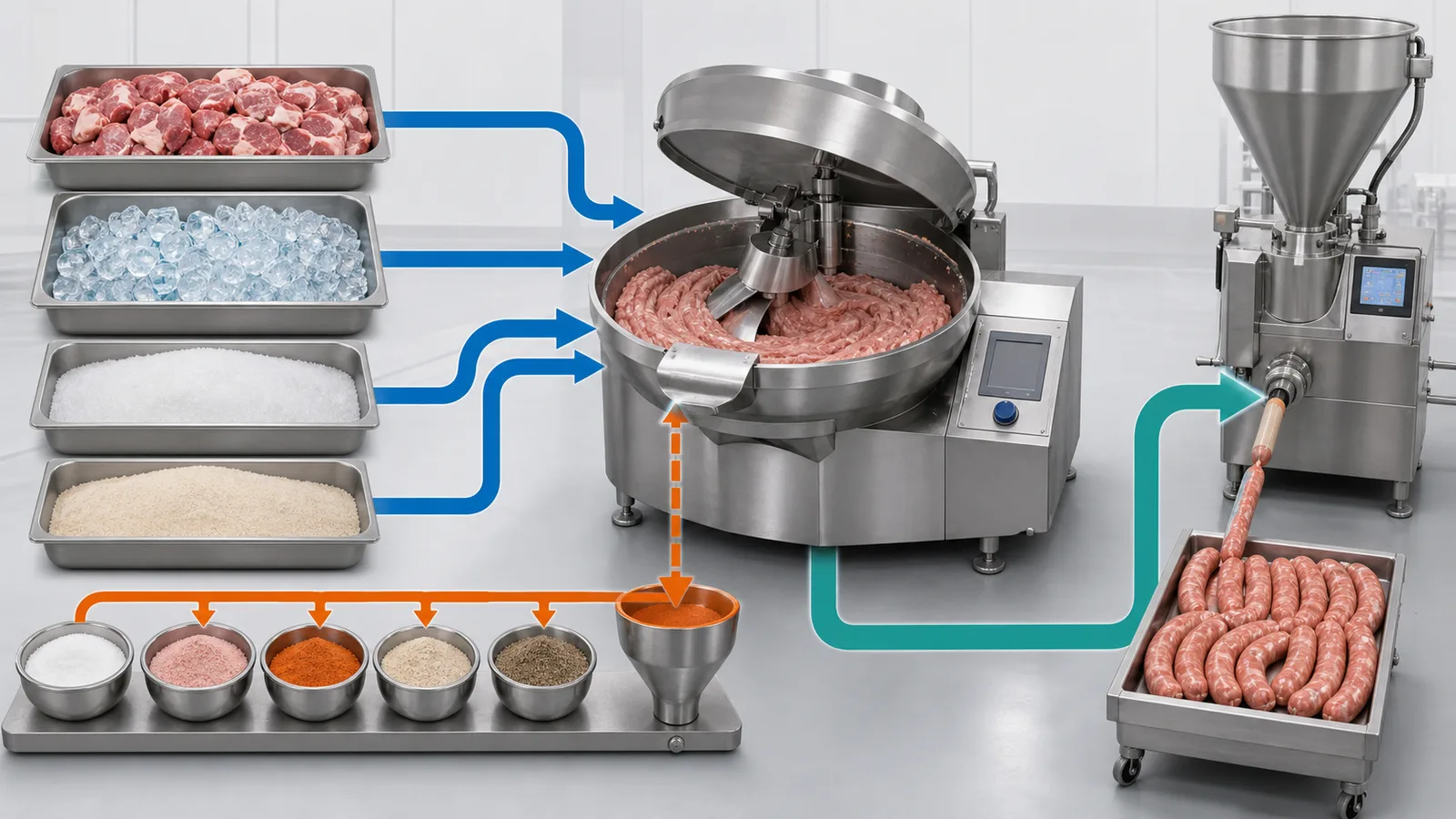
Example: convert a 100% group formula into 1,000 kg
The following generic group formula illustrates arithmetic only. It is not a recommended recipe and does not establish permitted additive levels or product identity.
| Ingredient group | Formula | Calculation | Target weight |
|---|---|---|---|
| Lean meat | 55.000% | 1,000 x 55 / 100 | 550.000 kg |
| Fat material | 20.000% | 1,000 x 20 / 100 | 200.000 kg |
| Water or ice | 20.000% | 1,000 x 20 / 100 | 200.000 kg |
| Salt and curing group | 2.000% | 1,000 x 2 / 100 | 20.000 kg |
| Seasoning group | 1.000% | 1,000 x 1 / 100 | 10.000 kg |
| Binders and other ingredients | 2.000% | 1,000 x 2 / 100 | 20.000 kg |
| Total | 100.000% | Reconciled raw batter | 1,000.000 kg |
The high-level check stops here. The production sheet must replace each group with actual approved ingredients, their exact weights, lot identities and weighing tolerances.
Expand cure and seasoning blends before release
A blend name can hide the concentration that matters. If 4.000 kg of an approved premix contains 2.5% of component A, it delivers 0.100 kg of component A. The example explains concentration math only and does not state that component A is permitted.
delivered active mass = premix mass x active concentration / 1004.000 kg x 2.5 / 100 = 0.100 kg delivered active mass.Record the premix product code, supplier, lot, current specification and target market. If suppliers change concentration or carrier composition, the old blend weight cannot be assumed equivalent.
Ten steps from approved formula to released batch
Fix the product identity, destination jurisdiction, label version and approved process.
State whether percentages use total batter, meat block, finished product or a sub-blend.
Use only the current authorized formula and confirm all group and ingredient totals.
Show actual cure, salt, seasoning, allergen and functional ingredients with concentrations.
Scale every ingredient at full precision, then apply the approved scale resolution and tolerance.
Compare targets with actual weights and investigate unexplained differences before mixing.
Follow approved grinding, mixing, chopping, vacuum, water or ice addition and discharge steps.
Capture raw-material, batter discharge, filling and thermal-process values required by the process plan.
Separate raw batter, stuffed mass, cooked or dried mass, accepted output, rework and waste.
Use authorized food-safety, legal, chemical, physical and sensory acceptance criteria.
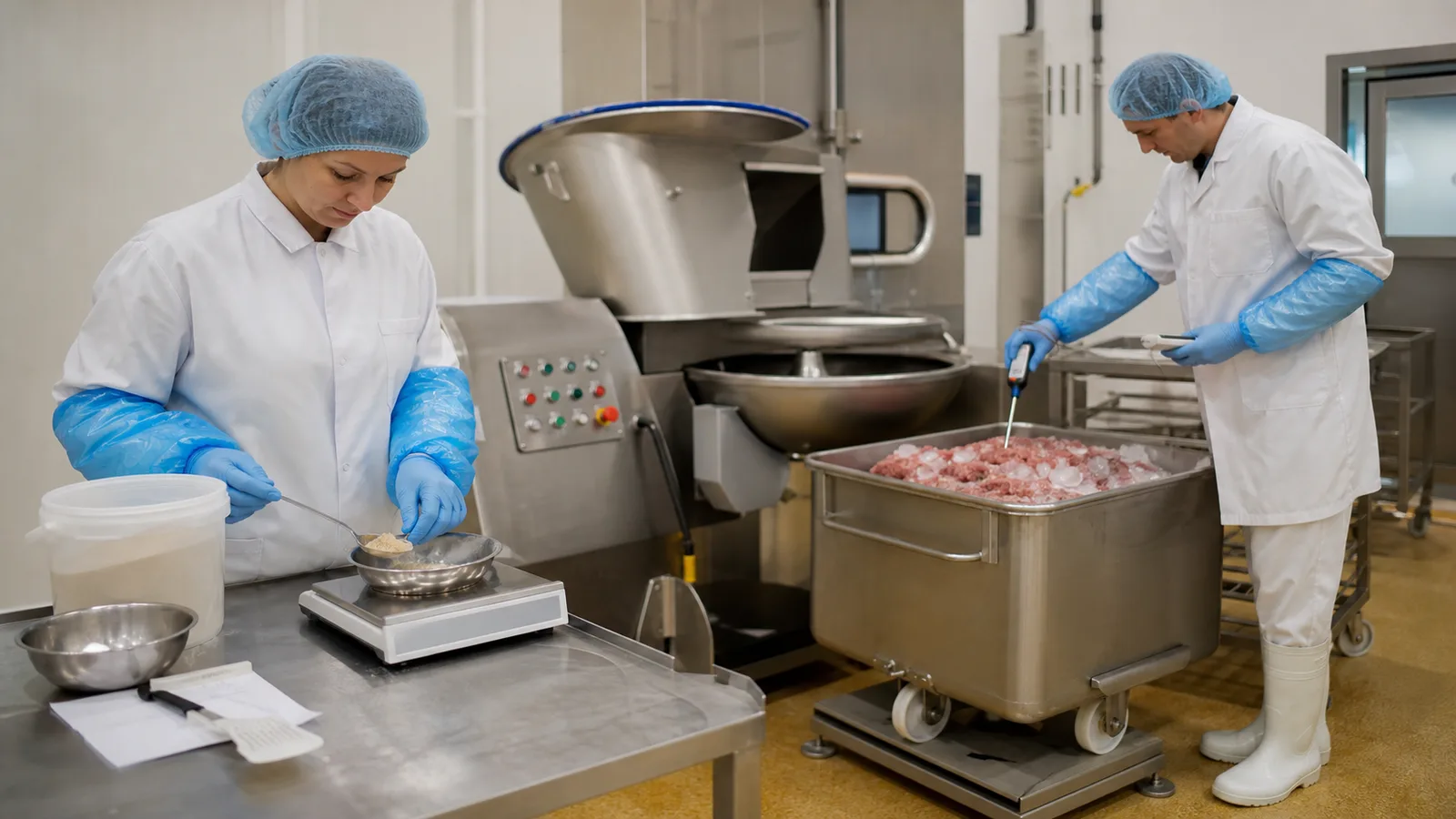
Match the scale to the ingredient risk
Major raw materials
Meat, fat and water need scales that cover batch quantity while preserving enough resolution to reconcile the total batter.
Minor ingredients
Small additions may require a separate verified balance, controlled premix or staged weighing system. A floor scale is not automatically suitable.
Tare and residue
Record container tare and account for material left in bags, bins, transfer lines, grinder, mixer or cutter when it affects batch reconciliation.
Independent checks
High-risk additions should follow the site's authorized verification method, such as barcode, recipe lock, second-person check or automated dosing confirmation.
Why an accurate batch can still fail
Published sausage research shows that composition, added water, raw-material state, fat characteristics, chopping or cutting conditions and cooking temperature can change stability, fluid release and texture. Therefore, a correct weighing sheet is necessary but not sufficient.
Raw-material functionality
Species, cut, lean quality, fat type, frozen history, pH and protein functionality can change binding at the same nominal percentages.
Particle size and sequence
Grinding plate, cutter endpoint, salt addition, water or ice distribution and functional-ingredient sequence affect protein extraction and structure.
Time, energy and temperature
Mixers, bowl cutters and emulsifiers apply different mechanical energy. Use a product-specific approved temperature and endpoint rather than a universal internet value.
Filling and thermal process
Vacuum, pressure, casing, dwell time, cooking, smoking, cooling and handling influence purge, fat separation, shape and accepted yield.
Define which yield you are measuring
stuffing yield (%) = stuffed mass / reconciled raw batter x 100process yield (%) = cooled accepted product / raw stuffed mass x 100Use the exact plant-defined measurement points. Do not compare a hot weight with a cooled accepted weight without labeling the difference.Record purge, casing loss, line residue, cooking or drying loss, rejects, samples and rework separately. A finished target of 900 kg at a validated 90% process yield requires 1,000 kg raw stuffed input; that forecast is only as reliable as the historical yield basis.
Every market requires its own review
Permitted curing agents, phosphates, antioxidants, binders, colours, allergens, product standards and label declarations vary by jurisdiction and product. In the United States, 9 CFR 424.21 and current FSIS ingredient directives are examples of sources that specify acceptable uses and limits. They are not global formula tables. Verify the current rule, product category and calculation basis with a qualified specialist for each destination market.
Codex meat-hygiene guidance treats raw comminuted sausage, cooked non-shelf-stable sausage and dry fermented products as different processing categories. The product-specific hazard analysis and validated process must therefore remain separate from the formulation calculator.
Minimum formulation and process record
Sausage formulation FAQ
Can the calculator design a new sausage recipe?
No. It converts an approved total-batch percentage formula into group weights.
Can salt and curing blend remain one ingredient?
Only for an early group-total check. The controlled weighing sheet must identify each actual ingredient and relevant premix concentration.
Should the target batch mean raw batter or finished sausage?
The linked calculator uses raw batter. If planning from finished demand, first convert demand to raw input with a validated, clearly defined process-yield basis.
Why did two batches with the same formula behave differently?
Review material lots and condition, actual weights, grinding, sequence, water or ice distribution, time, temperature, equipment energy, vacuum and downstream thermal processing.
Does a 100% total prove the batch is compliant?
No. It proves only arithmetic reconciliation. Ingredient permission, concentration, product identity, labeling and food-safety validation require separate review.
Convert the approved formula into batch weights
Check the six main ingredient groups against a defined raw-batter target, then expand the result into the plant's controlled weighing sheet.
Open Sausage Formulation CalculatorSources and technical references
- 9 CFR 424.21 - current U.S. regulation covering certain food ingredients and sources of radiation used in meat and poultry products.
- USDA FSIS Directive 7120.1 - current safe and suitable ingredient reference for meat, poultry and egg products.
- 9 CFR 417.2 - U.S. hazard-analysis and HACCP-plan requirements for covered establishments.
- Codex Code of Hygienic Practice for Meat, CAC/RCP 58-2005 - risk-based process control, HACCP, documentation and meat-processing categories.
- Morrison et al., Journal of Food Science - experimental relationship between composition, added water and sausage-type emulsion stability.
- Glorieux et al., Food and Bioprocess Technology - effects of meat type, fat type and cooking temperature on sausage properties.