
Blade count tells you how many cutting bands a saw uses. Cutting arrangement tells you where the cuts lie and which direction they follow. Feeding tells you how the product advances. These are three separate specifications: a single-blade saw can feed automatically, and a multi-blade saw can produce a particular strip pattern without making every possible portion.
Use this guide to compare layouts, then follow the relevant model link for its documented configuration. The diagrams explain geometry; they are not machine drawings or blade-setting instructions.
Compare the terms · See the cut patterns
Three specifications to read separately
| Specification | Meaning and limit |
|---|---|
| Blade count | How many saw bands are used: one, two or more. It is not the tooth count, piece count or number of cutting cycles. |
| Cutting arrangement | Where the cutting paths sit relative to each other and to the product. Parallel cuts make a different pattern from cuts in two directions. |
| Product feeding | Whether an operator advances the product or a powered mechanism advances it. A powered blade motor alone does not establish automatic product feed. |
Count cutting planes, then look at their arrangement
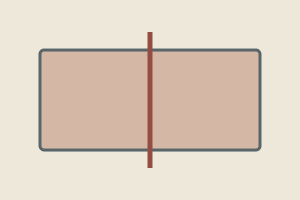
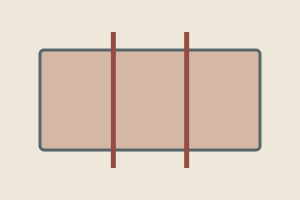
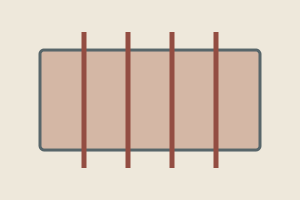
Red lines show complete cut paths through one connected blank; they are not drawings of physical saw bands. All cuts lie inside its edges. These parallel-cut examples do not define the JGJ-5060 layout.
The number of resulting pieces depends on the arrangement, not just the blade total. Separate lanes, trimming cuts and successive cutting stages can produce different results. Ask what enters, which cuts occur and what leaves; a photograph showing two blades cannot answer all three questions.
A single blade can still have automatic feeding
The JGJ upright bone saw series uses operator-controlled feeding, with table and accessory choices across its range. The JGJ-6580A combines a single band blade with servo-controlled feed and product holding. Both are single-blade arrangements, but their feeding architectures differ.
A sliding worktable supplies moving support; it does not by itself establish powered indexing. Likewise, “automatic” needs a defined scope: product loading, holding, advance and discharge are separate functions. Compare the documented sequence rather than treating the word as a promise that every production task is automated.
ASTECH's SRA-D is an independent example of automatic product advance. Its angle-cutting features are specific to that machine.
Dual blades need a defined cut pattern
The original HELPER JGJ-5060 description identifies two saw blades, automatic feeding and double-layer product clamping. That establishes a different architecture from the single-blade JGJ-6580A. It does not mean every saw advertised as “dual” has the same blade layout or portioning sequence.
For a comparison, identify whether the required result is several parallel pieces, repeated portions or a trimming operation. Keep blade count separate from the number of products loaded. “Double cut” is also not a sufficient description of blade quantity: request the actual arrangement instead of converting a marketing term into an assumed two-blade machine.
Multi-blade strip cutting is a specific production task
The current JGJ-3060 four-blade rib saw page describes four parallel cutting planes and five outgoing strips from a compatible incoming piece. It lists customized segment spacing, which should be understood as an ordered configuration rather than an assumed touchscreen adjustment range.
Four parallel cuts alone produce a strip pattern, not cross-cuts in a second direction. A cube-shaped output requires additional geometry and a defined process sequence. A supplier's “strip and cube” description therefore needs an explanation of the complete arrangement; it is not proof that a parallel blade pack alone makes cubes.
A strip pattern is an output shape; it is not a statement that the machine weighs each portion.
Compare adjustment and output, not a blade-count multiplier
| Question | What to distinguish |
|---|---|
| What sets the size? | Distance between cutting planes, programmed feed increment and finished portion dimension are separate descriptions. |
| What changes between products? | A software recipe, a configured blade arrangement and a different holding system are different kinds of change. |
| What counts as output? | Accepted portions over the complete loading, cutting and discharge cycle, rather than blade count alone. |
Dimension example: On an imaginary parallel-blade layout, a 20 mm blade gap describes separation across the cut paths. A 30 mm indexed feed step describes product advance between cycles. Changing that feed step does not describe changing the blade gap. These are illustrative dimensions, not HELPER settings, finished-size guarantees or adjustment instructions.
For an ideal blank, four internal parallel cuts create five pieces. Neither “four cuts” nor “five pieces” proves four or five times the hourly accepted output of another machine. Product size, loading, discharge and the required cut pattern still define the comparison.
Multiple kerfs also need consideration; an extra cutting plane is not a guarantee of better material yield. For replacement-band terminology, use the blade specification guide. For mass targets, the thickness versus weight guide explains why blade count and servo control do not establish fixed-weight capability.
Frequently asked questions
Does a single-blade saw mean manual feeding?
No. The single-blade JGJ-6580A has automatic feeding. Blade quantity and feeding method are separate specification fields.
Do two blades always produce two pieces?
No. Piece count depends on the geometry. Two complete parallel internal cuts through one connected blank create three parts; other arrangements can differ.
Can a four-blade strip saw make cubes in one pass?
A parallel blade pack alone makes parallel cuts. Cube production needs another cutting direction and a documented process arrangement; confirm the complete machine sequence.
Are blade spacing and feed thickness the same setting?
No. They describe different relationships. Confirm which dimension is configured, which is programmable and which finished dimension the supplier's claim actually covers.
Sources and scope
Manufacturer descriptions checked 9 November 2026. Comparisons concern architecture, not a performance test. Illustrations show geometry concepts and do not specify a machine configuration.
- Original HELPER JGJ-5060 description. Undated page identifying dual blades, automatic feeding and clamping; it does not establish the universal geometry of dual-blade saws.
- ASTECH SRA-D. Undated manufacturer example of automatic product advance and a defined cutting arrangement. Its features are not transferred to HELPER models.
- FUMA multi-saw description. Undated example listing blade quantity and customizable dimensions. No numerical specifications are transferred.
- Current HELPER JGJ-3060 page. Source for the published parallel-strip configuration; not an independently witnessed production trial.