
Equal-thickness bone saw cuts can have different weights because thickness is only one dimension of a portion. Its cross-sectional area and composition also matter. Fixed-thickness cutting prioritises a dimension; fixed-weight portioning prioritises mass. Repeatable servo feeding does not, by itself, establish either finished-thickness accuracy or a fixed portion weight.
For buyers comparing the JGJ bone saw series, the first decision is the required result: a consistent slice thickness, an individual portion weight, or a package weight. This guide explains those specifications, with hypothetical arithmetic rather than HELPER trial data.
Four specifications that should stay separate
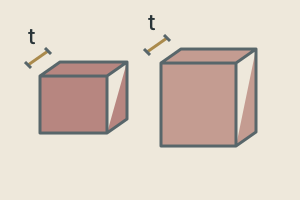
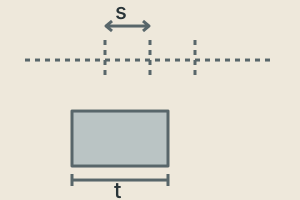

Original conceptual illustrations, not machine drawings or measured performance evidence.
| Specification | What it describes |
|---|---|
| Feed increment | The programmed or measured advance of the feeding mechanism, usually a length. |
| Finished thickness | The dimension of the portion after cutting, with a defined measurement method. |
| Individual weight | The mass of one portion, stated in grams or another mass unit. |
| Pack weight | The combined product mass in a package, which may contain several unequal portions. |
Why the same thickness can produce different weights
A narrow end and a broad middle section of a primal can yield different portion volumes even when their thicknesses match. For a short segment with an approximately constant cross-section, volume is approximately cross-sectional area multiplied by thickness. Mass then depends on that volume and its effective density.
Bone, meat and fat are not interchangeable composition descriptions. Nor does matching the outer outline prove identical internal composition. This is why a universal conversion from millimetres to grams is unsuitable for variable bone-in products.
MARELEC's PORTIO 3D description illustrates the distinction: its software uses a scanned shape and density information to calculate cutting locations for target weights. That is a named manufacturer's portioning method, not a capability established for every servo-fed saw.
Worked example: equal thickness, 50% more volume
Assume two idealised, uniform segments have cross-sectional areas of 100 cm² and 150 cm². Both portions are 20 mm thick. Convert the thickness first: 20 mm equals 2 cm.
| Portion | Volume calculation |
|---|---|
| A | 100 cm² × 2 cm = 200 cm³. |
| B | 150 cm² × 2 cm = 300 cm³. |
The ratio is 300 ÷ 200 = 1.5. B has 50% more volume. Only if their effective densities are equal would it also weigh 50% more. No gram value follows without a density or an actual weight measurement. Real curved sections and changing composition make this simplified calculation an explanation, not a cutting recipe.
What fixed-weight portioning adds
Dedicated portioning systems can plan cuts from more information than a repeated advance. Marel's June 2021 I-Saw brochure describes camera-vision scanning and separate constant-weight and constant-thickness modes for frozen boneless or bone-in products. It demonstrates the distinction between control objectives; its performance claims are not transferred to HELPER equipment.
Nantsune also distinguishes fixed-thickness, individual fixed-weight and pack fixed-weight modes in its slicer range. These examples show why “automatic portioning” needs a more precise description. Identify whether the target applies to each cut or to a group, and which product variation the system is designed to accommodate.
Read accuracy claims against the finished product
The JGJ-6580A page describes servo-controlled feeding and product holding. Those features explain its architecture; they do not establish a scanning-based fixed-weight function. A quoted positioning figure also needs its measurement object identified before it can describe finished portions.
Ask whether a thickness claim concerns mechanism travel or the finished cut, and whether a weight claim concerns one portion or a batch average. The claim's product condition, measurement method and variation matter alongside its headline number.
A hypothetical set of 180 g, 200 g and 220 g portions averages 200 g, although none of that proves all portions are close to the target. Read the spread and the individual results as well as the average. These example weights are not acceptance limits or test results.
Use the fresh, frozen and bone-in selection guide to define the application separately. Product suitability, dimensional consistency and weight consistency are related purchasing questions with different evidence.
Frequently asked questions
Will equal thickness give equal weight?
Only under sufficiently consistent geometry and composition. Thickness alone does not establish mass; changing cross-section can change the weight of an equally thick portion.
Does servo feeding mean fixed-weight cutting?
No. Servo feeding controls movement. A fixed-weight function needs a defined method of relating the actual product to the intended portion mass.
Can I specify both weight and thickness?
State both priorities and their allowed variation. Whether both can be achieved depends on product geometry and the selected process; neither follows automatically from the other.
Does a fixed-weight pack contain equal-weight portions?
Not necessarily. A pack target concerns the total product mass. An individual portion target concerns each piece and is a separate requirement.
Sources and scope
Original manufacturer sources checked 9 November 2026. They illustrate different portion-control methods; none establishes fixed-weight capability or a new accuracy claim for a HELPER saw.
- MARELEC PORTIO 3D. Undated manufacturer page describing scanning, density information and target-weight cut planning.
- Marel I-Saw brochure (PDF), marked June 2021. Historical technical example of constant-weight and constant-thickness modes for frozen products; not a current availability claim.
- Nantsune fixed-weight cutting range. Undated manufacturer page distinguishing thickness, individual weight and pack weight modes; no numerical performance claims adopted.
- HELPER JGJ-6580A. Existing feeding architecture description, not evidence of a weight-control system.