
Inspect
Confirm temperature, dimensions, bone condition and the approved blade for the scheduled product.
Select the worktable, cutting window and blade speed for frozen blocks, ribs, trotters, steaks, poultry and fish. Stainless construction, gas-spring blade tension and motor braking support precise, hygienic production.
The JGJ series covers small floor-standing and bench-format machines through the much larger JGJ-6000. The critical selection inputs are the maximum product width and height, frozen core temperature, bone density, desired portion thickness, worktable area and handling method. A larger motor does not compensate for a product that cannot be safely supported or guided through the cutting window.
These machines are documented for -18°C frozen meat and large bone-in pieces including ribs, pork, frozen fish, trotters, steaks, chicken and duck. They are manual-feed band saws, distinct from HELPER's four-blade rib saws and automatic-feed systems. Operator exposure, push tools, guarding and task design therefore require careful risk assessment.
Confirm temperature, dimensions, bone condition and the approved blade for the scheduled product.
Adjust fence, thickness guide, blade guard and table configuration with the machine isolated.
Use the approved push method and controlled feed rate while keeping hands outside the danger zone.
Monitor portion thickness, kerf loss, blade condition, temperature and accepted kilograms per hour.
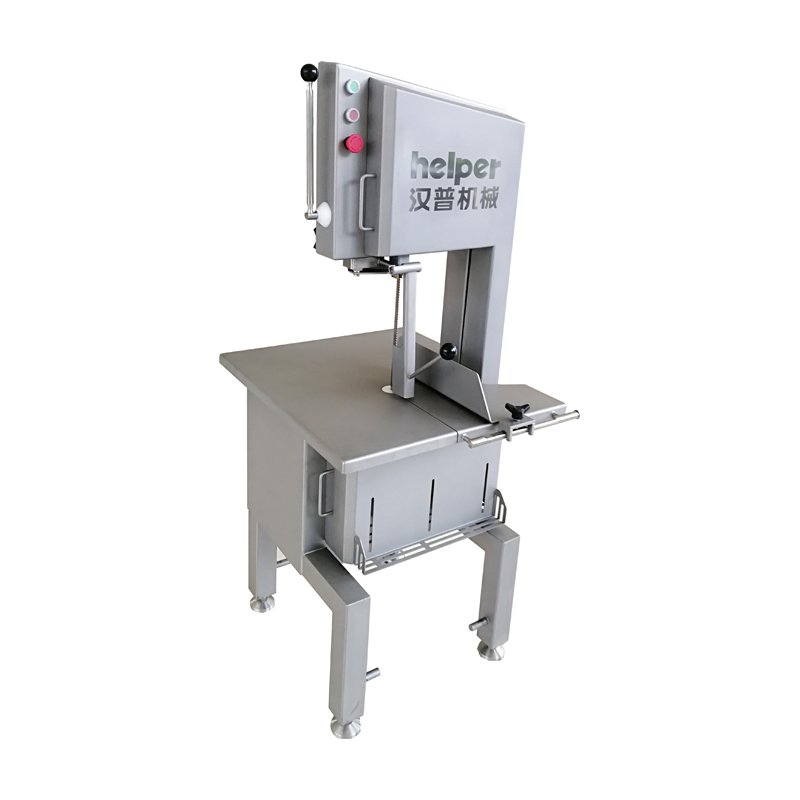
High-pressure cleaning still requires an approved sanitation procedure. Isolate power, remove residues, protect seals and bearings, and confirm chemical concentration and spray direction with the supplier.
| Model | Cut W × H | Blade speed | Power | Weight | Dimensions |
|---|---|---|---|---|---|
| JGJ-2600 | 220 × 260 mm | 18 m/s | 1.1 kW | 130 kg | 720 × 600 × 1420 mm |
| JGJ-3000 | 250 × 300 mm | 20 m/s | 1.1 / 1.5 kW | 165 kg | 785 × 666 × 1640 mm |
| JGJ-3500 | 330 × 350 mm | 28 m/s | 1.5 kW | 215 kg | 895 × 1000 × 1750 mm |
| JGJ-4000 | 330 × 400 mm | 28 m/s | 2.2 kW | 218 kg | 895 × 1000 × 1810 mm |
| JGJ-4500 | 380 × 450 mm | 32 m/s | 2.2 kW | 245 kg | 930 × 1000 × 1930 mm |
| JGJ-5000 | 380 × 500 mm | 32 m/s | 2.2 kW | 246 kg | 930 × 1000 × 1980 mm |
| JGJ-6000 | 600 × 600 mm | 35 m/s | 7.5 kW | 640 kg | 1290 × 1375 × 2240 mm |
Cut loss is affected by band thickness, tooth pitch, blade tension, guide alignment, speed, feed pressure and product temperature. A blade that wanders can create variable portions and unnecessary bone dust even when the thickness fence is correctly positioned. HELPER states a guide-amplitude test of 0.01 mm; confirm how that value is measured and maintained.
For trials, weigh incoming blocks, accepted portions, trim, bone dust and remaining ends. Measure portion thickness at multiple points and inspect the cut face for smear, chipping and fracture. Repeat with the coldest and largest production product rather than a convenient soft sample.
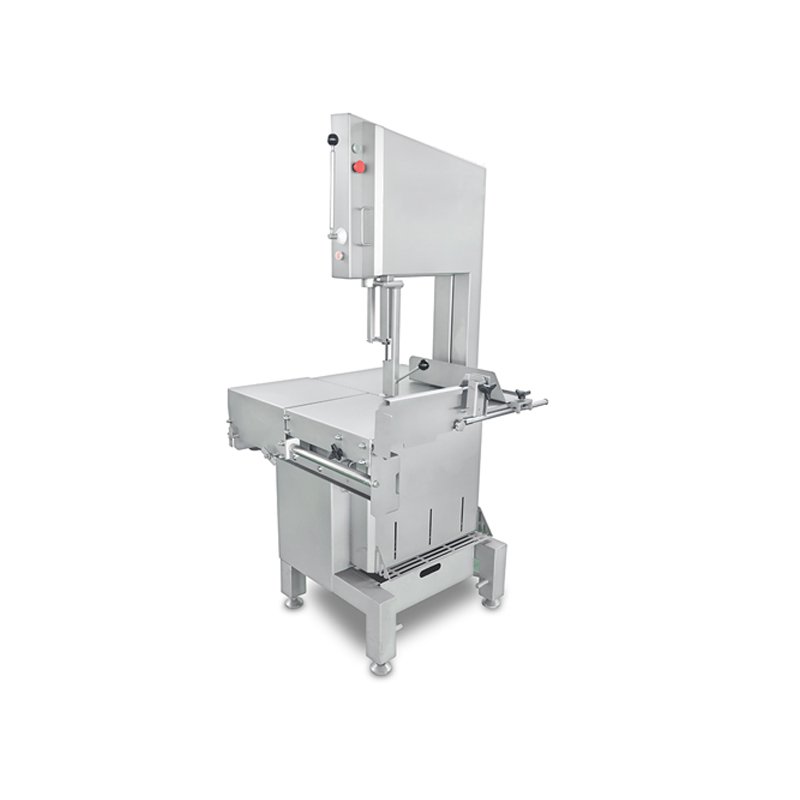
Flexible for changing products and portion requirements where trained operators control each cut.
For parallel multi-cut processing and a defined rib or bone-in product geometry.
For repeatable high-volume portions with guarded mechanical presentation to the cutting zone.
Measure blade stop after normal stop, emergency stop, door opening and power interruption under defined conditions.
Verify door interlock, adjustable blade guard, covers, push tools, fence locking and restart prevention.
Run minimum and maximum products at real temperature; record output, thickness, kerf, vibration and blade drift.
Demonstrate safe blade removal, wheel and guide access, scrap collection, drainage and post-clean inspection.
Send product species, photographs, maximum width and height, frozen core temperature, bone type, required portion thickness, hourly volume and operator method. Include room temperature, floor plan, available voltage, washdown standard, downstream handling and preferred table height. Request the approved general arrangement, electrical diagram, blade list, replacement frequency, safety circuit description, cleaning manual and witnessed FAT protocol. Local machinery regulations and operator risk assessment must be completed before production release.
That is the published application. Performance still depends on product dimensions, bone structure and actual core temperature; validate the coldest production material.
Start with the maximum cutting width and height, then confirm table area, handling method, blade speed and power. Do not select solely from motor rating.
The exact page states IP65 and direct high-pressure cleaning. Confirm the offered enclosure rating and follow an approved isolation, chemical and spray-direction procedure.
No stable model-specific JGJ operating video was found. The page uses exact official product images and does not substitute an automatic or multi-blade saw video.
Receive a JGJ model review covering table, blade, guards, utilities, cleaning and acceptance testing.