
Qualify
Confirm dimensions, core temperature, bone position and surface condition against the approved product window.
Turn a compatible rib or bone-in slab into five parallel portions in one controlled pass. Synchronized belts, removable conveying parts and customized 25–65 mm segment spacing make this a dedicated production machine—not a general-purpose manual band saw.
The JGJ-3060 uses four vertical saw blades and coordinated feed belts to create five strips from one incoming piece. Compared with repeating four cuts on a manual saw, this fixes the blade-to-blade relationship for the ordered configuration and reduces repeated product handling. It is intended for stable, repeatable rib and compatible bone-in geometries.
This architecture should be selected by the incoming product envelope, finished strip width and bone orientation. The published 25–65 mm segment width is customized, not an operator recipe range that can automatically be changed during production. Buyers should therefore provide drawings or representative samples for every required cut pattern before the blade pack is released.
Confirm dimensions, core temperature, bone position and surface condition against the approved product window.
Verify blade condition, tension, spacing, guards, belts and collection areas before production release.
Synchronized belts stabilize and convey the product through all four cutting planes in a single pass.
Measure all five strips, cut-face quality, bone dust, kerf loss and accepted kilograms per hour.
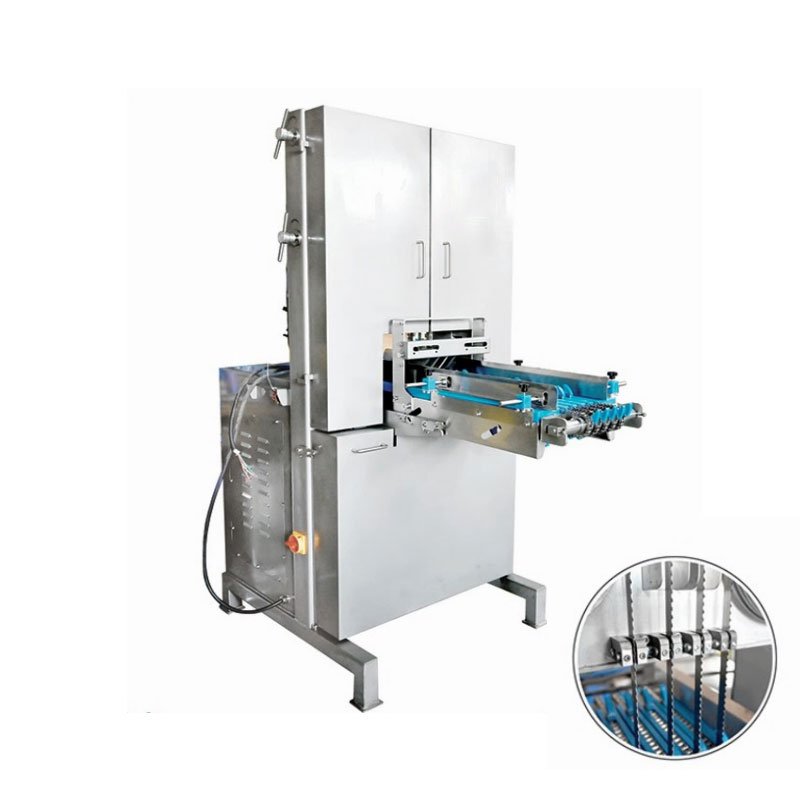
The official description identifies construction and functional principles but does not publish stainless grade, ingress protection, belt material or safety-category details. Confirm each item in the quotation and technical agreement.
| Model | JGJ-3060 |
|---|---|
| Workbench / feed width | 300 mm |
| Maximum cutting height | 160 mm |
| Published dimensional accuracy | 1.5 mm |
| Segment width | 25–65 mm, customized |
| Saw-blade linear speed | 20 m/s |
| Installed power | 9.55 kW |
| Blade lengths | 2000 mm × 2; 3550 mm × 2 |
| Machine weight | 650 kg |
| Overall dimensions | 1600 × 1100 × 1960 mm |
The model-specific HELPER video is positioned here because it helps engineering teams review presentation, belt guidance and discharge after the process and specification context is understood.
Watch whether the product stays square to every cutting plane and whether individual strips leave without twisting or collision. Video demonstrates the mechanism, but it cannot establish capacity, accuracy or yield for a buyer's raw material. Those values require a witnessed run using representative cold product.
Record feed interruptions, blade vibration, dust accumulation, cut-face damage and the handling needed at the infeed and discharge. Include stop and restart behavior, because trapped product around four blades can create a different recovery task from a single-band machine.
A multi-blade saw can remove four kerfs in one pass. Total saleable yield therefore depends on blade thickness, tooth set, bone density, product temperature, alignment and the end-trim strategy. The relevant result is not only nominal strip width: measure the weight of all accepted strips, trim, bone dust and unrecovered material.
Dimensional accuracy should be checked across every lane and along each strip. If one blade drifts, its error changes the two neighboring portions. Establish a sampling plan that identifies blade position, not just a pooled average. Trend strip width and cut-face quality to detect blade wear or guide movement before rejects accumulate.
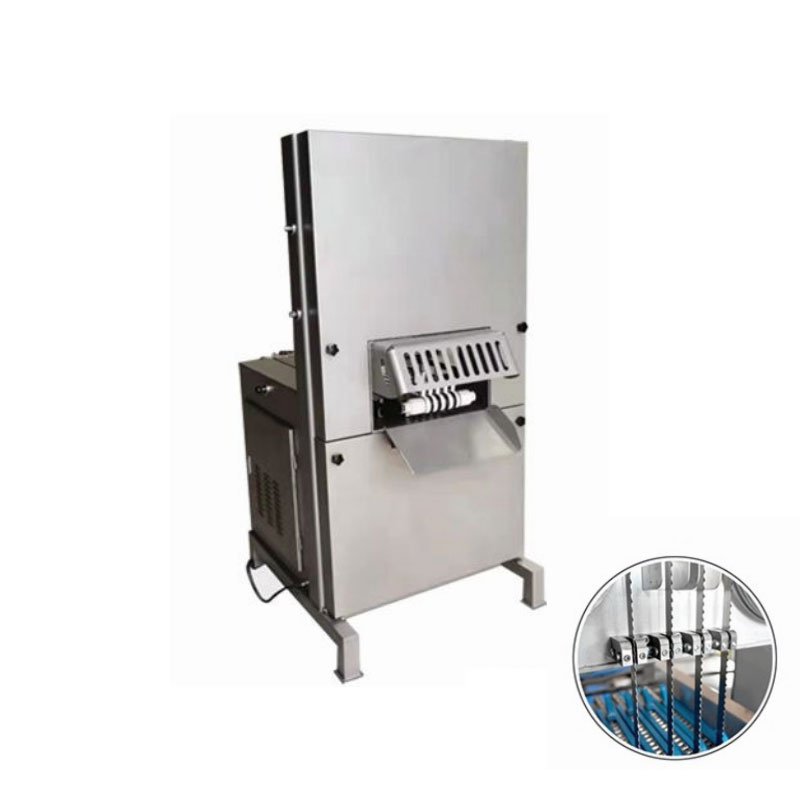
Best for one validated bone-in geometry that needs five parallel strips and repeatable spacing in one pass.
More flexible for changing shapes and thicknesses, but each cut depends on trained operator presentation.
Better where programmable portioning or a different feed architecture is needed; evaluate the exact machine separately.
Verify access prevention, cover interlocks, emergency stops, restart prevention and measured blade stopping time.
Run minimum and maximum product sizes at real core temperature; measure every one of the five resulting strips.
Confirm tension procedure, break detection if offered, guide inspection, replacement access and safe trapped-product recovery.
Remove the conveyor as demonstrated, inspect belts, slides, pins, saw wheels, guides and residue collection for retained soil.
The factory acceptance test should define raw-material quantity, temperature band, bone orientation and feed presentation. Record gross input, accepted output, trim and dust; calculate yield and accepted throughput. Check noise, vibration, motor current and temperature during a sustained run. After sanitation, inspect hidden surfaces and verify that the conveyor relocates repeatably without changing the cut pattern.
Send product species, clear photographs, minimum and maximum length, width and height, bone location, core temperature, target strip widths and permitted tolerance. State required accepted kilograms or pieces per hour, shift pattern, sanitation chemicals, plant voltage, available floor space and upstream/downstream transfer heights. If more than one width pattern is required, identify changeover frequency and ask whether the spacing conversion is supplier-only or plant-maintainable.
Request a signed general arrangement, guard layout, electrical and pneumatic schedule, blade drawing, spare-parts list, sanitation instructions and FAT protocol. Confirm CE or other market-specific compliance for the supplied serial configuration. Site risk assessment, guarding interfaces, operator training and lockout procedures remain necessary even when a machine carries a certificate.
Four parallel blades divide one compatible incoming piece into five strips in a single pass.
The official page describes 25–65 mm as a customized segment width. Treat the ordered spacing as a configured cut pattern and confirm any changeover method before purchase.
The published work width is 300 mm and maximum cutting height is 160 mm. Length, bone orientation, temperature and belt grip still require sample validation.
Yes. The embedded official HELPER video uses ID A3HeCEfGQ8w and is presented after the process and specification sections so the footage can be reviewed in engineering context.
HELPER can review blade spacing, feed suitability, guarding, utilities, sanitation and a product-specific acceptance test.
Application fit
Best suited to parallel portion cutting of ribs and comparable bone-in products that can be presented safely and consistently across four cutting lanes. Final suitability should be confirmed with representative product trials and the agreed acceptance criteria.