
Qualify product
Confirm dimensions, temperature, bone orientation and surface condition against the validated feed window.
Automate presentation of frozen ribs, steaks, bone-in meat and fish products while keeping operators away from the cutting zone. Dual saw bands, servo-controlled portion settings and a double-layer clamping system support repeatable, higher-output cutting.
The JGJ-5060 combines automatic feeding with two saw blades. Operators load and orient product at the feed area; a special double-layer clamping device stabilizes the material, and servo control sets cutting speed and portion thickness. This architecture targets repeatable production rather than flexible one-off cuts.
The exact official application range is frozen product from approximately -18°C to -4°C, including ribs, frozen meat, steak, bone-in meat and fish products. Performance changes with product width, bone layout, surface frost and temperature. The stated range is therefore a trial envelope, not proof that every shape within it will feed reliably.
Confirm dimensions, temperature, bone orientation and surface condition against the validated feed window.
Choose approved thickness and speed settings; inspect blades, belts, clamps, air supply and guarding.
The double-layer device stabilizes product while servo-controlled feeding presents it to both cutting planes.
Track portion thickness, accepted weight, kerf, bone dust, incomplete cuts and interventions by blade lane.
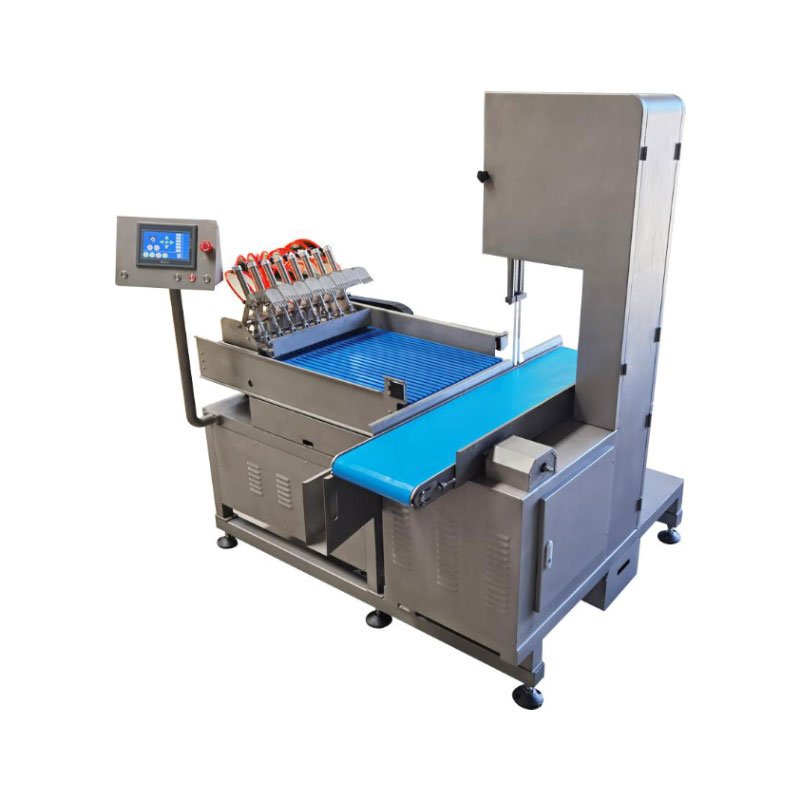
The exact page does not publish servo resolution, clamp stroke, feed speed, cycle capacity, touchscreen recipe count or safety circuit category. These are quotation and FAT items.
| Model | JGJ-5060 |
|---|---|
| Table size | 700 W × 520 L mm |
| Maximum product height | 150 mm |
| Cutting thickness range | 3–150 mm |
| Published cutting accuracy | 0.1 mm |
| Blade speed | 32 m/s |
| Blade specification | 3375 × 19 × 0.56 mm, 3T/4T |
| Published total power | 9.4 kW |
| Cutting motor | 5.5 kW |
| Conveyor-belt motor | 0.6 kW |
| Air pressure | 0.6 MPa |
| Machine weight | 970 kg |
| Overall dimensions | 2200 × 2180 × 1950 mm |
The verified JGJ-5060 video is presented after the mechanism and specification sections to support engineering review of the actual automatic-feed sequence.
Observe how the clamp closes, how product advances toward both blades and whether the cut pieces clear the discharge without collision. Check how end pieces are managed and what operator actions are needed between cycles.
Footage confirms architecture; it cannot prove the published 0.1 mm accuracy, sustained output or yield on a buyer's material. Verify those values with cold representative products and a defined measurement system.
Measure leading, middle and trailing positions and identify which blade produced each cut surface.
Record incoming mass, accepted portions, ends, trim and bone dust to calculate saleable yield.
Trend lane-specific deviation, vibration and cut-face quality as blades wear through a production run.
Challenge the clamp with minimum and maximum widths, surface frost and realistic bone orientation.
A touchscreen value is not the finished-product measurement. Define thickness tolerance, sampling frequency, gauge method and product conditioning. Because two blades work simultaneously, unequal tension or guide alignment can create different results between lanes. Acceptance data should preserve that distinction.
Mechanical clamping keeps routine operator handling farther from the cutting area than a manual saw. Remaining hazards include loading reach, clamp pinch points, blade access, broken bands, trapped product, discharge contact and unexpected restart. Confirm interlocked guards, emergency stops, safe torque removal or equivalent control, pressure isolation and a locked-out jam-recovery procedure.
Measure stopping time under normal stop, emergency stop, guard opening and power interruption. Verify that loss and restoration of air or power cannot create uncontrolled clamp or feed movement. Destination-market assessment must include upstream and downstream interfaces.
Frozen meat residue and bone dust can enter belt returns, clamp joints, blade slots, guides and the lower wheel cabinet. Request a demonstrated cleaning sequence, approved chemical limits and ingress ratings. Isolate electrical and pneumatic energy, confirm blade stop and follow the supplier's blade-handling method before removing guards.
Time disassembly, cleaning, inspection and reassembly during FAT. After sanitation, verify blade tracking, conveyor tracking, clamp alignment, sensor function and recipe accuracy. Hygienic acceptance should evaluate retained soil rather than external appearance alone.
Provide minimum and maximum product dimensions, species, bone layout, core temperature, target thicknesses and hourly accepted output. Run representative material from -18°C through the warmest approved condition. Record cycle time, loading and discharge labor, accepted kilograms, thickness distribution, blade-lane differences, kerf, dust, stops and interventions.
Challenge several recipes, including minimum 3 mm and larger production portions where relevant. Check clamp marks, broken or chipped bone, end-piece handling and restart after interruption. Complete electrical-load, air-consumption, noise, vibration, stopping and cleaning tests. Agree numerical acceptance limits before manufacture and retain samples or photographs with the FAT report.
The official page lists ribs, frozen meat, steak, bone-in meat and fish products at approximately -18°C to -4°C. Each actual geometry still requires feeding and cut-quality validation.
That is the published thickness range. Confirm recipe steps, blade spacing logic, end-piece handling and tolerance with your product during FAT.
0.1 mm is the published claim. The page does not define its method, sample or statistical basis, so establish a mutually agreed measurement protocol and acceptance limit.
Yes. The official product page exposes video ID -oWnJ-ntX9c. No footage from the four-blade or single-blade automatic machine is substituted.
Receive a JGJ-5060 review covering feed trials, dual-blade performance, utilities, guarding, sanitation and FAT criteria.