
Automatic Wonton & Shumai Forming Machine
A full-servo forming platform that combines three-stage dough sheeting, accurate filling and product-specific molding for industrial wonton and shumai production.
Coordinate sheeting, filling and forming
Product quality depends on the complete relationship between dough condition, sheet reduction, filling rheology, mold geometry and discharge handling.
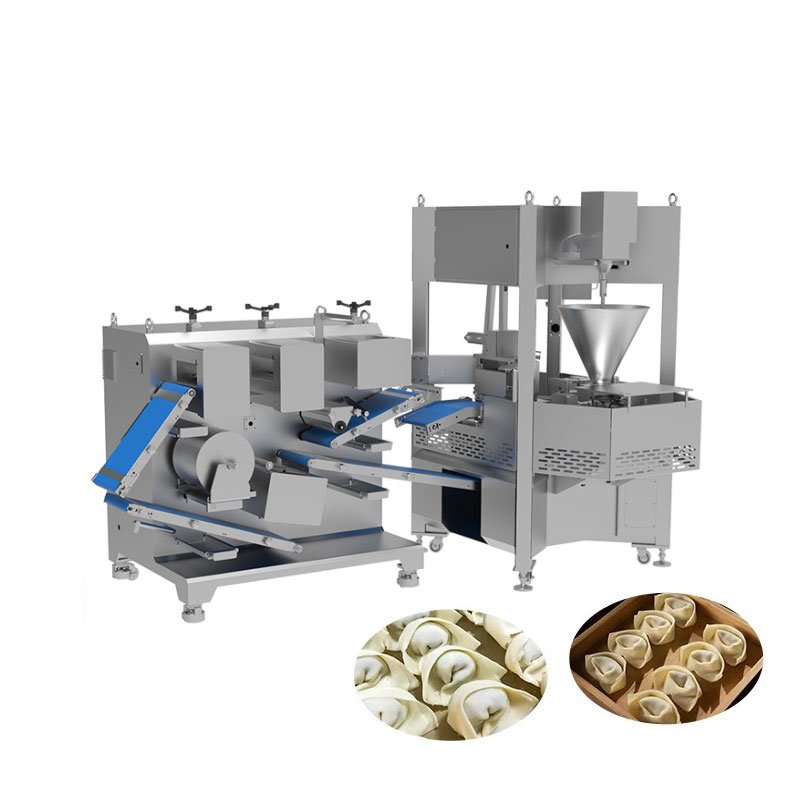
Designed for repeatable industrial forming
Coordinated motion stabilizes dough transport, filling timing and mold position.
PLC or industrial-computer control supports product changeover and repeat settings.
Stainless-steel construction and removable contact parts support sanitation.
Finished shape and seal profile are engineered around approved product samples.
Technical specifications
| Model | Capacity | Product weight | Air pressure | Power | Weight | Dimensions |
|---|---|---|---|---|---|---|
| JZ-2 | 80–100 pcs/min | 55–70 g | 360 mm | 11.1 kW | 1600 kg | 2900 × 2700 × 2400 mm |
JZ-2 is a shared servo platform. Wonton and shumai geometry requires the correct dedicated mold and verified filling characteristics.
How JZ-2 forms consistent wontons or shumai
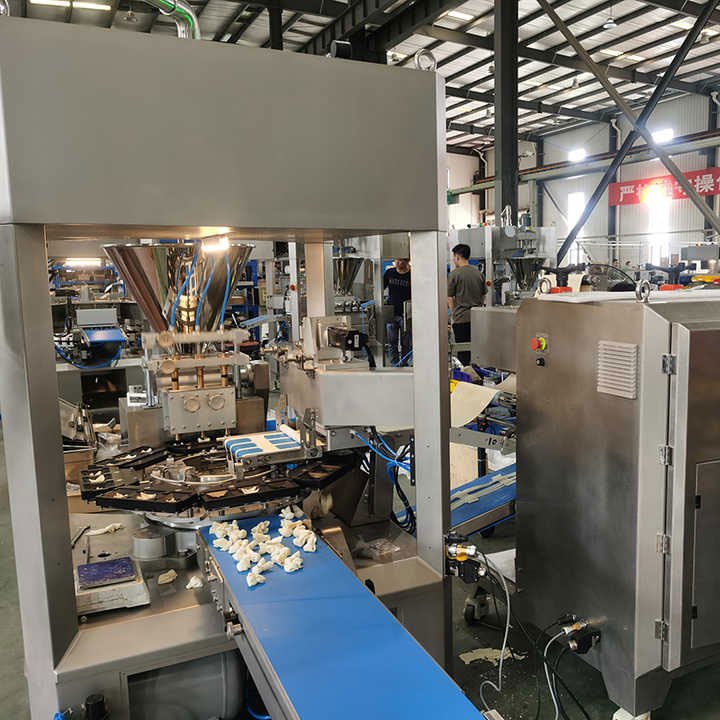
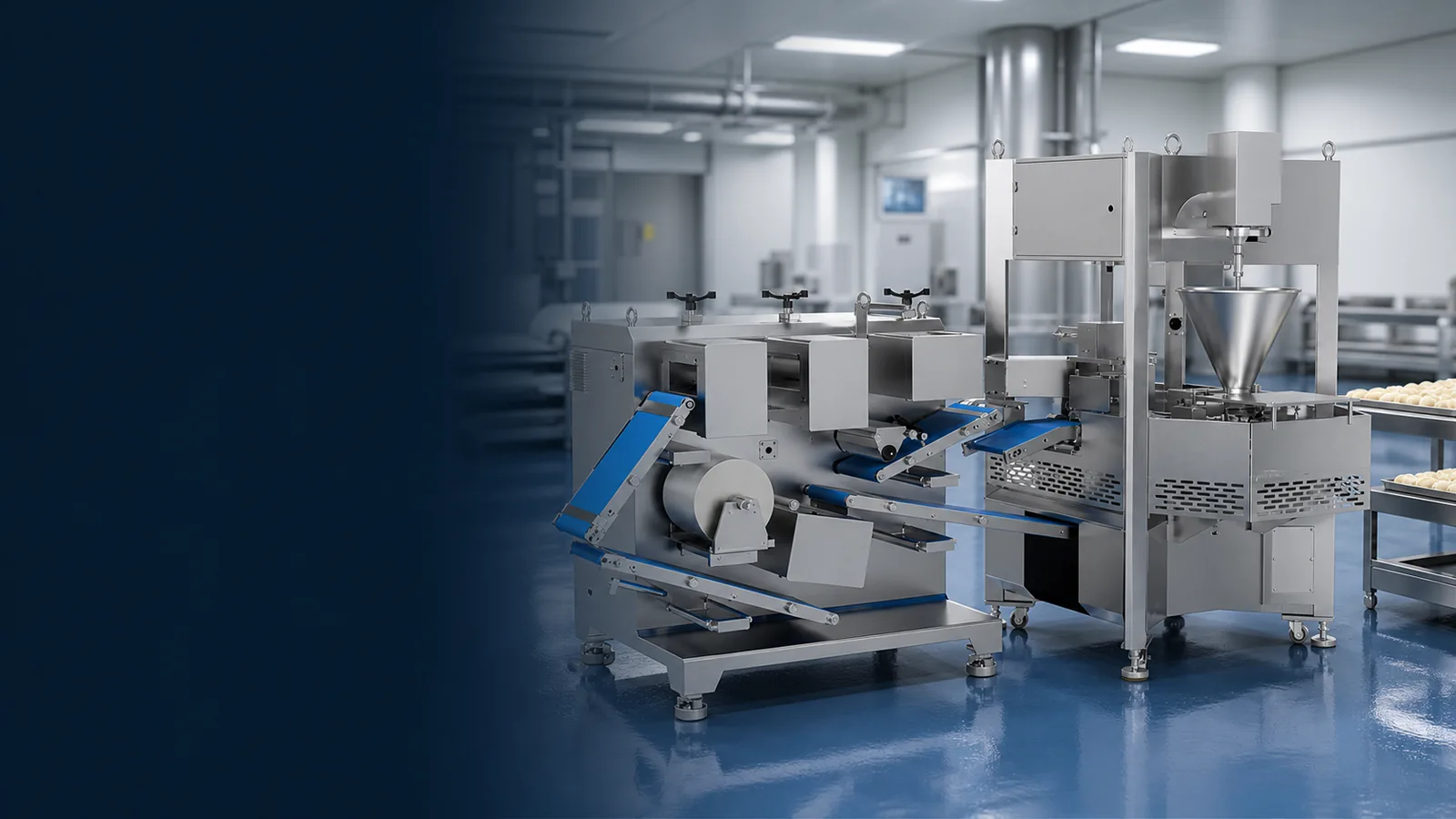
JZ-2 combines a three-stage dough-sheet reduction system, synchronized filling and a product-specific forming station on one full-servo platform. Progressive rolling prepares a stable 360 mm dough band before it reaches the high-precision hollow rotary table. The controls coordinate sheet advance, filling timing and mold motion so wrapper weight, filling position and finished geometry can remain repeatable.
Wontons and shumai require different forming actions. A wonton normally folds and closes around the filling; shumai controls an open-top profile with visible filling. They can share the JZ-2 base platform, but each needs an approved mold, recipe and discharge setup. A change between the two is therefore a validated tooling change—not merely a screen selection.
Flour strength, hydration, mixing development, resting time and temperature affect edge cracking, adhesion, spring-back and sheet thickness. Trials establish the practical roller settings.
Particle size, fibers, free liquid, fat temperature and viscosity influence dosing accuracy and wrapper contamination. The real formula should be tested before acceptance.
Tool geometry determines the outline, fold, seal and release. Samples or dimensioned drawings are used to confirm the finished product and change parts.
Discharge height, belt speed and spacing can be matched to tray loading, steaming, cooking or freezing after the downstream interface is defined.
Published operating envelope
The official specification lists 80–100 pieces per minute, a finished weight of 55–70 g and a wrapper portion of 20–25 g. These figures define the JZ-2 configuration envelope. Sustainable factory output depends on continuous dough supply, filling behavior, product acceptance criteria and downstream capacity.
Cleaning and changeover
Food-contact components support removal for sanitation. The factory plan should define disassembly order, allergen changeover, cleaning chemistry, inspection points and restart verification while protecting electrical and pneumatic components from uncontrolled washdown.
JZ-2 wonton and shumai machine FAQ
Can one JZ-2 make both products?
Yes, when supplied with compatible dedicated tooling and validated recipes. HELPER reviews the desired samples before confirming the changeover scope.
Is 100 pieces per minute guaranteed?
It is the upper end of the published range. Final accepted speed depends on dough, filling, mold and downstream handling.
What compressed air is required?
The published requirement is at least 0.6 MPa and approximately 200 L/min. Pipe sizing and pressure stability should be checked during utility planning.
What is needed for a quotation?
Send samples or drawings, dimensions, weight, wrapper and filling formulas, target output, voltage, air supply and the intended cooking or freezing process.
Machine configuration and forming area
Information required for accurate selection
Specify Automatic Wonton & Shumai Forming Machine from the finished product backwards
A reliable quotation starts with the product and process target rather than a catalogue capacity alone. Provide piece shape, target weight, wrapper thickness, filling particle size, dough-to-filling ratio and downstream cooking or freezing. Samples, drawings and representative raw materials allow the supplier to identify the working configuration and any limits that should appear in the signed specification.
Published capacity is a reference condition, not an unconditional guarantee for every recipe. Sustainable performance must be measured as accepted product after normal rejects and interruptions. The acceptance plan should record piece-weight variation, seal integrity, wrapper damage, filling giveaway, reject rate and accepted pieces per hour. Agree the run duration, staffing, utility conditions and sampling frequency before the factory acceptance test so both parties evaluate the same result.
Confirm voltage and frequency, connected load, compressed air, water, drainage, exhaust or refrigeration where applicable. Check loading height, discharge direction, service clearance, floor loading and the real interface with upstream and downstream equipment.
Review dough and filling contact parts, mould access, residue recovery, allergen changeover and sanitation verification. The sanitation method must suit the machine’s electrical protection and the factory’s documented food-safety program.
Use the intended material and product format. Record start-up loss, stable output, quality variation, alarms, downtime, cleaning time and changeover time. Repeat critical checks after installation with actual site utilities and trained operators.
Send product photos or samples, formula where relevant, target hourly output, shift pattern, pack or downstream format, factory layout and utility schedule. Mark mandatory requirements separately from optional future expansion.
Related decision path
Continue from this page
Configure the machine around your product
Send product samples or drawings, dough and filling formulas, target output and available floor space.
Ready to discuss your project?
Use our single online inquiry form to send your product, capacity, utility and layout requirements.
Go to contact formApplication fit
Applications for Automatic Wonton & Shumai Forming Machine
Best suited to formed dumplings, gyoza, wonton, shumai or khinkali when the tooling, wrapper condition and filling properties are validated for the required product. Final suitability should be confirmed with representative product trials and the agreed acceptance criteria.