
Full-Servo Dumpling & Gyoza Forming Machines
A configurable servo forming family for dumplings, gyoza, potstickers, wontons and shumai, combining integrated sheeting, precise filling and high-accuracy rotary forming.
Coordinate sheeting, filling and forming
Product quality depends on the complete relationship between dough condition, sheet reduction, filling rheology, mold geometry and discharge handling.
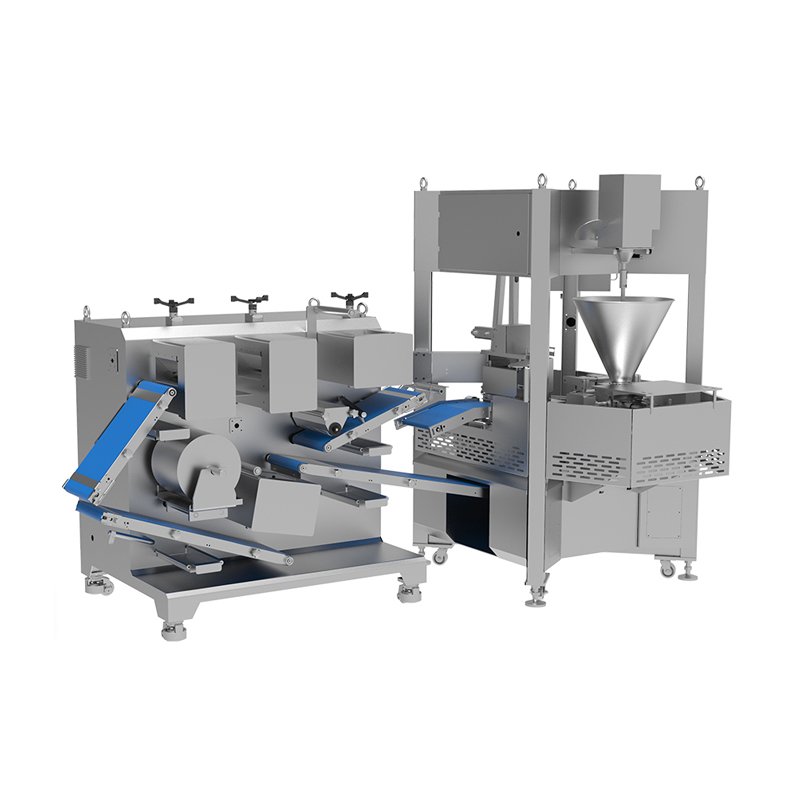
Designed for repeatable industrial forming
Coordinated motion stabilizes dough transport, filling timing and mold position.
PLC or industrial-computer control supports product changeover and repeat settings.
Stainless-steel construction and removable contact parts support sanitation.
Finished shape and seal profile are engineered around approved product samples.
See the servo platform in operation
Technical specifications
| Model | Capacity | Product weight | Air pressure | Power | Weight | Dimensions |
|---|---|---|---|---|---|---|
| SJ-1 | 40–60 pcs/min | 18/23/25 g | 0.4 MPa | 4.7 kW | 550 kg | 1365 × 1500 × 1400 mm |
| SJ-3 | 100–120 pcs/min | 14–30 g | 0.6 MPa | 11.8 kW | 1500 kg | 3100 × 3000 × 2100 mm |
| JJ-2 | 160 pcs/min | 12–35 g | 0.6 MPa | 8.4 kW | 1350 kg | 3120 × 3000 × 2100 mm |
| JJ-3 | 180–200 pcs/min | Confirm mold | 0.6 MPa | 8.9 kW | 1500 kg | 3120 × 3000 × 2100 mm |
| SM-2 | 80–100 pcs/min | 70–100 g | 0.6 MPa | 10 kW | 1530 kg | 3100 × 3000 × 2100 mm |
| YT-2 / TY-3 | 120 / 180–200 pcs/min | 8–20 g / confirm | 0.6 MPa | 9.6 kW | 1430 kg | 3100 × 3000 × 2100 mm |
Model selection depends on lane count, product geometry, dough-sheet width and mold. Published family data contains blank weight fields for JJ-3 and TY-3; these are deliberately marked for confirmation.
Select by product, lane count and downstream capacity
This family ranges from a compact single-lane machine to multi-lane industrial forming. Published models cover about 40–200 pieces per minute and 8–100 g products where weight data is available. The correct choice is not automatically the fastest model: product geometry, wrapper dimensions, filling portion, mold cycle, lane count and downstream equipment all determine a workable configuration.
The platform integrates dough sheeting, servo filling and rotary forming. Published descriptions identify industrial-computer control with EtherCAT communication, precision reducers and a hollow rotating table; a corroborating HELPER listing describes eight servo motors. Electronic synchronization helps reproduce timing after changeovers, while stable dough and filling remain essential to product quality.
SJ-1 publishes 40–60 pieces/min at 4.7 kW. SJ-3 publishes 100–120 pieces/min and a 14–30 g range.
JJ-2 publishes 160 pieces/min for 12–35 g products. JJ-3 publishes 180–200 pieces/min; its source leaves product weight blank.
The published 70/80/90/100 g settings suit larger filled products at 80–100 pieces/min, subject to tooling and filling trials.
YT-2 covers 8–20 g at 120 pieces/min. TY-3 publishes 180–200 pieces/min, but the missing source weight is deliberately not inferred.
Flexible is not universal
Dumplings, gyoza, potstickers, wontons and shumai require different wrapper outlines, filling positions and seals. A new format can require its own mold, nozzle, recipe, guide and discharge setup. Every proposed changeover should be stated in the quotation.
Lane count and tray loading
More lanes demand consistent sheet width and even filling distribution across all positions. Optional automatic tray loading requires tray dimensions, cavity pattern, pitch, buffer logic and freezer or packing interface.
Servo dumpling and gyoza machine FAQ
How do I select a model?
Begin with product weight and geometry, accepted pieces per hour, lane preference, floor space and downstream capacity; then match an approved mold to the model.
Can one machine make every listed product?
No universal configuration should be assumed. Each format requires compatible tooling and recipe validation.
Why are some weights marked “confirm”?
The official table leaves those values blank, so this page does not invent them. They must be confirmed with the selected mold.
Is tray loading standard?
It is optional and must be engineered around the actual tray and downstream process.
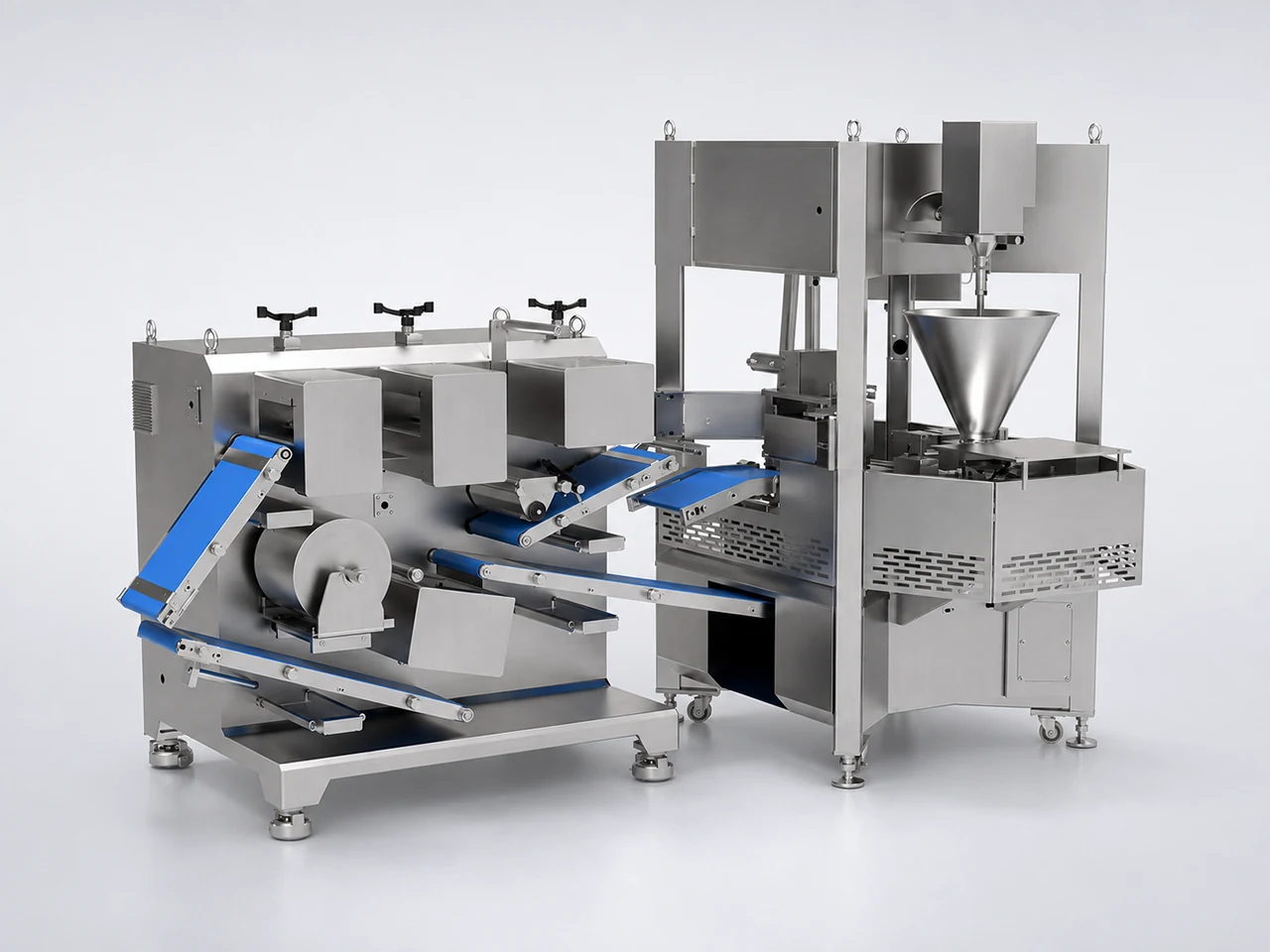
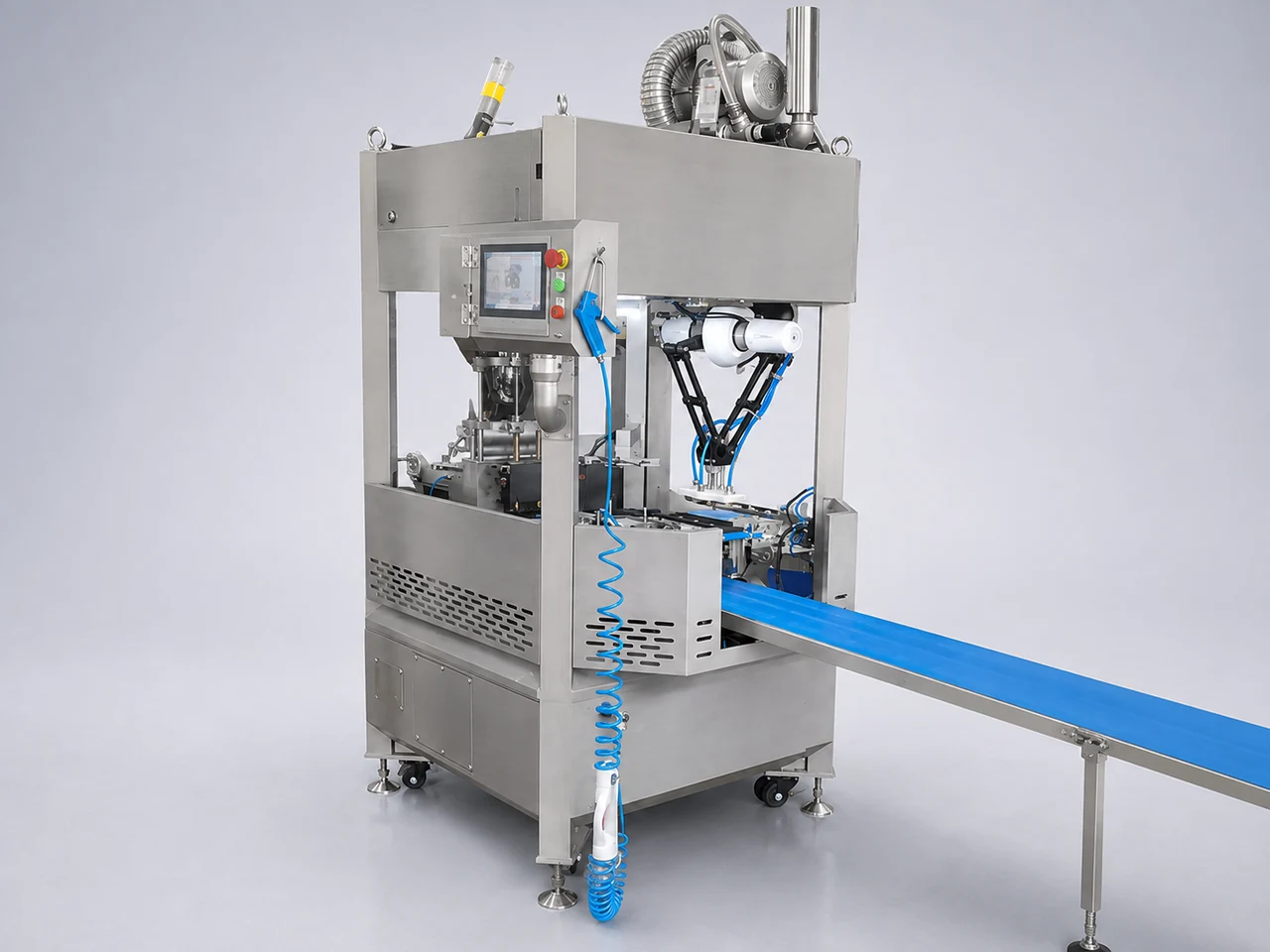
Machine configuration and forming area
AI-generated studio views based on the original equipment images. These illustrations show the machine layout; final details depend on the agreed configuration.
Information required for accurate selection
Related decision path
Continue from this page
Configure the machine around your product
Send product samples or drawings, dough and filling formulas, target output and available floor space.
Ready to discuss your project?
Use our single online inquiry form to send your product, capacity, utility and layout requirements.
Go to contact formApplication fit
Applications for Full-Servo Dumpling & Gyoza Forming Machines
Best suited to formed dumplings, gyoza, wonton, shumai or khinkali when the tooling, wrapper condition and filling properties are validated for the required product. Final suitability should be confirmed with representative product trials and the agreed acceptance criteria.