
Direct answer: calculate sensible product load from mass flow, specific heat and temperature reduction. Then add packaging, equipment, pumps/fans, room transmission, infiltration, moisture, defrost and other simultaneous loads under named design conditions. If the product freezes, evaporates or condenses, add phase-change energy explicitly. Finally prove the product cooling curve at the worst geometry and operating condition.
Who uses this planning method?
Food process engineers
Set product-side duty and residence time for chillers, cooling conveyors, spirals and baths.
Refrigeration engineers
Translate all loads into compressor, evaporator, condenser and secondary-loop design conditions.
Food-safety and quality teams
Define the required time-temperature path and validate representative worst-case product.
Factory owners and buyers
Compare offers on the same product load, ambient, refrigerant and operating basis.
The formulas used by the online estimator
Base sensible product load (kW) = product flow (kg/h) x specific heat (kJ/kg.K) x temperature reduction (K) / 3,600Preliminary product duty (kW) = base sensible load x (1 + engineering allowance)Equivalent refrigeration tons = preliminary product duty / 3.517The formula covers continuous sensible cooling with no phase change and constant specific heat. The allowance is not a calculation of room, equipment, infiltration or freezing loads.
Worked example using the estimator defaults
Cool 1,000 kg/h of product from 80 C to 20 C. Use specific heat 3.6 kJ/kg.K and 20% engineering allowance.
- Temperature reduction = 60 K.
- Base product load = 1,000 x 3.6 x 60 / 3,600 = 60 kW.
- Preliminary product duty = 60 x 1.20 = 72 kW.
- Equivalent = 72 / 3.517 = 20.5 TR.
This is a product-side heat rate. It does not mean a nominal 20.5 TR catalogue unit will deliver the required cooling at project conditions.
Define the product load correctly
| Input | Engineering basis | Common error |
|---|---|---|
| Mass flow | Maximum sustained flow through the cooling step, including product water or carrier where applicable. | Using final saleable output after downstream loss. |
| Inlet temperature | Highest credible product temperature and distribution entering the cooler. | Using an average when startup batches are hotter. |
| Outlet temperature | Defined location, statistic and acceptance limit at cooler discharge. | Confusing surface, bulk and core temperature. |
| Specific heat | Formulation and temperature-range data or validated measurement. | Using the tool default for every food. |
| Allowance | Named uncertainty not already calculated elsewhere. | Using 20% to hide all auxiliary and room loads. |
Thermal capacity does not prove cooling time
The energy balance states how many kilojoules must leave per second. Heat transfer determines whether that can occur within the available residence time. Evaluate product thickness, shape, orientation, package, contact area, thermal conductivity, internal convection, medium velocity, surface coefficient, fouling and temperature approach.
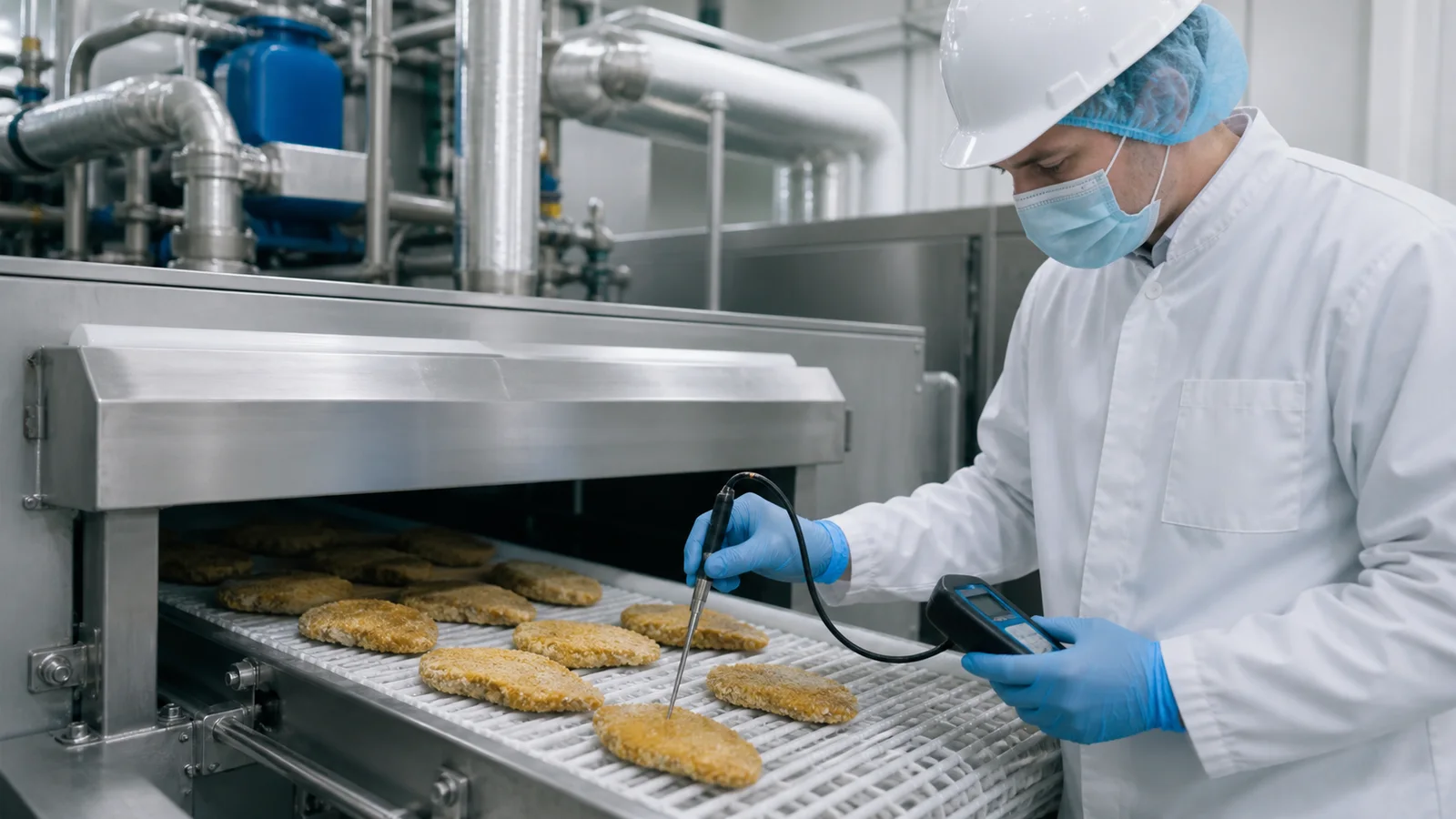
Develop a cooling curve or validated thermal model for worst-case product geometry and load pattern. Measure multiple representative locations and define sensor response, accuracy and placement.
Batch cooling needs an energy-time profile
For a batch, calculate total product energy and divide by the allowed cooling period only for an initial average:
Batch sensible energy (kJ) = batch mass x specific heat x temperature reductionAverage batch load (kW) = batch energy / cooling time (seconds)Real load is usually higher early in the cycle and falls as product approaches medium temperature. Overlapping batches, door opening and pull-down can set the refrigeration peak. Do not assume average batch kW is a flat compressor load.
Freezing and other phase changes
A freezing calculation separates at least three regions:
Total freezing energy = sensible energy above initial freezing + latent/freezing-range energy + sensible energy below freezingFood does not behave like pure water. Initial freezing point, unfrozen water fraction, latent heat and specific heat vary with composition and temperature. Obtain product-specific data or qualified property models. Include packaging, trays, belt, racks and frost/defrost effects.
Evaporative cooling removes latent heat with water mass and changes yield. Condensation on product or equipment adds latent load and can create hygiene or package problems. These mechanisms are outside the estimator.
Build the total refrigeration load
| Load group | Examples | Required basis |
|---|---|---|
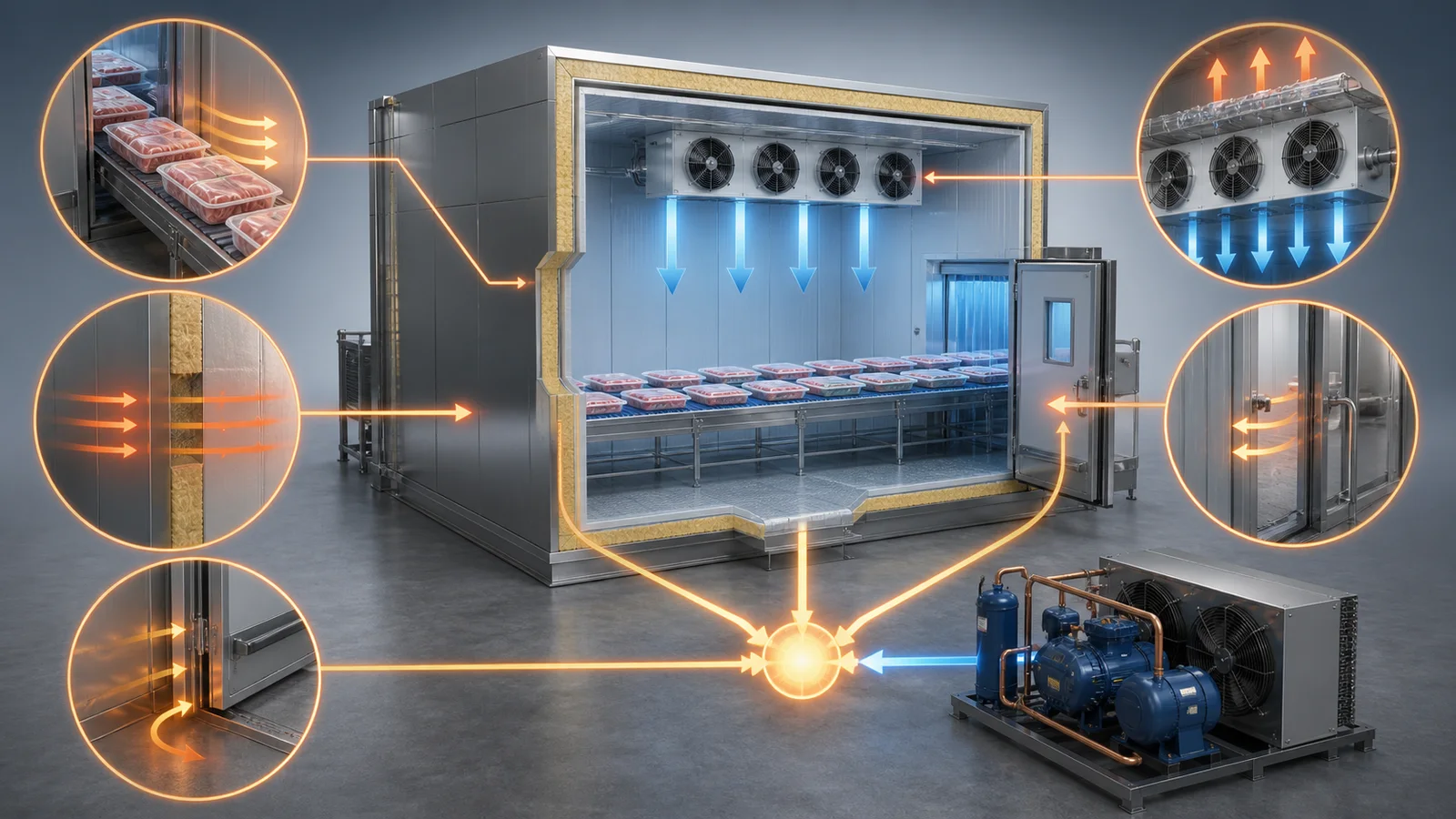
| Product | Sensible cooling, freezing, respiration or reaction where relevant. | Mass, temperatures, properties and time profile. |
| Packaging and handling | Tray, carton, rack, trolley, belt and pallet cooling. | Mass, material, entry temperature and cycle. |
| Equipment | Fan, pump, motor, lights, controls and defrost heat entering the cooled zone. | Actual input and fraction entering refrigeration load. |
| Envelope | Walls, floor, ceiling, thermal bridges and ground. | Area, U-value and design temperature difference. |
| Infiltration/moisture | Doors, conveyors, pressure imbalance, vapour and frost. | Air exchange, psychrometrics, schedule and controls. |
| Operations | People, cleaning, door openings, pull-down and recovery after interruptions. | Time-coincident operating scenarios. |
ASHRAE's 2026 Handbook - Refrigeration covers refrigeration systems and food-processing applications. Use the current handbook and qualified calculations for total system design rather than applying one generic percentage to product load.
Chilled-water or glycol interface
For a secondary fluid loop, a preliminary flow balance is:
Fluid flow (kg/s) = heat duty (kW) / [fluid specific heat (kJ/kg.K) x supply-return temperature rise (K)]Define fluid type and concentration, supply and return temperatures, flow, pressure, allowable pressure drop, fouling, materials, freeze protection, pump/control scope and hygienic separation from product. Fluid properties change with concentration and temperature; do not use water values for every glycol solution.
Refrigeration capacity must use project conditions
State required duty at actual evaporating and condensing conditions, refrigerant, superheat/subcooling basis, ambient or heat-rejection condition, part-load range and fouling/defrost state. Nominal compressor horsepower, catalogue tons and refrigeration capacity are not interchangeable.
- Lower evaporating temperature generally reduces compressor capacity and efficiency.
- Higher condensing temperature increases power and may reduce available capacity.
- Pressure drops change the condition seen by compressor and evaporator.
- Part-load control and minimum stable capacity affect temperature control.
- Defrost and standby equipment determine available duty over the full schedule.
Cold rooms and cooling equipment are different duties
A storage room may receive product already at storage temperature; a blast cooler or freezer is designed to remove product heat within a defined time. ASHRAE notes that product/freezing load can range from zero for pure distribution storage to a dominant share near production. Define whether the project is holding, cooling, freezing or recovering from warm product receipt.
Food-safety and quality time-temperature targets
Set the required cooling path from the product hazard analysis, shelf-life/quality needs and legally applicable rules. The FDA Food Code 2022 includes cooling criteria for time/temperature control for safety foods, but FDA describes the Food Code as a model for U.S. retail and food-service regulation. It is not a universal industrial-process specification.
Codex guidance for quick-frozen foods emphasizes passing the maximum ice-crystallization range quickly and maintaining the cold chain. Product-specific regulations, customer requirements and validated HACCP controls remain project-specific.
Control condensation, frost and drainage
Coordinate air temperature, humidity, surface temperatures, doors, air balance, insulation vapour barriers and defrost. Provide hygienic collection and drainage for condensate and defrost water. Prevent drips onto exposed product and standing water in hygiene zones. Defrost timing must preserve both cooling capacity and production schedule.
Ten-step cooling-load workflow
- Define the food-safety and quality target. Product location, temperature path and maximum time.
- Characterize the product. Flow/batch, geometry, formulation, properties, package and entry condition.
- Calculate sensible and phase-change loads. Keep each component visible.
- Develop the heat-transfer model. Medium, coefficient, area, approach and residence time.
- Add non-product loads. Equipment, room, infiltration, moisture and defrost.
- Build operating scenarios. Startup, peak production, sanitation, defrost and recovery.
- Set refrigeration design conditions. Evaporating, condensing, ambient, refrigerant and secondary fluid.
- Freeze interfaces and responsibility. Connections, controls, pumps, drains and insulation.
- Validate worst-case product cooling. Representative geometry, load pattern and environment.
- Commission and benchmark. Thermal duty, temperatures, energy and accepted product.
Commissioning evidence
- Product mass flow or batch mass, geometry and loading arrangement.
- Calibrated inlet, surface/core and outlet product temperature records.
- Cooling-medium supply/return temperature, flow and pressure.
- Evaporating and condensing conditions and refrigeration capacity basis.
- Fan, pump and compressor operating state and electrical power.
- Room temperature, humidity, door/line openings and relevant ambient conditions.
- Frost, defrost, condensate and drainage performance.
- Cooling curve at maximum product load and worst credible entry condition.
- Alarm, loss-of-cooling, restart and product-disposition response.
Product cooling load FAQ
How do I calculate sensible product cooling load?
Multiply kg/h by specific heat in kJ/kg.K and temperature reduction, then divide by 3,600 for kW. Add identified non-product loads separately.
Can the estimator calculate freezing load?
No. Freezing needs sensible heat above and below freezing plus latent heat through the product's freezing range and all auxiliary loads.
Does refrigeration capacity prove cooling time?
No. Product geometry, packaging, heat-transfer coefficient, medium condition, velocity, residence time and equipment state determine the cooling curve.
Can calculated kW select a chiller?
No. Rate equipment at actual evaporating, condensing, ambient and fluid conditions and include all simultaneous product and non-product loads.
What specific heat should I use?
Use measured or formulation-based data across the relevant temperature range. The tool default is only an early assumption for some high-moisture foods.
Primary references
- ASHRAE, 2026 Handbook - Refrigeration.
- U.S. FDA, Food Code 2022, current full model code and supplements portal.
- U.S. FDA, 2022 Food Code print version, including cooling provisions and methods.
- Codex Alimentarius guidance for processing and handling quick-frozen foods.
Research reviewed: August 7, 2026. Planned review: August 7, 2027, or earlier if product, refrigeration conditions or applicable food-safety requirements change.