
Direct answer: packaging film planning starts with the machine's actual web width and advance per cycle, not the finished pack dimensions alone. Calculate theoretical length, area and mass for every web separately. Then add measured startup, trim, splice and reject losses before converting demand into usable rolls. A purchase specification must also control structure, sealing, barrier, food-contact status, winding and roll geometry.
Who uses this planning method?
Packaging engineers
Translate product shelf-life and seal requirements into a film structure the machine can run.
Production planners
Convert schedules and operating efficiency into daily, monthly and campaign material demand.
Procurement teams
Order compatible roll quantities with documented tolerances, lead time and safety stock.
Cost and sustainability teams
Reconcile grams per accepted pack, material loss and packaging-reduction projects.
Three plans that must not be confused
| Planning layer | Core question | Required evidence |
|---|---|---|
| Film specification | Will the material protect the food and run reliably? | Structure, total gauge, sealing window, barrier, friction, strength, food-contact documentation and machine trials. |
| Consumption forecast | How much film will the approved schedule use? | Web width, advance, cycle speed, schedule, efficiency, number of webs and measured losses. |
| Purchase plan | How many compliant rolls must arrive and when? | Usable roll length or net mass, core, diameter, winding, splice policy, lead time, minimum order and safety stock. |
The calculation used by the online tool
Linear film/day (m) = advance (mm) / 1,000 x cycles/min x 60 x scheduled hours x efficiency
Film area/day (m2) = linear film/day x web width (mm) / 1,000
Film mass/day (kg) = area/day x thickness (micron) / 1,000,000 x density (kg/m3)
Monthly mass (kg) = film mass/day x production days
Rolls/day = linear film/day / usable length per roll
The calculation is a theoretical machine-web estimate. Run it once for each forming, lidding or overwrap web. It does not automatically add trim, startup, rejected packs, multiple lanes, multiple packs per cycle or safety stock. Packs per cycle are needed if you want grams per individual accepted pack.
Worked example: one roll-fed web
A machine uses a 420 mm web, advances 250 mm per cycle, runs at 8 cycles/min for 8 scheduled hours/day at 80% operating efficiency. Film is 100 micron with an assumed density of 920 kg/m3, and each roll contains 500 usable metres.
- Linear film = 0.25 x 8 x 60 x 8 x 0.80 = 768 m/day.
- Area = 768 x 0.42 = 322.56 m2/day.
- Approximate mass = 322.56 x 0.0001 x 920 = 29.68 kg/day.
- For 22 production days = 652.9 kg/month before loss.
- Roll consumption = 768 / 500 = 1.54 rolls/day before rounding and loss.
If the verified total loss is 5%, planning mass becomes about 685.6 kg/month. Do not add 5% again if the efficiency input or supplier roll yield already includes the same loss.
Inputs that control the answer
| Input | Use the following basis | Common error |
|---|---|---|
| Web width | Actual ordered roll width, including trim and seal zones. | Using only the visible finished package width. |
| Advance per cycle | Machine index, cutoff or print repeat in the machine direction. | Using package height without seal, registration or pitch allowances. |
| Cycle speed | Sustainable speed for the approved product and package. | Using the machine's empty maximum speed. |
| Efficiency | Scheduled operating ratio supported by production history or commissioning assumptions. | Hiding material scrap inside a runtime efficiency value. |
| Thickness and density | Total measured gauge and supplier-confirmed effective density for the laminate. | Applying a generic polymer density to a multilayer laminate. |
| Usable roll length | Net usable material after core, damaged outer wraps and agreed end-of-roll limits. | Using gross roll weight or nominal length without receiving verification. |
Film specification fields for an RFQ or URS
- Product name, supplier material code, layer structure and each layer's function.
- Nominal total thickness, tolerance, sampling plan and named measurement method.
- Roll width, width tolerance, print repeat, registration mark and allowable print variation.
- Seal initiation range, validated sealing window, sealant side and hot-tack requirement.
- Oxygen and water-vapour transmission requirements with test conditions where shelf life depends on barrier.
- Coefficient of friction, stiffness, tensile, puncture and tear requirements relevant to feeding and distribution.
- Food-contact declaration and migration evidence for every intended sales market and use condition.
- Core inside diameter, maximum roll outside diameter, maximum roll weight and winding direction.
- Splice type, marking, maximum splices per roll, roll traceability, storage and shelf life.
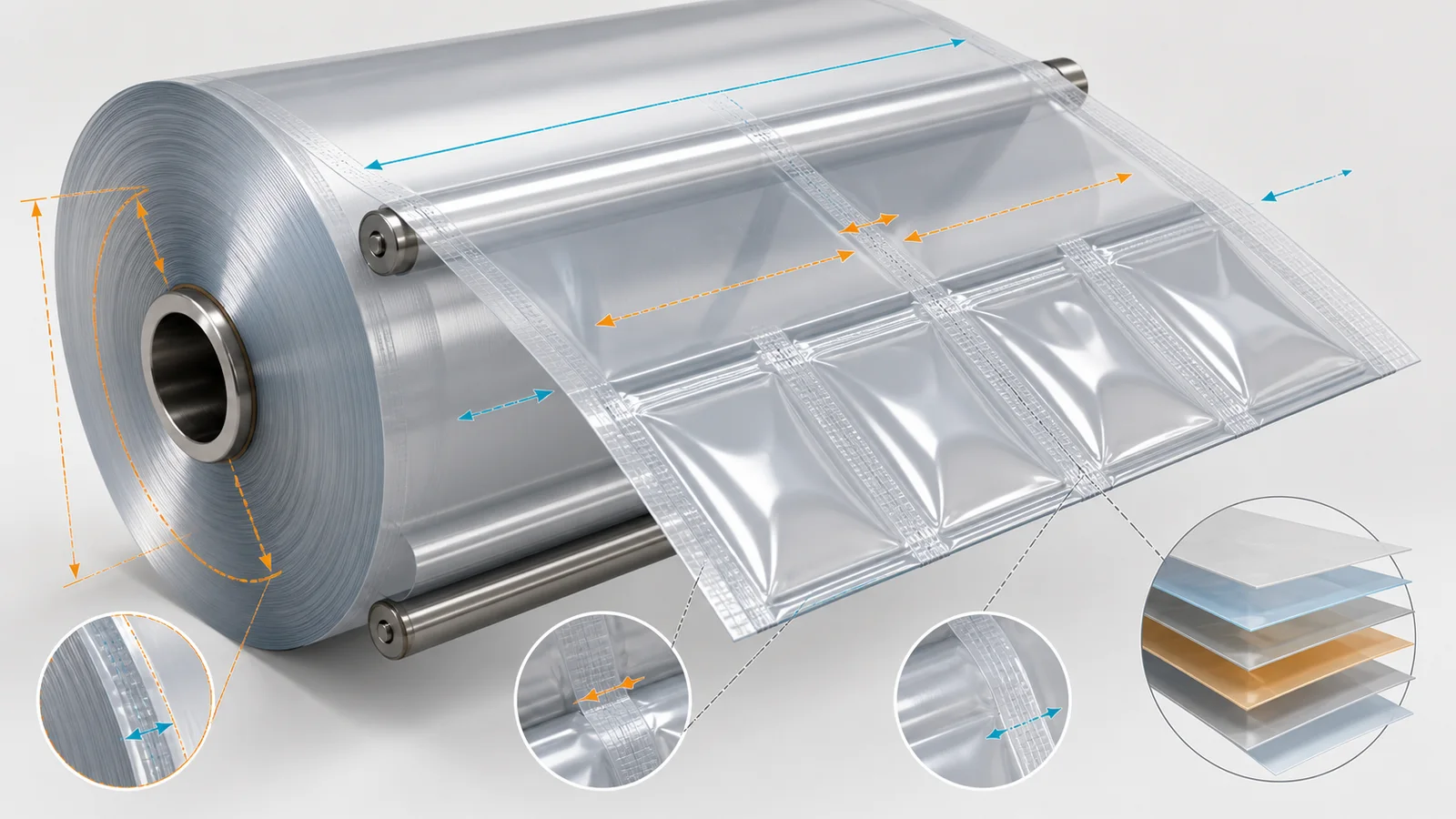
Machine geometry and package format checks
For vertical or horizontal form-fill-seal equipment, verify web width, former geometry, lap or fin seal, transverse seal width and cutoff pitch. For thermoforming, calculate bottom and top webs separately; forming depth and skeletal trim make a simple flat-area estimate optimistic. Multi-lane systems need both packs per cycle and lane layout to calculate film per pack. Zippers, labels, valves, easy-open features and reclose components require separate material lines.
Preformed pouches are normally planned from supplier-confirmed pouch unit weight and accepted pack count rather than roll-web geometry. Shrink film and stretch film need their own draw, overlap and recovery assumptions.
Build loss from evidence, not a universal percentage
Record loss by cause so corrective action remains possible:
- Startup threading and temperature stabilization.
- Side trim, skeletal matrix and seal-area geometry.
- Print-registration adjustment, film tracking and tension faults.
- Supplier splices, internal production splices and roll changes.
- End-of-roll remnants, damaged wraps and quarantined material.
- Seal rejects, coding rejects, quality samples and product-change purges.
Actual film per accepted pack = (film issued - reusable film returned) / accepted packsFilm loss rate = (actual use - theoretical use) / actual use x 100%Define whether rejected packs and rework are included before comparing lines. Otherwise two plants can report different waste rates from the same physical loss.
Convert the forecast into a roll purchase plan
- Freeze the package and web geometry. Record approved width, repeat, lanes and all film webs.
- Set the production basis. Use accepted units, schedule, product mix, changeovers and realistic efficiency.
- Calculate theoretical demand. Keep length, area, mass and grams per accepted pack visible.
- Add verified losses once. Separate process loss from runtime efficiency and avoid double counting.
- Confirm the commercial roll. Check net film length or mass, core, diameter, weight, winding and splice limits.
- Round to whole usable rolls. A fractional roll is a planning quantity, not a purchasing quantity.
- Add controlled safety stock. Base it on lead-time demand, supplier reliability, demand variability and change risk.
- Check handling compatibility. Maximum roll weight must suit shafts, lifting aids, operators and guarding.
- Reconcile forecast against actual use. Update the standard after trials and representative production campaigns.
Measurement, standards and compliance
ISO 4593:1993 specifies mechanical scanning for plastic film and sheeting thickness and was confirmed current in 2025; ISO notes that it is not suitable for embossed material. ASTM D6988-21 provides guidance for plastic-film specimen thickness when thickness is used in physical-property calculations, but ASTM also notes that it does not replace every commercial or quality-control measurement method. State the exact method, instrument, contact pressure and sampling approach in the supplier agreement.
GS1's Package and Product Measurement Standard provides a consistent way to report trade-item dimensions, including flexible packages. These finished-package dimensions support data exchange, but they do not replace machine web width or repeat length in consumption calculations.
For products sold in the European Union, Regulation (EU) 2025/40 establishes current packaging and packaging-waste requirements. Material reduction must not be treated as gauge reduction alone: food protection, seal integrity, transport performance, recyclability, food-contact obligations and waste caused by failures remain part of the decision. Confirm the rules for every destination market with qualified packaging and regulatory specialists.
Commissioning acceptance checks
- Run the approved film at representative product temperature, fill condition, speed and environment.
- Record roll identity, starting and ending mass or length, accepted packs and rejects by cause.
- Challenge low and high limits of the agreed sealing window rather than validating one convenient setpoint.
- Verify coding, registration, tracking, splice detection, alarms and changeover repeatability.
- Inspect seal integrity and package performance with methods suitable for the food, package and distribution route.
- Release the consumption standard only after production, quality, engineering and procurement agree on the same data basis.
Packaging film planning FAQ
How do I calculate packaging film consumption?
Calculate linear film from advance per cycle, cycles per minute, scheduled minutes and operating efficiency. Multiply by web width for area, then by thickness and density for approximate mass. Calculate each web separately and add validated losses.
Should film be purchased by length or weight?
Use the supplier's commercial unit, but reconcile both usable length and net film mass. Exclude the core and confirm roll diameter, roll weight, winding direction and splice limits.
How can I calculate film per pack on a multi-lane machine?
Divide theoretical or actual film use by accepted packs, not cycles. Accepted packs equal accepted cycles multiplied by good packs per cycle, adjusted for empty pockets and lane-specific rejects.
What waste allowance should I use?
There is no reliable universal value. Measure startup, trim, splices, roll remnants, rejects and samples in representative production. Use the verified rate and keep it separate from machine operating efficiency.
Can I reduce film thickness to reduce cost?
Only after trials confirm machinability, seals, barrier, handling and distribution performance. A thinner film that increases rejects, leaks or food waste can raise total cost and environmental impact.
Primary references
- ISO 4593:1993, Plastics - Film and sheeting - Determination of thickness by mechanical scanning. ISO lists Edition 2 as published and confirmed in 2025.
- ASTM D6988-21, Standard Guide for Determination of Thickness of Plastic Film Test Specimens.
- GS1 Package and Product Measurement Standard.
- Regulation (EU) 2025/40 on packaging and packaging waste.
Research reviewed: August 7, 2026. Planned review: August 7, 2027, or earlier if cited standards or market requirements change.