
How should a food packaging machine be selected?
Define the food, fill temperature, dimensions, package presentation, contact material, storage and distribution first. Then select vacuum, thermoforming, tray sealing or form-fill-seal equipment around the validated atmosphere, barrier, seal and shelf-life requirements. Compare accepted leak-free packs per minute using actual product and materials, not empty-machine cycle speed.
Who should use this guide?
Food manufacturers
Launching a package format or replacing manual or inconsistent sealing.
Packaging engineers
Matching material, tooling, atmosphere and line interfaces to the product.
Procurement teams
Comparing proposals with common pack-quality and acceptance criteria.
Choose the package format before the machine
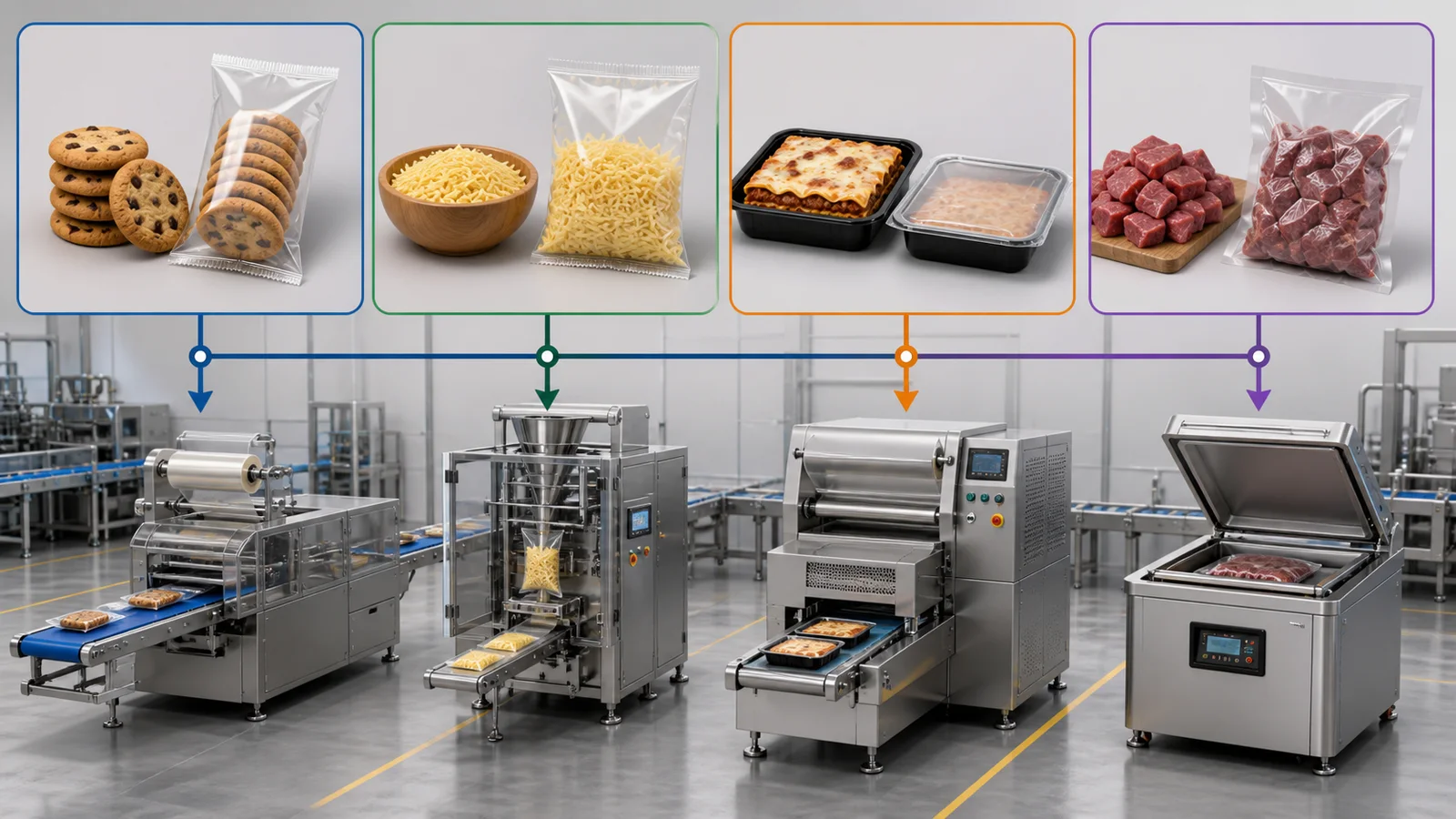
Chamber vacuum packaging
Common where product is loaded into a prepared pouch and air is evacuated before heat sealing. Chamber size, pouch, product height, liquid behavior and vacuum/seal recipe define fit.
Thermoforming packaging
Forms a lower web, loads product, applies vacuum or gas as specified, seals a top web and cuts packs. Forming depth, web properties, index layout and product loading are critical.
Tray sealing
Seals lidding film to preformed trays with air, vacuum/gas or another validated process. Tray flange, contamination, tooling, denesting and packs per cycle control performance.
Horizontal or vertical form-fill-seal
Forms packages from film around a metered product. Product flow, orientation, jaw timing, seal contamination, bag length and upstream dosing determine the platform.
Minimum data for packaging-machine selection
| Input | What to define |
|---|---|
| Food | Composition class, moisture/fat/acidity, respiration where relevant, sharp edges, loose particles, sauce or free liquid. |
| Condition at packing | Temperature, frozen/chilled/hot condition, surface moisture, cleanliness of seal area and product orientation. |
| Pack format | Pouch, formed pack, tray or flow-wrap; inside dimensions, fill weight, headspace, opening and presentation. |
| Atmosphere | Air, vacuum or validated gas mixture; residual-gas criteria, gas-to-product relationship and monitoring method. |
| Material | Exact film/tray structure, thickness, food-contact status, forming/sealing range, barrier, puncture and distribution requirements. |
| Shelf life | Validated target under stated storage, temperature, light, handling and distribution conditions. |
| Output | Accepted packs/min, kg/h, products per pack, product mix, changeovers, efficiency and reject definition. |
| Line interface | Loading method, dosing, inspection, coding, checkweighing, metal detection, secondary packing and buffers. |
| Sanitation | Food exposure, wet/dry cleaning, allergen changeover, condensate, removable tooling and verification access. |
Match system strengths to product requirements
| System | Best selection questions |
|---|---|
| Chamber vacuum | Can the pouch, product and chamber arrangement reach the validated vacuum and create a clean seal without drawing liquid into the seal area? |
| Thermoforming | Can the lower web form the required depth without unacceptable thinning? Do cavity layout, loading and cut pattern meet presentation and output? |
| Tray sealer | Are tray flange, lidding film, tooling, gas/vacuum process and product loading compatible across all approved SKUs? |
| Form-fill-seal | Can the upstream feeder present product consistently while jaws make uncontaminated seals at the required bag length and speed? |
Packaging material approval is use-specific
Food contact status alone does not define performance
FDA food-contact authorizations and EU food-contact rules are tied to materials, foods and conditions of use. Confirm the exact structure for the actual food, temperature, duration and processing conditions. Separately verify mechanical and barrier performance: oxygen and water-vapor transmission where relevant, puncture, flex-crack, forming behavior, sealant compatibility, hot tack, machinability and distribution damage.
For the EU, Regulation (EC) No 1935/2004 provides the general framework and Regulation (EC) No 2023/2006 addresses good manufacturing practice for food-contact materials. Material-specific measures and destination-market rules may also apply.
Vacuum and MAP require product-specific validation
Product response
Microbiology, oxidation, color, respiration, drip and texture respond differently to oxygen removal or selected gas mixtures.
Package response
Barrier, headspace, seal integrity and gas/product ratio affect how the package atmosphere changes during storage.
Distribution response
Temperature abuse, vibration, compression, puncture and time can defeat a package that passed an immediate factory check.
Do not copy a gas mixture from another product
MAP must be validated for the exact food, initial microbiological condition, process controls, package volume, film permeability, storage temperature and shelf-life target. Reduced-oxygen packaging can create specific hazards and regulatory obligations.
Define the seal before selecting cycle speed
| Seal requirement | What to establish |
|---|---|
| Seal window | Validated ranges for temperature, time/dwell, pressure and material condition, including start-up and speed changes. |
| Seal cleanliness | Maximum product, oil, water, powder or condensation allowed in the sealing area and controls to prevent it. |
| Visual acceptance | Wrinkles, channels, burns, incomplete seals, flange damage, contamination and registration limits. |
| Mechanical performance | Defined seal-strength or opening behavior using a method and specimen preparation suitable for the package. |
| Leak/integrity performance | Validated test method, sensitivity, sample plan and acceptance limit tied to product and distribution risk. |
| Process control | Monitoring, challenge checks, reject handling, traceability and response when a parameter leaves its limit. |
ASTM F88/F88M-23 is an active method for flexible-barrier seal strength. It measures a specific mechanical property; it does not by itself prove package sterility, shelf life or freedom from every leak. Select complementary methods according to the package and risk.
Calculate accepted pack rate
Accepted packs/min = packs per cycle x cycles/min x operating efficiencyA four-cavity tray tool at 12 cycles/min and 85% efficiency gives 40.8 accepted packs/min. Verify product loading, atmosphere/seal time, inspection, coding and secondary packing at this output with the actual package.
For thermoforming, cavity layout and index length interact with machine cycle and loading labor. For form-fill-seal, product dosing and bag length can set the practical rate. Rejects must be removed from accepted output.
Three interfaces that commonly limit packaging output
Product loading
Orientation, spacing, portion accuracy and seal-area cleanliness must be maintained at full speed.
Inspection and coding
Code quality, checkweighing, contaminant detection and reject confirmation must match every pack presentation.
Secondary packing
Cooling, accumulation, carton loading and pallet flow must accept the primary package without deformation or delay.
Packaging-machine trial and acceptance
Package evidence
- actual food, tray/pouch and film lots;
- pack dimensions and product presentation;
- vacuum or gas result as specified;
- visual seal and leak/integrity result;
- seal mechanical behavior;
- distribution and shelf-life validation samples.
Production evidence
- sustained accepted packs/min;
- loading and dosing stability;
- start-up and steady-state rejects;
- material tracking and registration;
- changeover, tooling and cleaning time;
- coding, inspection and reject integration.
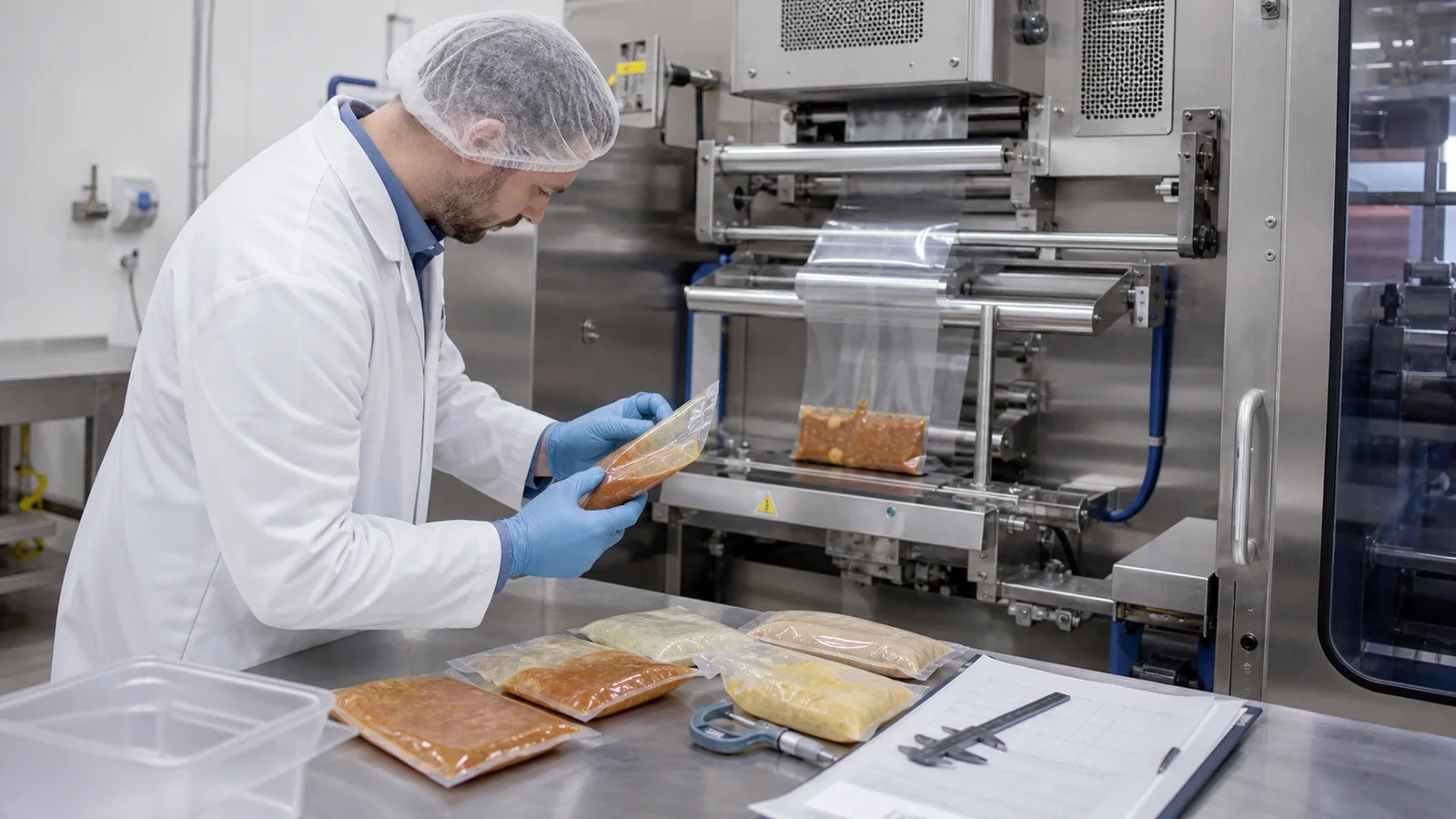
Run the approved materials at the minimum and maximum product conditions that matter. Empty-pack tests cannot establish product loading, seal contamination, atmosphere, leak or shelf-life performance.
Worked example: four-cavity MAP tray line
Translate market format into testable equipment criteria
- Product
- Chilled cooked sausage portions with defined temperature, surface condition and fill weight.
- Package
- Approved preformed tray and lidding film with a specified flange, headspace and validated gas process.
- Target
- Four packs/cycle, 12 nominal cycles/min and 85% planning efficiency: 40.8 accepted packs/min.
- Interfaces
- Portion loading, gas supply/monitoring, coding, inspection, checkweighing, reject control and case packing.
- Acceptance
- Pack appearance, residual atmosphere criteria, seal/integrity tests, accepted rate, rejects and changeover time.
- Separate validation
- Food-safety controls, material compliance and shelf life remain product-, package- and market-specific.
Common packaging-machine selection mistakes
Do not select the machine before approving the package
- Specifying only bag or tray dimensions without exact material structure.
- Assuming food-contact compliance means the film will form, seal and protect the product.
- Copying a vacuum or MAP recipe from a different food.
- Comparing empty-machine cycles instead of accepted leak-free packs/min.
- Ignoring liquid, oil, powder or condensation in the seal area.
- Leaving coding, inspection, reject handling and secondary packing outside the line balance.
- Claiming shelf life from an immediate seal test without distribution validation.
Food packaging equipment enquiry checklist
- Identify every food and SKU.
- State product temperature at packing.
- Provide dimensions and fill weight.
- Define pouch, tray or formed pack.
- Provide exact film/tray specifications.
- Confirm food-contact use conditions.
- Define air, vacuum or gas process.
- State validated shelf-life target.
- Set accepted packs/min and kg/h.
- Define loading and dosing method.
- Specify coding and inspection.
- Define secondary packing interface.
- Set visual seal criteria.
- Select leak and seal tests.
- Agree full-speed trial duration.
- Define changeover and cleaning.
Research sources and boundaries
- U.S. FDA, Packaging & Food Contact Substances. FDA maintains authorization resources for food-contact substances and intended uses. Accessed 7 August 2026.
- U.S. FDA, Food Types & Conditions of Use for Food Contact Substances. The tables illustrate why material suitability must be tied to food type and temperature/use conditions. Accessed 7 August 2026.
- Commission Regulation (EC) No 2023/2006 on GMP for food-contact materials and articles. Apply with Regulation (EC) No 1935/2004 and relevant material-specific measures. Accessed 7 August 2026.
- ASTM Committee F02.20 active packaging test methods. The catalogue lists F88/F88M-23 for flexible-barrier seal strength and other physical-property methods. Accessed 7 August 2026.
- McMillin, Where is MAP Going? A review of modified-atmosphere packaging for meat. Meat Science 80 (2008), 43-65, DOI 10.1016/j.meatsci.2008.05.028. The review supports treating material, equipment, logistics and product response as an integrated system.
Research date: 7 August 2026. This guide supports preliminary equipment selection. Food safety, reduced-oxygen controls, gas selection, migration compliance, package validation, shelf life, labeling and distribution testing require product- and market-specific professional review.
Food packaging machine FAQ
What information is needed to select a food packaging machine?
Define the product, temperature, dimensions, package format, food-contact material, atmosphere, shelf-life target, accepted packs per minute, coding, inspection and secondary packing.
How do I choose between vacuum and modified-atmosphere packaging?
Choose from product behavior, safety controls, appearance, package structure, distribution and validated shelf life. Neither method is universally better for every food.
Is packaging-machine cycle speed the same as production output?
No. Accepted output depends on packs per cycle, operating efficiency, loading, gas or vacuum time, sealing, inspection, rejects and downstream handling.
How should package seals be accepted?
Define visual, leak and mechanical seal criteria using methods suitable for the package, product and distribution risk, then validate the process across its operating window.
Identify the correct packaging direction
Use the selector to organize product condition, package format and required line speed before technical confirmation.
Open packaging selector Estimate packaging cost