
SG-50 & SG-70 Vegetable Salad Spinner
Remove free surface water after washing while protecting leafy greens and cut vegetables inside a removable basket.
Surface-water removal—not thermal drying
The HELPER SG series uses centrifugal force to remove water carried on washed vegetables. Product is loaded into an inner basket, the lid closes, and the basket spins for a controlled cycle. Water passes through the basket openings and drains from the chamber. The process does not cook or heat-dry the food; its purpose is to reduce free moisture before salad mixing, seasoning, filling, freezing or packing.
Basket handling helps keep delicate material contained and makes batch collection straightforward. An internal basket cover is intended to stop leaves or cut pieces from escaping during acceleration. Speed and dewatering time are adjustable, allowing a processor to develop recipes for products with different fragility, cut size and water retention.
The official range contains two models. SG-50 is the smaller 50-litre unit; SG-70 provides a 70-litre basket and higher stated hourly output. Model selection should be based on real batch weight and cycle time rather than basket volume alone.
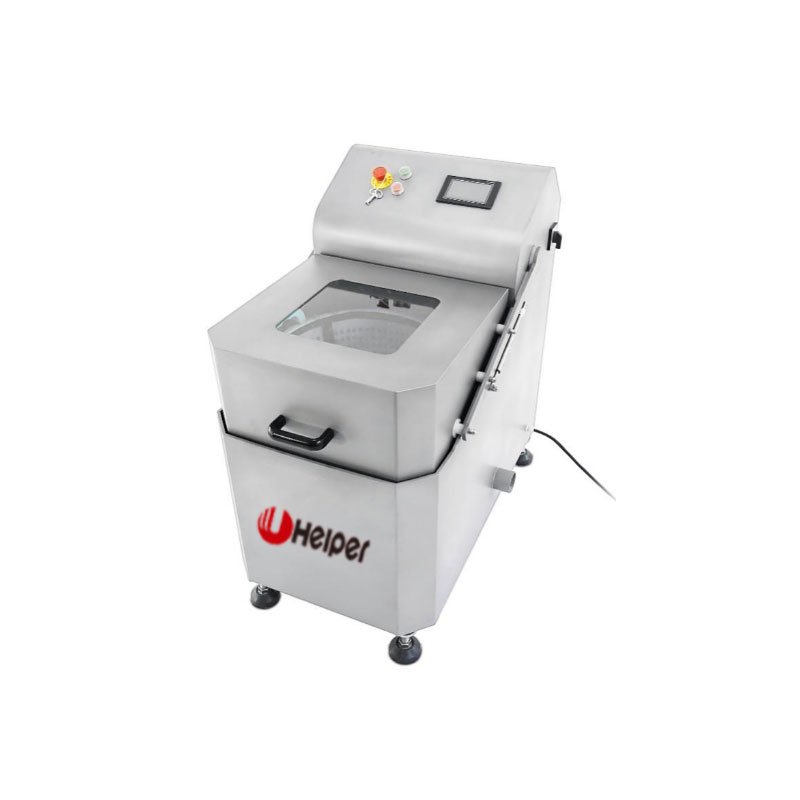
From washed product to a drain-ready batch
Correct loading matters. An uneven or overloaded basket can increase vibration and reduce consistency. A very light leafy product may fill the basket by volume before reaching a high batch mass; dense cut roots behave differently. Validate batch weight, acceleration, speed and duration with the actual incoming product.
SG-50 versus SG-70
| Specification | SG-50 | SG-70 |
|---|---|---|
| Basket volume | 50 L | 70 L |
| Stated capacity | 300–500 kg/h | 600–900 kg/h |
| Power | 1.1 kW | 1.62 kW |
| Machine weight | 150 kg | 310 kg |
| Dimensions (L×W×H) | 1000×650×1050 mm | 1050×1030×1160 mm |
Capacity interpretation: published hourly ranges are not a guarantee for every vegetable. Actual output changes with bulk density, basket fill, cycle time, loading/unloading time, target residual moisture and permitted product damage.
Choose by the complete cycle
Start with required finished kilograms per hour, then measure representative batch weight. Add loading, lid movement, acceleration, spinning, deceleration and unloading to establish cycle time. A larger basket can improve throughput, but only if operators and upstream washing can supply balanced batches without creating queues.
Confirm electrical supply, floor loading, drain position, basket quantity and the handling route. Spare baskets can reduce idle time when one basket is unloading while another is prepared, subject to the approved operating procedure.
Designed for repetitive fresh-cut production
The machine is described with an intelligent servo system that automatically opens and closes the cover and controls starting and stopping. The control box and bracket can rotate through multiple angles, helping the operator view the screen from the working position. The body uses stainless steel with a sandblasted, vacuum fingerprint-resistant finish.
Sixteen shock-absorbing springs beneath the machine are intended to improve stability and help keep operating noise relatively low. These supports do not eliminate the need for balanced loading or a level, load-bearing floor. Vibration limits and response to an intentionally unbalanced trial should be agreed during acceptance testing.
The outer casing is removable to improve sanitation access and reduce hidden dead areas. Cleaning review should include basket perforations, lid underside, inner cover, chamber, drain, spindle area, seals and removable panels. Confirm safe isolation before access, approved cleaning chemicals, drainage capacity and the method for inspecting basket damage.
Prove moisture reduction without unacceptable damage
Run the machine with the buyer’s actual leafy greens and cut vegetables across minimum and maximum planned batch sizes. Record incoming surface water, batch weight, recipe speed, spin time, total cycle time, finished weight and visible bruising or breakage. Where residual moisture is critical, agree a repeatable sampling method before the test.
Demonstrate lid interlocks, emergency stop, controlled deceleration, servo opening and closing, touchscreen recipe changes, drain flow, restart behavior and alarms. Observe vibration and noise at representative loading. Verify that an operator can remove the basket at the stated working height without unsafe reach or twisting.
Cleaning acceptance should time strip-down, wash, inspection and reassembly. Inspect product-contact zones after cleaning and check that water does not remain trapped. The final signed specification should identify basket quantity, basket material, control language, electrical standard, guarding, drain connection and spare parts.
Information required for sizing
- Vegetable type, cut size and fragility
- Incoming and target surface moisture
- Required finished output per hour
- Expected batch mass and operating shifts
- Upstream washer and downstream process
- Power, drainage and available floor space
No exact official video is embedded on the verified product page. To preserve product accuracy, footage from a different spinner or another supplier has not been substituted.
Vegetable spinner selection questions
What is the difference between SG-50 and SG-70?
SG-50 has a 50 L basket and stated capacity of 300–500 kg/h. SG-70 has a 70 L basket and stated capacity of 600–900 kg/h, with higher power, weight and overall size.
Can this machine dry vegetables completely?
It removes free surface water by centrifugal action. It is not a hot-air dryer and does not guarantee a completely dry product. Final moisture depends on product structure and recipe.
Will spinning damage leafy salad?
Correct speed, time, fill level and balanced loading are essential. Product trials should establish the lowest recipe that achieves required drainage without unacceptable bruising or breakage.
Is an exact product video available?
No exact embedded video was found on the verified official product page, so unrelated footage is intentionally omitted.
Test your actual vegetable and target moisture
Send product type, cut size, batch weight, required output, upstream washer, target moisture and utility conditions for SG-50 or SG-70 selection.
Send dewatering requirementsApplication fit
Applications for SG-50 & SG-70 Vegetable Salad Spinner
Best suited to centrifugal removal of surface water from washed leafy vegetables, salads and other trial-approved fresh-cut products. Final suitability should be confirmed with representative product trials and the agreed acceptance criteria.