
Direct answer
Size food batch equipment from accepted batch output and complete unit turnaround time. The complete cycle begins when the unit is committed to a batch and ends only when it is clean, reset and available for the next batch. Convert batch mass to working volume with measured bulk density and validated fill limits; then compare the release interval with downstream demand to determine whether one unit, staggered parallel units or a buffer is required.
Define the complete batch cycle
Processing time is only one phase. A capacity model must include every activity that prevents the same equipment unit from starting its next batch.
Cycle time = prepare + load + process + hold + discharge + clean/reset + unavoidable unit waitingTrack shared-resource waiting separately where possible. It identifies a scheduler, operator, hoist, CIP or downstream constraint that can be improved without changing the core process.
Use accepted output in every capacity formula
Accepted output per batch
Working batch mass x batch quality yield. Do not use ingredient charge mass when moisture loss, trim, residue or rejected material reduces saleable output.
Ideal unit throughput
Accepted output per batch / cycle time. Express cycle time in hours when the result is required in kg/h.
Expected unit throughput
Ideal unit throughput x availability factor. Avoid applying losses twice if the measured cycle already includes the same stops.
Batches required
Required accepted quantity / accepted output per batch. Round up and evaluate the residual final batch separately.
Release interval = accepted output per batch / downstream accepted demand rateIf each batch feeds a 600 kg/h downstream process and supplies 300 accepted kg, a new batch must become available at least every 0.5 hour, or 30 minutes, unless planned downstream stops change the schedule.
Units required = ceiling(full cycle time / maximum release interval)This is an ideal synchronization result. Recheck equipment availability, common loading and cleaning resources, buffer size, maintenance coverage and the actual batch-start schedule.
Convert batch mass to equipment working volume
Machine names often use liters, while production plans use kilograms. The conversion requires representative bulk density in the actual process condition. Aerated flour, compacted meat, dough pieces and liquid emulsions can have very different volume behavior.
Working product volume = batch mass / bulk density
Required gross vessel volume = working product volume / validated fill fraction
Use kg and kg/L to obtain liters. The fill fraction must come from supplier limits and product trials; it is not a universal percentage.
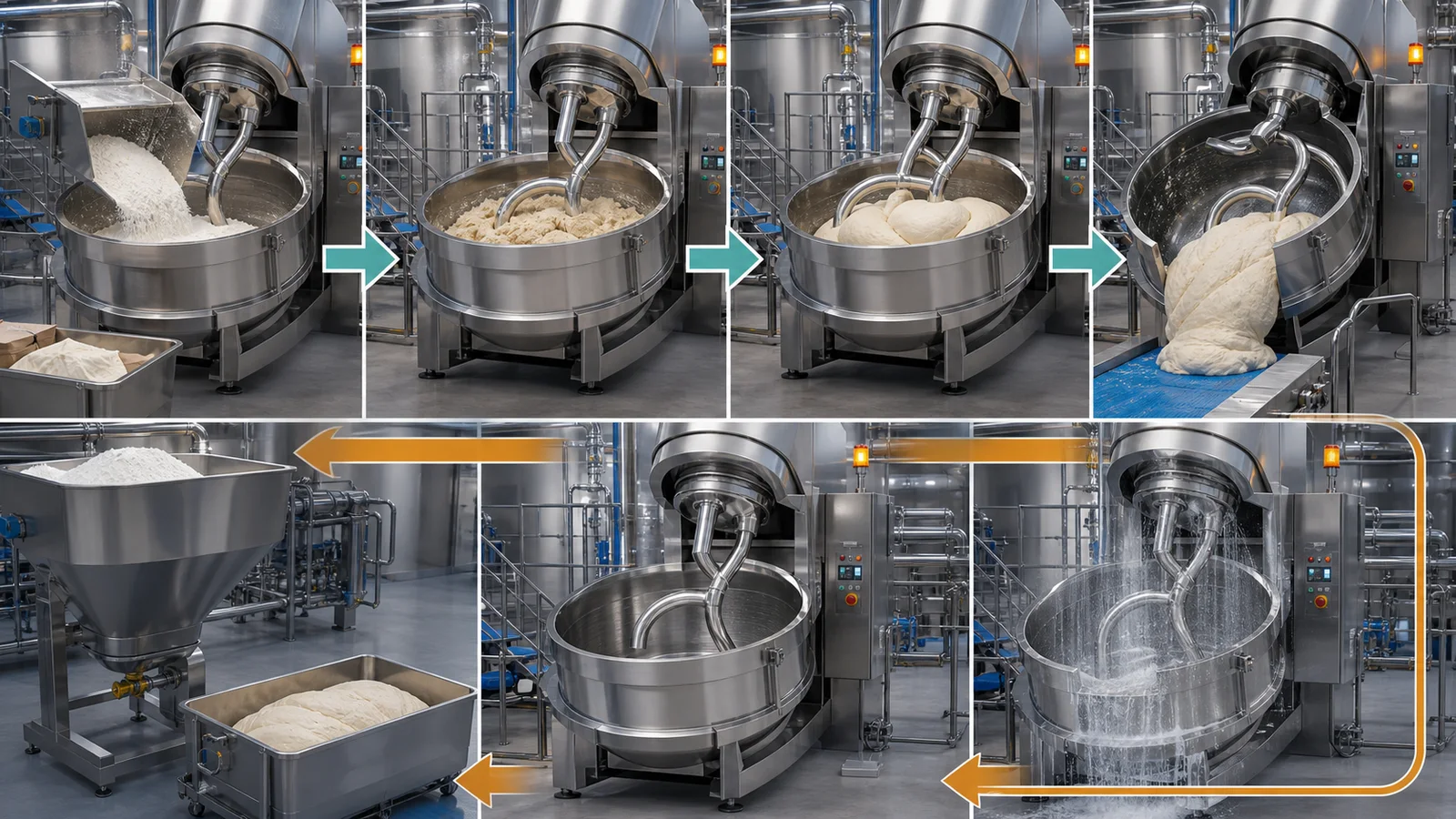
Seven sizing steps
Worked example: feed a 600 kg/h continuous line
Batch and cycle assumptions
| Cycle phase | Minutes | Capacity implication |
|---|---|---|
| Prepare and load | 8 | Depends on ingredient staging and weighing availability. |
| Process | 25 | Validated recipe time; do not shorten only to gain capacity. |
| Hold and quality check | 10 | Can become a release constraint if sampling is delayed. |
| Discharge | 9 | Depends on product rheology and downstream acceptance. |
| Clean and reset | 22 | Includes inspection and ready-for-use release. |
| Total unit cycle | 74 | 1.233 hours per completed batch. |
ceiling(74 / 31.04) = ceiling(2.38) = 3 unitsAt 90% equipment availability, three units provide an estimated 679.6 kg/h before shared-resource and interaction losses. That margin must be tested against loading labor, quality release, cleaning capacity and downstream buffer behavior.
Volume check for the same batch
If representative bulk density is 1.05 kg/L, the 320 kg working batch occupies about 304.8 L. At a validated maximum fill fraction of 75%, preliminary gross vessel volume is about 406.3 L.
320 kg / 1.05 kg/L = 304.8 L working volume
304.8 L / 0.75 = 406.3 L preliminary gross volume
A nominal 450 L class may be a starting point, but only the supplier's stated working limits and a product trial can confirm the actual model.
Balance batch equipment with the rest of the line
Pulse discharge
A batch releases a large quantity at once while downstream consumes continuously. Define hopper working volume, minimum level, maximum hold time and refill control.
Shared utilities
Simultaneous heating, vacuum, compressed air, chilled water or motor starts can create utility peaks that are hidden by average consumption.
Shared sanitation
One wash station, CIP circuit or sanitation team may serialize supposedly parallel equipment and reduce the expected batch release rate.
Product sequence
Recipe order changes cleaning time, allergen controls, color or flavor carryover and the amount of unusable residual product.
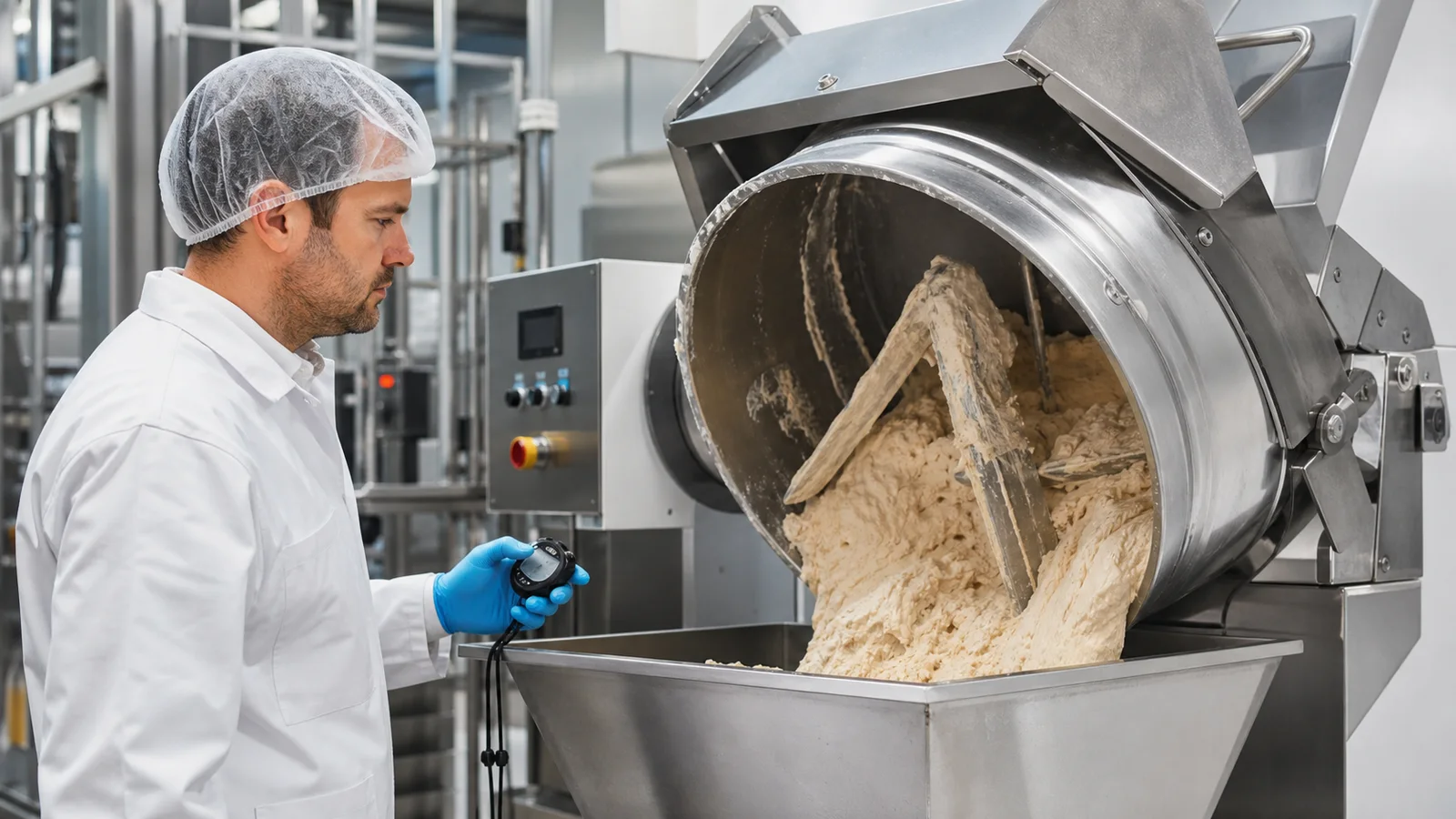
Do not assume process time remains constant after scale-up
A larger vessel changes geometry, product depth, circulation path, surface-to-volume ratio, heat transfer, vacuum removal, loading and discharge. A motor power ratio alone does not prove equivalent mixing or product quality. Establish measurable acceptance criteria such as uniformity, temperature profile, hydration, particle integrity, vacuum level, emulsion stability or discharge residue, depending on the process.
Batch-planning and acceptance record
Batch equipment sizing FAQ
How is food batch equipment capacity calculated?
Multiply accepted output per batch by completed batches per hour, then account for availability and shared resources. Use the full cycle time, not processing time alone.
Is mixer vessel volume the same as batch mass?
No. Convert batch mass to working volume using representative bulk density, then apply validated minimum and maximum fill limits. Gross vessel volume is not automatically usable batch capacity.
How many parallel batch units are required?
Compare full cycle time with the maximum release interval required by downstream demand, round up, and then test availability, staggering, shared resources and buffer behavior.
Can a larger batch always improve output?
No. A larger batch can extend loading, processing, heating, cooling, discharge and cleaning and may change product uniformity. Validate both quality and full cycle time at the intended scale.
Should waiting time be included in cycle time?
Include unavoidable waiting in demonstrated turnaround time, but code the reason separately. This shows whether equipment size, scheduling, labor, quality release or a shared resource should be improved.
Research basis and further reading
- IEC 61512-1:2026, Batch control - Part 1: Models and terminology - current second edition establishes a batch-control reference framework and separates recipe procedural elements from equipment procedural elements.
- ISA-88 Series of Standards - ISA describes standardized batch terminology, equipment and recipe models, machine states, production records and traceability applications.
- ISO 22400-1:2014, Manufacturing operations management KPI framework - provides industry-neutral concepts for defining and using manufacturing KPIs across batch, continuous and discrete industries; confirmed by ISO in 2025.
- NIST AMS 300-11, Manufacturing Data Recommendations - emphasizes equipment-state context, appropriate use cases and data needed for manufacturing-performance decisions.
Scope note: This guide is a preliminary engineering method. It does not reproduce the purchased standards, validate a food process, establish a safe recipe or guarantee output. Confirm final equipment through supplier working-volume data, representative trials, hygienic review and agreed FAT/SAT criteria.
Build the batch schedule with your own process data
Calculate batch quantity and cycle time first, then use the product-specific mixer planner where applicable.
Open Batch Production Time CalculatorDough Mixer CapacityMeat Mixer Batch Planner