
Direct answer
Plan noodle and dumpling line capacity by defining the finished product and measurement boundary first. Convert every operation to the same accepted-output basis, then balance batch mixing, resting inventory, sheet mass flow, cutting or forming rate, process yield and downstream treatment. Do not compare wet dough, dried noodles, cooked noodles and packaged product as if one kilogram meant the same thing at every stage.
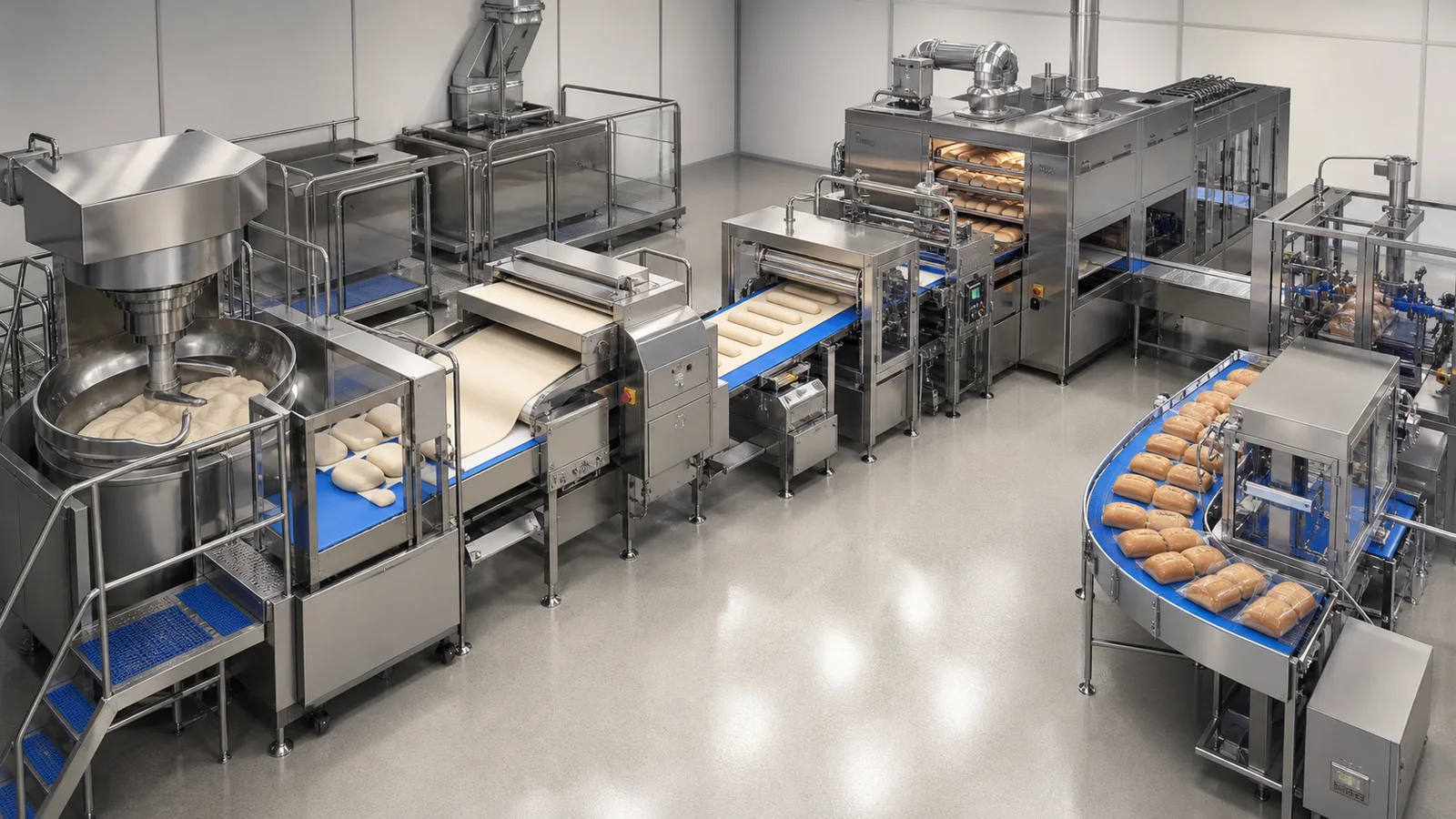
Map the complete process route
Not every product uses all eight stages. Freeze the actual route and alternate product paths before calculating equipment.
Choose one capacity boundary
| Product family | Useful planning boundary | Mass-change issue | Primary quality result |
|---|---|---|---|
| Fresh raw noodles | Accepted cut noodle mass at packaging infeed | Trim and dusting; limited moisture change | Thickness, strand width, length and separation |
| Cooked or frozen noodles | Accepted packed mass after cooling or freezing | Cooking water uptake and handling loss | Cook yield, texture, temperature and portion weight |
| Dried or instant noodles | Accepted dry product at packer | Water removal, frying oil uptake and breakage | Final moisture, block mass, cooking quality and integrity |
| Dumplings and filled foods | Accepted formed pieces before or after freezing, clearly stated | Wrapper trim, filling giveaway, reject and freezing loss | Piece mass, ratio, seal, shape and breakage |
Core flour-food capacity formulas
upstream kg/h = required accepted downstream kg/h / cumulative yieldApply only the losses between the two named boundaries.
kg/h = width (m) x thickness (m) x sheet density (kg/m3) x speed (m/min) x 60 x accepted-sheet factorMeasure density for the actual dough and reduction state.
accepted pieces/min = tracks x cycles/min x pieces/cycle x acceptance factorSome tools form more than one piece per track and cycle; document the geometry.
kg/h = accepted pieces/min x accepted average piece mass (kg) x 60Use accepted mass, not the machine setpoint alone.
wrapper kg/h = product kg/h x wrapper fraction
filling kg/h = product kg/h x filling fraction
The fractions must reconcile with actual piece weights and trim or residue.
resting WIP (kg) = downstream dough demand (kg/h) x resting time (h)Add controlled operating margin and round containers up to whole units.
Reconcile drying and cooking before comparing rates
When drying removes water and dry-solids loss is ignored for a preliminary estimate, solids conservation gives:
final mass = initial mass x (1 - initial moisture fraction) / (1 - final moisture fraction)Use wet-basis moisture fractions consistently. Then add measured trim, breakage, fryer, handling and packaging losses separately.
Cooking can increase mass through water uptake. Measure cooked yield for the approved formula and process; do not infer it from dry noodle capacity. Codex CXS 249-2006 distinguishes fried and non-fried instant noodles, requires pregelatinization and dehydration, and defines product composition and quality factors. These process routes therefore require separate capacity and utility models.
Sheet-flow example
Estimate accepted sheet flow
0.60 x 0.0015 x 1,100 x 12 x 60 = 712.8 kg/hAt a 95% accepted-sheet factor after edge trim, tears and other sheet loss, accepted sheet flow is approximately 677.2 kg/h. Confirm whether downstream slitting, forming or thermal treatment can accept the same rate.
Worked example: 600 kg/h accepted dumplings
Convert the finished product into line demands
600 / 0.020 / 60 = 500 accepted pieces/minAt six tracks and 90 cycles/min, nominal output is 540 pieces/min. A 95% forming acceptance factor gives 513 pieces/min, leaving only 2.6% above the target.
A dough mixer releasing 220 accepted kg every 35 minutes provides 377.1 kg/h ideal output. At 90% availability it provides about 339.4 kg/h, only 2.8% above wrapper demand. The mixer, forming machine and packer all require product trials because their planning margins are small.
Resting is both a process phase and capacity inventory
Research indexed by PubMed and USDA ARS shows that mixing, resting, rolling and repeated sheeting change gluten structure and noodle texture. Rest time must therefore come from the approved product process, not from spare floor area or a desired output number.
Container quantity
Divide required resting WIP by accepted dough per bin, tray or conveyor position, then round up and include loading and release margin.
FIFO and identity
Control batch ID, recipe, start time, target release time, allergen status and maximum hold. Physical space alone does not create a valid resting system.
Environment
Temperature, humidity, covering and surface condition may affect dough behavior and must match the validated method.
Failure response
Define what happens to resting dough when the sheeter or former stops and the maximum acceptable extension or delay.
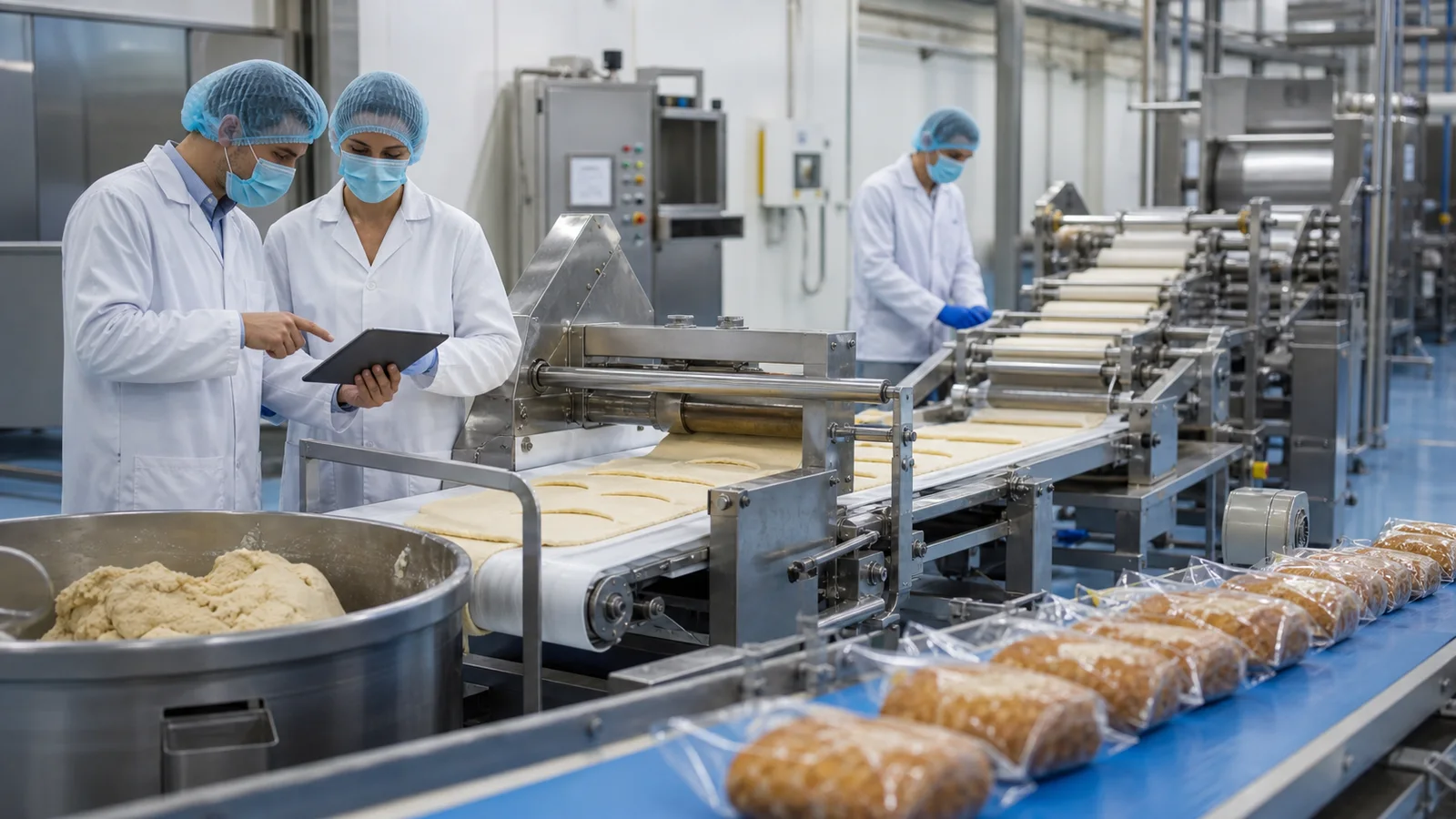
Balance each interface, not only each machine
Product-line FAT and capacity record
Flour-food line capacity FAQ
How is noodle production line capacity calculated?
Calculate every step on a consistent product and moisture basis. For sheeting, use width, thickness, measured density, speed and accepted yield, then compare mixing, resting, cutting, treatment and packaging.
How is dumpling machine output converted to kilograms per hour?
Multiply accepted pieces per minute by accepted average product mass in kilograms and by 60. Separate wrapper and filling demand using the approved product ratio.
Does dough resting affect capacity?
Yes. It creates work in process and needs controlled time, containers, space and release sequence. Shortening it solely to increase speed can change processing and finished quality.
Can raw dough kg/h be compared with dried or cooked noodle output?
No. Drying removes water and cooking can add water. Use a defined moisture or dry-solids basis and name every measurement boundary.
Which machine is normally the bottleneck?
There is no universal answer. Product recipe, rest, sheet reduction, forming geometry, treatment residence time, freezing load, packaging and changeover can each become the active constraint.
Research basis and further reading
- Codex CXS 249-2006, Standard for Instant Noodles - defines instant-noodle scope, fried and non-fried styles, pregelatinization, dehydration and quality factors; includes 2023 amendments.
- Dough gluten transformation during mixing and resting - research including USDA ARS affiliation reports that appropriate mixing and resting changed gluten structure and noodle quality.
- Two-stage resting and dried-noodle quality - experimental research reports changes in sheet extensibility, gluten network and cooked-noodle quality.
- Salt, kansui and repeated sheeting research - evaluates rheological, chemical and structural changes during repeated noodle-dough sheeting.
- USDA ARS noodle-processing research summary - describes structural and textural changes through mixing, resting, rolling, sheeting and cooking.
- NIST-authored manufacturing KPI research - supports accepted throughput, blocking, starvation and WIP measurements for connected production systems.
Scope note: This guide provides preliminary mass-balance and capacity methods. It does not establish a recipe, validate food safety or shelf life, guarantee product quality or replace representative product trials and a signed line acceptance protocol.
Calculate the critical flour-food line rates
Use the product-specific calculators, then reconcile every result on one accepted-output and moisture basis.
Dough Mixer CapacityNoodle Line OutputDumpling Capacity