
Direct answer
Food conveyor capacity depends on how product occupies the conveyor. Use loaded cross-sectional area for loose bulk flow, or lanes and product pitch for regular units. Preliminary residence time is travel-path length divided by actual belt speed. Neither result proves acceptable transfers, product quality or a validated cooking, cooling, freezing or sanitation process.
Define the conveyor duty before selecting a formula
Five core conveyor calculations
kg/h = loaded area (m2) x bulk density (kg/m3) x belt speed (m/s) x 3,600The loaded area must represent the stable product cross-section, not the full theoretical belt envelope.
units/min = lanes x belt speed (m/min) / product pitch (m) x acceptance factorPitch is center-to-center spacing in the travel direction and includes required gap.
kg/h = units/min x accepted unit mass (kg) x 60Use accepted average mass and check variation if giveaway or rejects matter.
minutes = effective travel-path length (m) / actual belt speed (m/min)Use centerline travel distance through curves, spirals or multiple passes, not machine footprint length.
buffer minutes = usable accumulated units / downstream accepted units per minuteUsable accumulation excludes transfers, sensors, release gaps and zones where product cannot safely stop.
Keep one unit system
| Input | Recommended unit | Common error |
|---|---|---|
| Belt speed | m/min for unit loads; m/s for bulk formula | Mixing m/min with seconds or hours without conversion. |
| Pitch | m per product position | Using product length while ignoring the required gap. |
| Bulk density | kg/m3 at actual loading condition | Using true material density or a value measured after compaction. |
| Travel length | m along the product path | Using plan-view footprint for a spiral or multi-pass conveyor. |
| Accepted output | units/min or kg/h after rejects | Comparing gross infeed with accepted downstream output. |
Worked example: four-lane dumpling conveyor
Check capacity at 6 m/min
4 x 6 / 0.10 x 0.90 = 216 units/minAt an accepted average mass of 22 g per dumpling, preliminary accepted mass flow is about 285.1 kg/h.
216 x 0.022 kg x 60 = 285.12 kg/hConfirm whether rejected, missing or overlapping products are removed before the selected line boundary.
Reverse the calculation for a 200-piece/min target
200 x 0.10 / (4 x 0.90) = 5.56 m/minIf the effective travel path through the process is 18 m, geometric residence time at 5.56 m/min is about 3.24 minutes.
Bulk loading must be physically stable
The bulk-flow equation assumes a known loaded cross-section moving with the conveyor. Verify side clearance, loading depth, free-flow behavior, segregation, roll-back on incline, carryback and whether product bridges or slips. Wet vegetables, flour, meat pieces and frozen products require different transfer and belt-surface behavior even at the same calculated kg/h.
Width and edge clearance
Usable loading width is smaller than total belt width. Keep product away from exposed edges, guides and return-side contamination paths.
Incline and acceleration
Cleats, flights, friction and acceleration limit the real load. A horizontal capacity calculation cannot be applied unchanged to an incline.
Feed distribution
A conveyor cannot carry its calculated capacity when upstream product arrives in unstable piles or only loads one side.
Mechanical design
Power, belt tension, support, drive traction and start-under-load duty require manufacturer engineering beyond the flow equation.
Residence time for a process conveyor
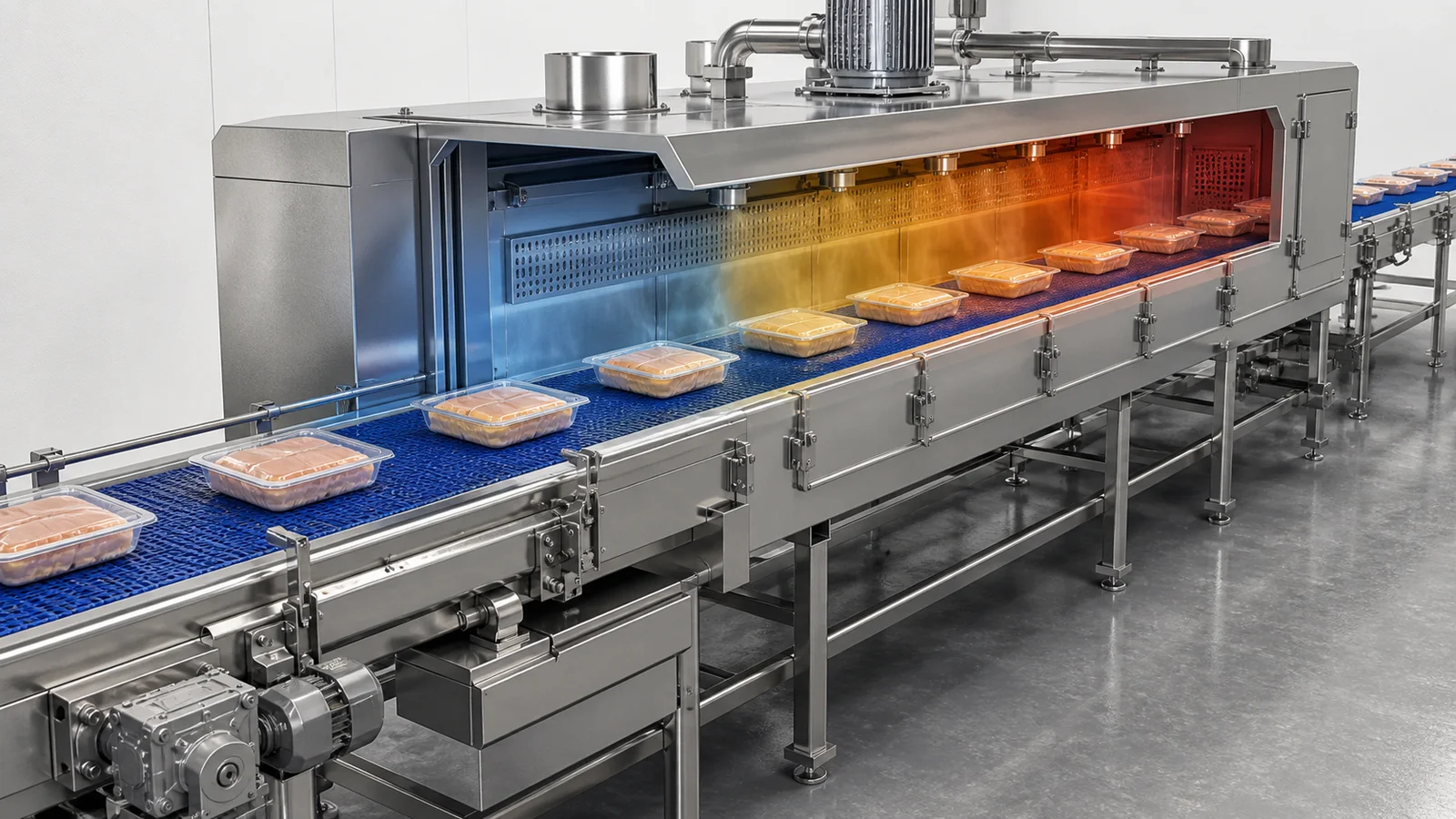
For product that does not slip relative to the belt, path length divided by belt speed is a useful first geometry check. Actual process exposure also depends on entry and exit boundaries, speed calibration, product placement, loading density and the process environment.
Plan accumulation from usable product positions
A 10 m conveyor is not automatically a 10 m buffer. Deduct infeed and discharge transfer zones, sensor zones, drive and tail transitions, non-accumulating curves and the minimum release gap. For single-file products:
units = usable accumulation length / stopped-product pitch x lanes x usable-position factorThen divide by downstream accepted rate to obtain minutes of coverage. Confirm whether the product may touch, stop or queue without deformation, sticking, temperature abuse or contamination.
Buffers do not create sustained line capacity. They isolate short disturbances. NIST research on perishable production lines treats finite buffers and residence time as interacting system properties; for food, maximum holding time can be more important than physical storage capacity.
Treat the belt and hidden return path as food equipment
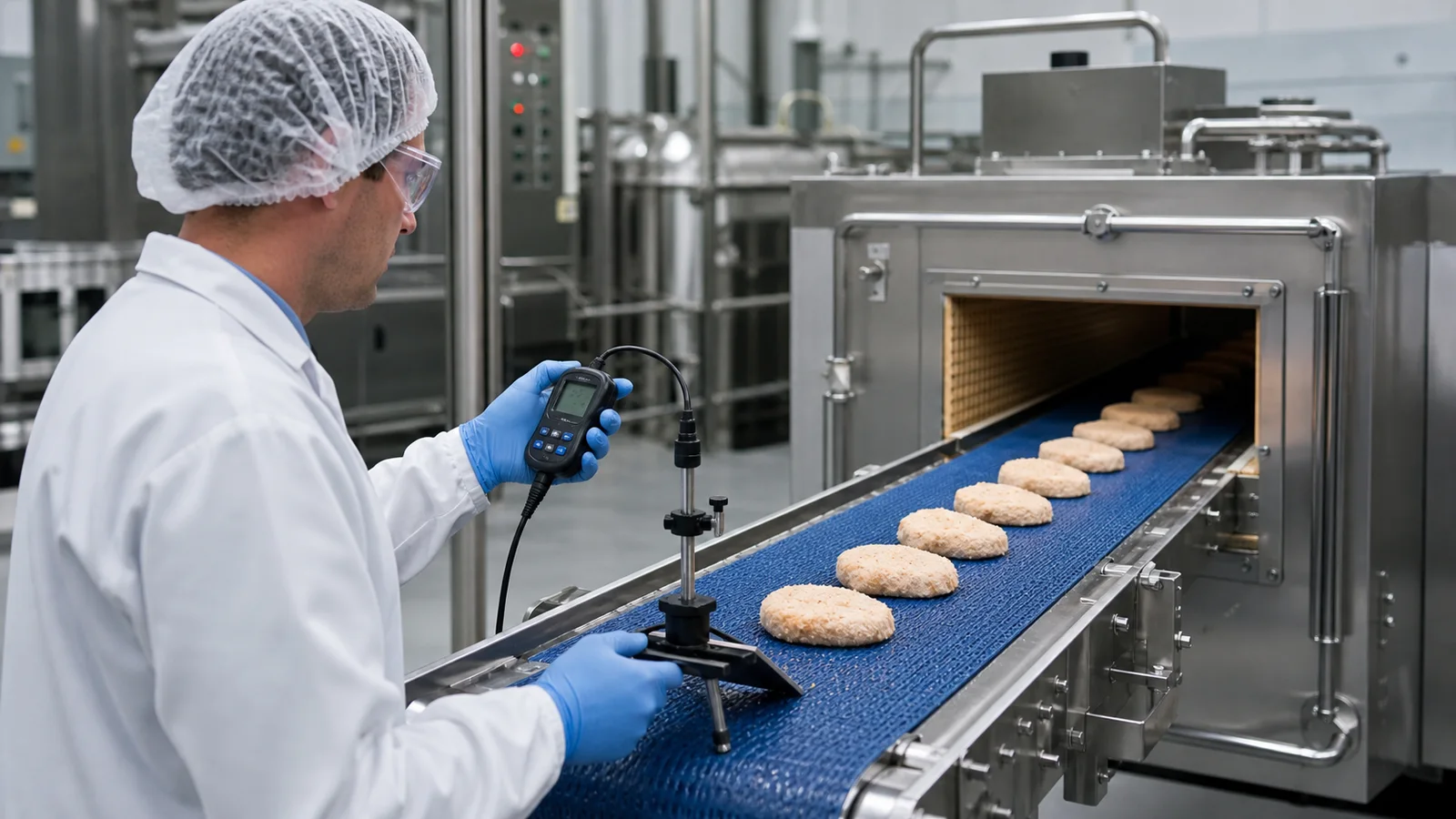
Food-contact boundary
Identify belt top, flights, guides, scrapers, transfer noses and any surface from which drainage or debris can reach food.
Return-side control
Review rollers, supports, wear strips, belt underside, tensioners and points where the cleaned belt can be recontaminated.
Cleaning access
Define belt release, lifting, component removal, drainage, cleaning chemistry, sanitation verification and safe isolation.
Material suitability
Confirm food-contact documentation, temperature, oil or chemical resistance, wear, fraying and compatibility with intended cleaning.
FDA food CGMP requirements state that equipment must be adequately cleanable and maintained to protect against allergen cross-contact and contamination. FDA fresh-cut guidance specifically lists conveyors, belts and chutes as food-contact surfaces and warns that hollow conveyor structures can collect water and debris.
Conveyor specification and FAT checklist
Food conveyor planning FAQ
How is food conveyor capacity calculated?
Use a formula matched to product presentation. Bulk flow uses loaded area, bulk density and speed. Regular unit flow uses lanes, belt speed, product pitch and an accepted-loading factor.
How is conveyor residence time calculated?
For product moving with the belt, preliminary geometric time is effective travel-path length divided by actual belt speed. Process residence time and product effect still require validation.
Does a longer conveyor always provide more buffer?
No. Only usable accumulation positions count. Transfers, gaps, lane behavior and maximum safe food holding time reduce effective capacity.
Can belt speed alone validate a cooking process?
No. Product dimensions, arrangement, loading, entry temperature, humidity or airflow and actual time-temperature response can affect the result. Use qualified process validation.
Should conveyor capacity exceed the downstream machine rate?
Usually some controllable margin is useful, but excessive speed can damage products or destabilize spacing. Size the transfer around accepted line demand, normal variation and the control strategy.
Research basis and further reading
- ISO 5048:1989, Belt conveyors with carrying idlers - defines calculation scope for capacity, cross-section, motion resistance, drive power and tensile forces; ISO reconfirmed the standard in June 2026.
- FDA Fresh-Cut Produce Guidance - identifies conveyors and belts as food-contact surfaces and discusses cleanable construction and hollow conveyor structures.
- FDA Aseptic Processing Inspection Guide - explains that flow rate, product characteristics and system design affect residence time and must be validated.
- USDA FSIS HACCP Validation Resources - validation examples identify product arrangement, belt speed, airflow and product time-temperature performance as relevant process evidence.
- NIST, Serial Production Lines with Perishable Products - studies finite buffers, perishable products and residence time in production-line behavior.
Scope note: This page provides preliminary capacity and geometry calculations. It does not design conveyor structure or drive power, establish hygienic compliance, validate a critical food process or guarantee product transfer.
Calculate flow and residence time with your product data
Use separate tools for carrying capacity and travel time, then document the assumptions for supplier review.
Open Conveyor Capacity CalculatorOpen Residence Time Calculator