
For watery bacon, start with separated slices in an uncovered pan and compare a smaller load. For white deposits, investigate product history as well as cooking conditions. Bacon releases both moisture and fat; the studied white exudate contained protein and salt too. Its presence does not prove excessive injected water. [1] Go to the improvement steps →
1. Separate three observations



Original explanatory drawings, not photographs of a tested batch. Appearance alone cannot identify composition or establish food safety.
Distinguish liquid inside the pack from liquid emerging during cooking. Use the packaging guide for pack performance.
2. Why one batch behaves differently
Heating alters meat proteins and muscle structure, changing the meat’s ability to hold water. Some moisture leaves the tissue; soluble material can travel with it. Heat also makes proteins unfold and aggregate, helping explain pale protein deposits in the released liquid. These general mechanisms explain different parts of the observation; they do not identify every white patch by sight. [5] [6]
Sheard and colleagues studied bacon exudate in 2001. The fluid was largely water with protein and salt; its protein pattern suggested mainly soluble muscle proteins. Uncured pork also released comparable exudate. Their samples differed by curing route, tempering history, salt content and storage age. Dry-cured samples ranked lower than rapid-cured samples, but this was not a guarantee for every commercial product. These historical results identify investigation points, not HELPER performance claims. [1]
Another pork experiment found that freezing history and cooking rate affected water distribution and cooking loss. It investigated uncured pork, not a commercial bacon frying line: its laboratory heating rates should not become bacon production settings. The practical implication is to compare products with matched storage and cooking histories. [3]
Pumped bacon receives a curing brine; dry curing uses a curing mixture applied to the belly. That distinction describes manufacture, not the quantity of liquid a particular pack will release. Read the product specification before drawing conclusions from a pan. [4]
3. What to change, and how to read the result
For a straightforward pan comparison, Illinois Extension describes separated strips placed side-by-side, uncovered, without added water or fat, cooked over medium heat and turned frequently. Follow the product’s cooking instructions and applicable food-safety procedure. This is a kitchen comparison method, not an industrial thermal-process validation. [2]
- Reduce crowding. Use a separated layer instead of overlapping slices. If pooling persists, compare a smaller load while keeping the pan and product the same.
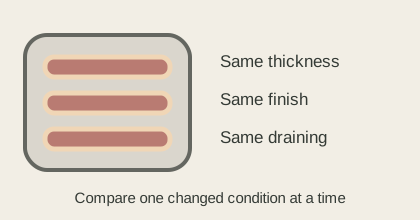
- Control the finish. Compare equal slice thickness and a defined cooked endpoint, not identical minutes applied to different products. Record texture after the same draining interval.
- Change one condition. Try a different loading level or approved heat profile separately. Increasing heat alone is not evidence that moisture retention improved.
- Judge the complete result. Compare pale deposits, browning, cooked portion size, crispness and cleaning effort together. A cleaner-looking pan is not automatically a higher-yield product.
Worked comparison: same pack, different pan load
Cook a smaller, separated load from the same pack, keeping slice thickness, pan, heat setting and endpoint comparable. Repeat before blaming a batch.
- Pooling decreases
- Loading contributes to the visible result. Keep that practical adjustment; it does not prove the meat retained more water.
- White deposits remain
- A smaller load has not removed this feature. Move to the product-history checks below.
- Only one batch differs
- Under matched cooking, investigate that batch’s material and processing history. The comparison narrows the search; it does not establish the cause.
Start each comparison with a clean, dry pan. Record added cooking water separately. Qualify oven and griddle results for their actual application.
4. If the difference follows the product
When matched cooking still distinguishes batches, trace the raw-material lot, curing formulation, distribution step, storage age and conditioning history. Use the receiving guide for belly and lot differences, and the slicing guide for thickness and slice integrity.
For an injected route, review brine preparation and delivery records alongside the brine-injector equipment range. Changing machinery alone cannot be assumed to eliminate residue. Keep formulation changes within the approved product and safety process.
Photograph equal portions under consistent lighting. If weighing, use identical pre-cook and drained post-cook boundaries. Weight loss includes more than water; use the pickup, retention and cooking-yield guide for calculation definitions. Return to the bacon production overview to place the finding in the complete route.
Frequently asked questions
Is the white material just fat?
No. The studied white exudate contained water, protein and salt. Rendered fat is another component of pan liquid; appearance is not a laboratory analysis. [1]
Does white residue prove that water was injected?
No. The study also found exudate from uncured pork. Check the declared product and manufacturing records rather than inferring an injection percentage from residue. [1]
Will dry-cured bacon always cook without residue?
No. The reported ranking describes studied samples, not a zero-residue promise. Compare the actual finished product under its intended cooking conditions. [1]
Should I rinse bacon or add water to remove it?
Neither is necessary for the baseline comparison above. Record any extra step separately; it changes the comparison and does not demonstrate that the manufacturing cause has been corrected.
Can I judge safety from the white deposits?
No. Treat this as an appearance investigation. Check product instructions, storage history and the applicable food-safety controls independently; a photograph cannot clear a questionable batch for use.
Will turning up the heat stop bacon releasing water?
Do not assume so. Less visible pooling can reflect faster evaporation rather than better retention. Compare a separated load first; changing the approved heat profile is a separate test, judged at the same finish.
Sources and scope
Reviewed 4 November 2026. Historical studies support explanations, not current news or HELPER trial results. Proposed comparisons are practical investigation steps, not guaranteed remedies. Original drawings illustrate concepts; no real batch is pictured.
- [1] Sheard et al., Meat Science, December 2001. Bacon white-exudate composition and influencing factors; abstract reviewed.
- [2] University of Illinois Extension, 4-H Cooking 201, 2015, printed pages 73–74. Bacon cooking comparison; household scope.
- [3] Mortensen et al., Meat Science, January 2006 (online July 2005). Freezing, cooking rate and water distribution in uncured pork; abstract reviewed.
- [4] Christina Bakker, South Dakota State University Extension, Don’t Go Bacon My Heart, updated 25 June 2024. Pumping and dry-curing definitions.
- [5] Yu et al., Cooking-Induced Protein Modifications in Meat, Comprehensive Reviews in Food Science and Food Safety, 2017 (online 24 November 2016). Abstract reviewed for protein denaturation and aggregation.
- [6] Eva Tornberg, Meat Science, July 2005. Effects of heat on meat proteins: implications for structure, water-holding and texture. Abstract and Lund University summary reviewed; no experimental temperature adopted as a bacon cooking instruction.