
Start with accepted packs, pack weight and a defined time window. Convert these into a required rate, check complete batch cycles, then calculate the queue at each release. Use one product stage and consistent units throughout.
1. Define the accepted-pack target and time window
Define the product, deadline and accepted pack specification using the packaging guide. Record actual fill weight, rejects and giveaway separately.
Write down seven inputs: accepted packs; kg per pack; window minutes; measured accepted packs/min while running; usable kg per batch; release times; and starting queue kg. The example’s 10 packs/min is an assumed input, not a rate derived from the target.
State which breaks, cleaning and waiting the window includes. Apply each time or quality loss once; an accepted running rate already excludes rejected packs. Vorne separates planned time, stops, speed and first-pass quality. [1]
Fictional example: 2,400 packs in six hours
Assume every accepted pack contains exactly 0.250 kg, with no further rejects, overfill or transfer loss. The 10:00–16:00 window contains 360 minutes. Start with zero queue just before the first release at 10:00. All queued weights below refer to the same ready-to-pack sliced-product stage.
- Finished product
- 2,400 × 0.250 = 600 kg
- Average required
- 2,400 ÷ 360 = 6.67 accepted packs/min
- While packing runs
- 10 accepted packs/min × 0.250 = 2.5 kg/min
The assumed running rate exceeds the shift average, but batch arrival gaps still matter. These figures illustrate arithmetic, not HELPER machine performance or a production guarantee.
2. Compare complete cycles with required releases
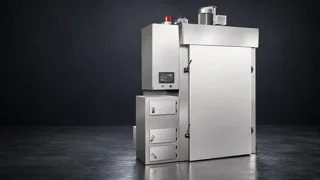
For each batch stage, record usable load and occupancy: loading, processing, unloading and preparation for the next load. Note cleaning/changeover separately with its frequency. A preliminary average capacity is usable batch kilograms ÷ complete cycle minutes × 60, provided the weights describe the same stage.
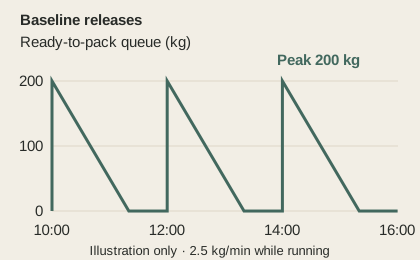
In the example, 200 kg arrives ready for packing at 10:00, 12:00 and 14:00. Each release represents 800 packs and requires 200 ÷ 2.5 = 80 minutes to pack. The 120-minute arrival interval is not a smokehouse cooking time. Upstream processing, cooling, conditioning and slicing must demonstrate that schedule.
Cycle check: suppose a separate batch resource delivers 200 kg of ready-to-pack-equivalent output per 140-minute complete cycle: 200 ÷ 140 × 60 = 85.7 kg/h, below the target 600 ÷ 6 = 100 kg/h. This hypothetical resource cannot sustain the target alone; starting stock only covers a finite period.
Measure release availability, transfers and final unloading. Check shared labour and trolleys. In this example, a 200 kg release supports 80 minutes of packing; the 120-minute release interval leaves a 40-minute gap. These are different from a batch machine’s complete cycle.
A single resource with a longer complete cycle cannot supply that interval indefinitely without another resource, changed loads or appropriate starting inventory. Use the batch-time calculator for arithmetic and review the published QZX configurations as stage examples; confirm actual usable loads and interfaces for the product.
3. Calculate the queue over time
Calculate immediately before and after each arrival. Let Q be the previous after-arrival queue, r the downstream kg/min and Δt elapsed minutes. For a constant rate, use the formulas below; split intervals at stops or rate changes.
Take the largest Q_after as this scenario’s peak buffer mass. The zero floor stops consumption when product runs out. These examples assume instant batch releases.
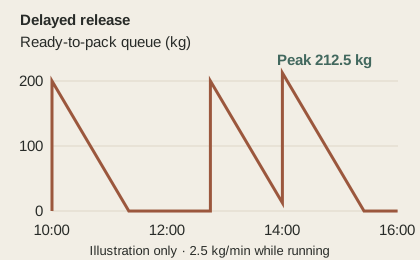
Follow the delayed case, event by event
| Time | Before arrival | Incoming | After arrival |
|---|---|---|---|
| 10:00 | 0 | 200 | 200 |
| 11:20 | 0 | 0 | 0 |
| 12:45 | 0 | 200 | 200 |
| 14:00 | 12.5 | 200 | 212.5 |
| 15:25 | 0 | 0 | 0 |
For the baseline, packing runs 10:00–11:20, 12:00–13:20 and 14:00–15:20. Now delay only the second release to 12:45. At 14:00 it has run for 75 minutes: 200 − (75 × 2.5) = 12.5 kg remaining. Add the third release: 12.5 + 200 = 212.5 kg. Packing then continues until 15:25.
The same total mass and running speed produce a different peak queue. Test late releases and stops, not only averages. These fictional waiting periods are not approved holding times. ASHRAE describes conditioning and controlled handling around bacon slicing; buffer layout also needs product-temperature, hygiene, airflow, access and space review. [2]
4. Give suppliers one connected capacity brief
Provide the raw-material profile, product/pack specification, accepted shift target, time boundaries, measured stage yields, batch loads, full cycles, release times and queue observations. Use the existing yield guide to work back through weight losses instead of treating 600 kg finished product as 600 kg incoming belly.
Ask proposals to identify tested conditions, usable loads, complete cycles and acceptance methods. Keep ideal machine speed separate from accepted shift output.
Identify who supplies and accepts cooling, conditioning, cutting, packing and transfer interfaces. Interfood's named bacon project illustrates an integrated supplier approach; it is not a HELPER installation or a capacity benchmark. [3] Review the bacon production topic and send a measured project brief for scope confirmation.
Buyer questions
Can I compare slices/min directly with packs/min?
No. Specify slices per pack, accepted portions and handling losses before converting the units.
Is usable batch load the machine's nameplate capacity?
Not automatically. Confirm the product, loading arrangement, process and complete cycle with the supplier.
Does enough average capacity guarantee the shift target?
No. Release timing, stops and queues can prevent the downstream operation from receiving product when needed.
Does a 212.5 kg buffer mean a 212.5 kg cold room?
No. It is the example's peak ready-to-pack queue. Storage geometry, access, temperature control and permitted holding require separate design.
What if the illustrative assumptions do not match our line?
Replace them with measured weights, accepted rates, losses and event times; recalculate the timeline before comparing proposals.
Why must the queue stop at zero?
A machine cannot consume absent product. Carry zero forward until the next arrival; do not subtract idle-time capacity as negative inventory.
Sources and scope
Reviewed 4 November 2026. The calculation scenario and charts are original planning illustrations, not factory measurements, refrigeration design or validated food-holding instructions. Confirm actual product, configuration, cycles and operating limits.
- [1] Vorne / OEE: calculating OEE (undated). Definitions of planned time, stops and accepted first-pass output.
- [2] ASHRAE, 2026 Refrigeration Handbook, Meat Products: bacon conditioning, handling and slicing-room context. No universal process settings adopted.
- [3] Interfood, 21 August 2026: named Weber/Danish Crown project; supplier account used only as an interface example.