
Shingled, stacked and laid-out describe the arrangement of bacon slices. Paper position is a separate choice: underleaving puts material beneath a slice or portion; interleaving puts it between the specified slices or portions. Read the arrangement, separator position and outer package separately. A paper-backed layer can itself be stacked, so identify what the word “stacked” refers to.
1. Picture the arrangement before choosing the name

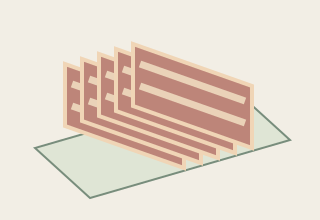
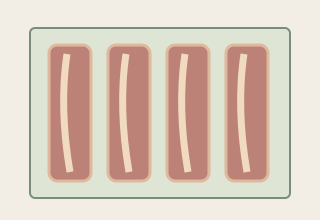
Original conceptual drawings. No dimensions, slice counts, machine performance or factory trials are represented.
The USDA-linked 1998 version of IMPS Series 500 describes a stack-pack option with slices standing on edge in their slicing sequence. [1] That is different from stacking several paper-backed portions. Equipment literature also distinguishes stacked and shingled presentations. [2] A sketch is more precise than the word “stack” alone.
Do not assume every product called Layout has completely separate strips. Hormel product 15679 is named LAYOUT PACK and described as raw wide-shingle bacon. [3] The named example shows why commercial descriptions need context. Confirm actual overlap and paper arrangement rather than translating a trade name into a universal geometry.
2. Specify what the paper separates
Here, a portion is a group handled together; a layer is one level in a multi-layer pack. Neither word alone states a serving weight.
Pale green shapes represent supporting or separator material. The separated side views clarify position, not real spacing or thickness.
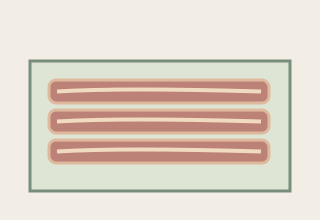

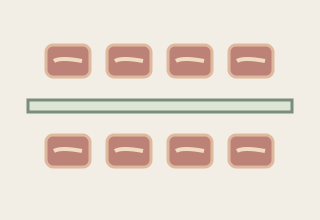
Weber’s underleaver description explicitly refers to paper or film beneath slices or complete portions, including layout-bacon applications. [4] Pacproinc describes equipment placing material under or between food products. [5] The useful distinction is the location of the separator and the unit being separated, not a presumed paper-per-slice rule.
Paper choice is another specification. Pacproinc lists greaseproof, bakeable paper for its named cooked-bacon interleaver. [6] This does not establish that any sheet found in a bacon package is suitable for an oven. Use the actual product and material instructions; do not transfer a named supplier’s claim to a different paper.
3. Read these descriptions as different packing jobs
Illustration A: retail shingle
“Overlapping whole strips on one backing card, one portion per pouch.”
At pack loading: one card-supported group enters the pouch. At use: individual strips still need separating; the card underneath does not divide them.
Illustration B: foodservice layers
“Side-by-side strips on each sheet, several sheets stacked in an outer pack.”
At pack loading: paper-backed layers form the stack. At use: a layer and an individual strip are different picking units; the sheet separates layers, not strips within them.
Teaching descriptions, not actual HELPER orders or universal retail and foodservice formats.
| Description | What it clarifies | What remains separate |
|---|---|---|
| Shingled or stacked | The stated presentation of slices or portions. | Thickness, net mass and declared piece count. |
| Paper under or between | The separator’s position and grouping level. | Paper suitability and the outer package. |
| Vacuum or MAP | A packaging-system description. | Slice arrangement and supported product-specific storage life. |
Use the slice-count and thickness guide for 18/22, Style and packaging quantities. Arrangement words do not establish raw or fully cooked status; read the separate product-state explanation.
4. Match the handoff to how the bacon is taken out
Follow the object being handled: one strip, one supported group or a stack of layers. For individual-strip picking, paper only under the whole portion leaves contact between its strips. For whole-layer transfer, the relevant question is whether the layer and its supporting paper remain together in the intended arrangement.
Compare the intended arrangement immediately after slicing with the arrangement presented at pack loading. Folded paper, displaced layers or disturbed overlap deserve attention even when the slice count is unchanged. For tearing or sticking causes, use the slice-defect guide; paper placement alone does not guarantee clean separation.
The meat cutting equipment range starts an equipment discussion, but a cutter should not be assumed to shingle, interleave or load packs without the corresponding configuration. See the packaging comparison and validation guide for pack-system questions, or the bacon production overview for the full route.
Frequently asked questions
What is shingled bacon?
It is an overlapping, stepped presentation of slices. The amount of overlap belongs to the actual product specification.
Is stacked bacon always a pile of flat slices?
No. A stack-pack description can refer to slices on edge, while a packing line may stack entire paper-backed portions. Identify the object and orientation.
Does laid-out bacon always have gaps between strips?
Do not assume that from a product name. The cited Hormel Layout product is described as wide-shingle bacon. Check its actual arrangement.
Does interleaved mean paper between every slice?
Not necessarily. Specify individual strips or complete portions. Paper between layers does not separate the strips within each layer.
Is a backing card the same as an interleaf?
A card under a group supports that group. A separator between pieces or portions divides them. State the actual position rather than relying on the material’s name.
Does shingling determine the packaging method or shelf life?
No. The arrangement does not identify vacuum, MAP or a supported storage life. Those require separate product and packaging information.
Can bacon be both laid out and stacked?
Yes. Strips can lie side by side on each sheet while those paper-backed layers are stacked in the outer pack. The words describe different grouping levels, not contradictory formats.
Sources and scope
Reviewed 4 November 2026. Terminology guide with original conceptual illustrations. Manufacturer examples concern their own products; they do not establish HELPER capabilities, customer cases, paper suitability or shelf life.
- [1] USDA AMS, IMPS Series 500, 1998 version, effective January 1992, pages 32–33. Historical vocabulary example; linked from the AMS IMPS directory. Not a universal current acceptance or safety specification.
- [2] Weber TS750 manufacturer brochure hosted by Interfood, pages 2 and 5. Generated date printed 09/05/2023. Named presentation examples; no equipment ratings transferred to HELPER.
- [3] Hormel Foodservice, product 15679, undated. LAYOUT PACK product described as raw wide-shingle bacon.
- [4] Weber weUNDERLEAVE, undated. Paper or film underneath slices or complete portions, including layout bacon.
- [5] Pacproinc, Interleaving & Underleaving, undated. Materials placed under or between products.
- [6] Pacproinc, ProLeaver Cooked Bacon Interleaver, undated. Paper types listed for the named configuration only.