
QDS-2 & QDS-3 Vegetable Fruit Dicers
Two stainless commercial cutting platforms for slices, square strips and dice—selected around cut range, hourly demand and available preparation space.
A compact two-model commercial series
The QDS-2 and QDS-3 are not duplicate listings of the larger XQD-02II. Their physical design, rated power, capacity, weight and working envelope differ. The official page positions them for central kitchens, restaurants, hotels and food-processing plants that need repeatable vegetable preparation without the much larger published duty of XQD-02II.
Official applications include white radish, carrot, potato, taro, sweet potato, melon, onion, green pepper, mango, apple, papaya and pineapple. Ham is also named, but buyers should treat a vegetable-and-fruit application as the primary scope unless the factory confirms food-contact zoning, cleaning procedure and performance for the intended animal product.
Both models can make slices, square strips and dice. The machine frame is described as SUS304 stainless steel, and the feed opening includes a microswitch. An optional safety feed hopper is mentioned. These features support safer operation, but they do not replace a site-specific risk assessment, guarding review, lockout procedure or operator training.
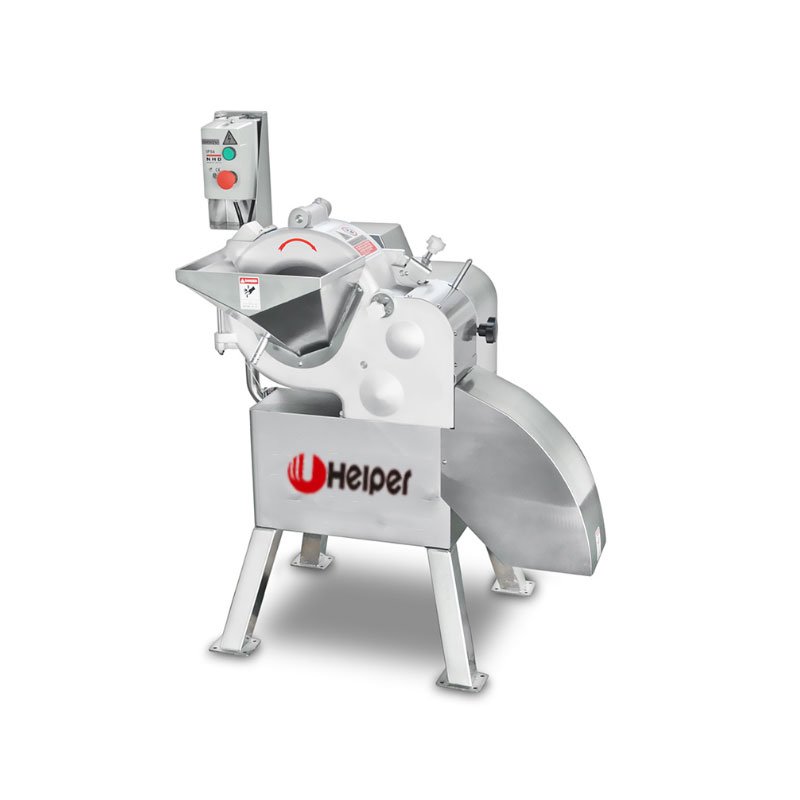
QDS-2 versus QDS-3
| Parameter | QDS-2 | QDS-3 |
|---|---|---|
| Slice size | 3–10 mm | 4–10 mm |
| Dice size | 3–10 mm | 4–10 mm |
| Shred / strip size | 3–10 mm | 4–10 mm |
| Power | 0.75 kW | 2.2 kW |
| Published capacity | 500–1,500 kg/h | 800–1,500 kg/h |
| Weight | 85 kg | 280 kg |
| Dimensions | 700 × 800 × 1300 mm | 1270 × 1735 × 1460 mm |
Selection note: the capacity figures are published ratings, not universal guarantees. Product firmness, maximum feed size, target geometry, loading consistency and blade condition determine usable output. Voltage, blade-set scope and feed-opening dimensions were not reliably published and require quotation confirmation.
Control preparation before chasing speed
Wash produce, remove stones and foreign matter, and reduce oversize ingredients to the confirmed feed envelope. Uniform feed improves both capacity and finished geometry.
Install the correct cutting components for slice, strip or dice output. Verify fasteners, guards, interlocks and clearance before production.
Separate acceptable product from oversize, undersize, fines and bruised pieces. Evaluate free liquid and product loss as well as gross kilograms per hour.
QDS-2 is the lower-power, lighter and smaller-footprint choice. It is appropriate where incoming flow is moderate, floorspace is constrained and 3 mm minimum formats are required. QDS-3 offers higher published throughput and a larger industrial envelope, with a 4 mm published minimum. The larger model should not be chosen on capacity alone: upstream washing and trimming, downstream mixing or packing, operator loading and cleaning labor must support the selected rate.
Choose around texture and finished appearance
Firm root vegetables generally tolerate mechanical cutting better than ripe fruit. Mango, papaya, melon and pineapple should be tested at the intended ripeness and temperature because softness and juice release can reduce edge definition. Onion and pepper trials should check layer separation and fines. For potato, taro and sweet potato, record fracture and surface damage at the smallest required format.
In filling production, the cut must remain compatible with mixers, depositors and forming machines. In salads and ready meals, appearance and size distribution may matter more than maximum throughput. The correct acceptance target is therefore usable product per hour within an agreed dimensional tolerance—not the machine's gross feed rate.
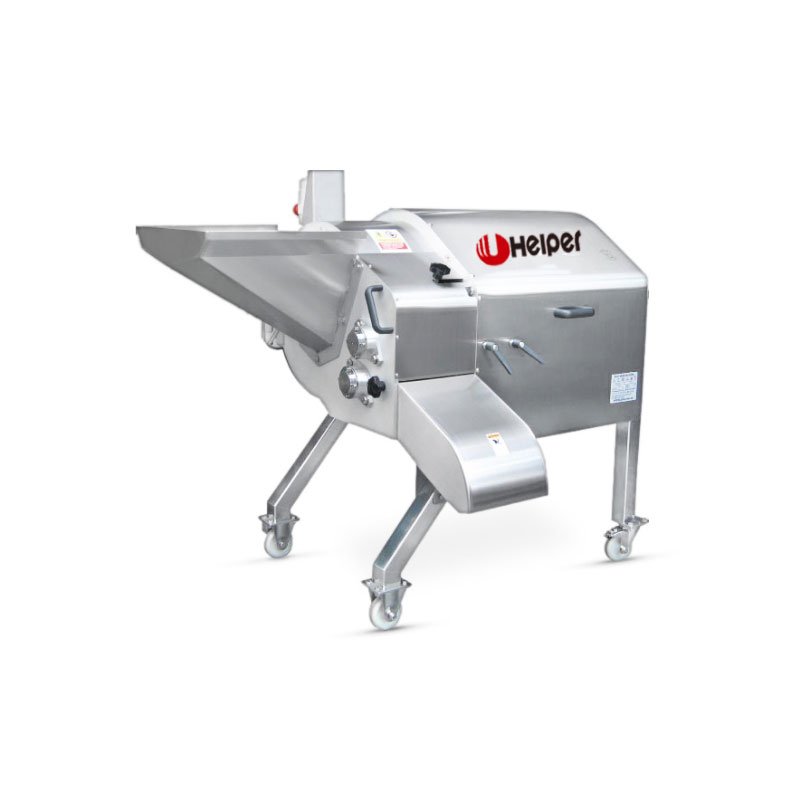
Test every contracted format
Run the buyer's actual ingredients at low, normal and peak incoming temperatures. For each knife configuration, record feed weight, acceptable output, oversize, undersize, fines, damaged pieces, free liquid and time. Demonstrate changeover, blade removal, cleaning and reassembly. Inspect the feed-port microswitch, emergency stop, guarding and restart behavior. Confirm that the optional hopper and any discharge collection or conveyor are included in the scope.
Sanitation review should cover access behind guards, under the cutting chamber and inside discharge surfaces. Establish blade accountability, cut-resistant PPE, safe handling tools and a sharpening or replacement schedule. Electrical supply, floor anchoring, drainage and washdown limits should appear on the signed technical schedule and general-arrangement drawing.
QDS series buyer questions
Are QDS-2 and XQD-02II the same machine?
No. Official specifications and images show different structures and duties. QDS-2 is a compact 0.75 kW commercial dicer; XQD-02II is a larger 3.75 kW high-output machine.
Which model has the smaller published cut size?
QDS-2 starts at 3 mm, while QDS-3 starts at 4 mm. Actual geometry depends on the supplied cutting set and product trial.
Can these machines cut fruit without damage?
They are marketed for fruit, but results depend on variety, ripeness, temperature and size. Trial the actual product and define acceptable juice release and edge quality.
Is there an official product video?
No exact embedded QDS-2/QDS-3 video was exposed on the verified product page, so unrelated vegetable-dicer footage has not been substituted.
Compare QDS-2 and QDS-3 with your ingredients
Send produce photos, incoming dimensions and temperature, required output geometry, hourly demand and available floorspace for configuration and a product-based trial.
Send cutting requirementsWatch the operational evidence
Video shows operation principle and layout logic; key performance still needs trial confirmation for your recipe.