
YC-200 Pushable 200L Meat Bin
Move meat, dough, vegetables and other food materials in a smooth SUS304 trolley engineered for factory handling systems.
Move food safely between batch processes
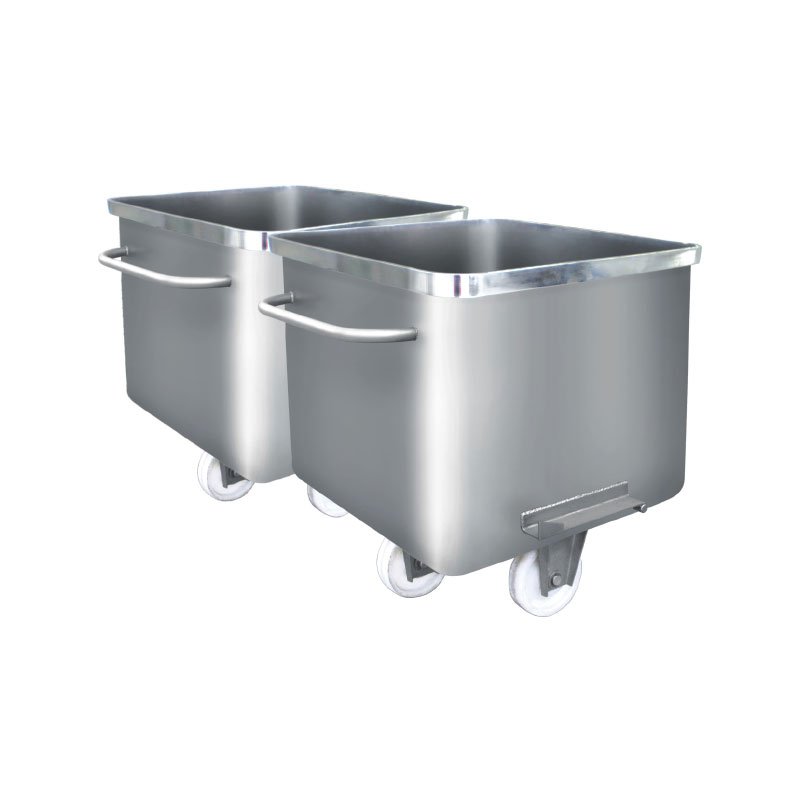
The HELPER YC-200 is a pushable 200-litre stainless-steel food bin, also described as a meat cart, Euro bin or dump buggy. It transports ingredients and work-in-process between grinders, mixers, fillers, tumblers, forming machines and packing areas. Its standardized geometry is intended to work with compatible bin hoists and washing equipment.
The body is made from SUS304 stainless steel with smooth internal and external surfaces for cleaning. Reinforced top edges, side push handles and four wheels support repeated factory movement. The official description identifies two high and two low wheels, a geometry intended to make the bin easier to push and stop.
Applications named by HELPER include sausage, chicken nugget, hamburger, pet-food, dumpling and meat-marinating factories. Suitability still depends on food-contact requirements, product temperature, density and cleaning chemicals.
Four interfaces determine whether a bin is truly standard
Match usable volume and working load to product density and freeboard.
Verify handles, wheels, floor transitions and stopping method.
Confirm rim, trunnion and base geometry with the intended hoist.
Validate complete spray access, drainage and chemical compatibility.
A nominal “200L Euro bin” name is not enough for interchangeability. Before ordering, compare dimensioned drawings for the bin, lifting carrier and washer. Small differences in rim profile, wheel position, handle projection or body taper can prevent secure docking.
YC-200 published specifications
| Item | Verified value |
|---|---|
| Model | YC-200 |
| Nominal capacity | 200 litres |
| Material | SUS304 stainless steel |
| Dimensions | 800 × 700 × 700 mm |
| Published product weight | 34 kg on HELPER’s official Alibaba listing |
| Mobility | Four-wheel pushable design |
| Interfaces | International-standard geometry; intended for compatible hoists |
Capacity clarification: 200L is volume, not a published safe working load. The 200 kg figure associated with the YT-200 hoist must not be transferred to the YC-200 bin. Obtain the bin’s rated payload and test method in the signed specification.
Why plate thickness is not listed
The official page says the raw stainless sheet has sufficient thickness but publishes no number. Third-party 200L carts often advertise 1.5 mm sheet, but that does not prove the YC-200 uses the same construction. Request wall, base, rim and reinforcement thickness separately.
Likewise, wheel diameter, bearing type, tread material, brake arrangement and temperature rating are not published. These details influence rolling effort, noise, cold-room performance and compatibility with thresholds.
Use physical interface evidence instead
The exact HELPER product page provides two image labels but exposes no product-specific video. A video of a powered dumper or hoist would describe different equipment, so no substitute is embedded here.
For approval, request footage showing the exact YC-200 being filled, pushed, stopped, engaged with the proposed hoist and cleaned in the proposed washer. The bin identity and dimensions should remain visible throughout.
What to inspect in samples
Check weld continuity, internal corner radius, sharp edges, distortion, water traps and surface finish. Roll the bin across real floors at empty and maximum proposed load, including drains, ramps and door thresholds.
Measure handle height, push force and stopping distance. Verify that wheels do not mark floors, seize under washdown or create uncontrolled travel on slope.
Make the trolley part of the sanitation system
Define whether the bin carries raw meat, allergens, cooked food or non-food waste. Zoning and colour or asset identification may be needed to prevent cross-use. Optional lids must be specified separately; the base description does not prove that every YC-200 includes a lid.
Cleaning validation should cover inside corners, rolled rim, handle welds, wheel forks, bearings and underside reinforcement. Confirm whether bins are manually cleaned or processed in the QXJ-200 washer and ensure all surfaces drain after the validated orientation.
Ergonomics and safe loading
A 200L bin can become extremely heavy. Calculate proposed gross weight from product density and fill level, then compare it with the confirmed rated payload, wheel capacity and plant manual-handling limits. Operators should push rather than pull where the route permits and retain clear visibility.
Where hoists are used, establish one-way traffic and a secure docking procedure. Damaged rims, wheels or handles can undermine lifting safety and should trigger quarantine rather than continued use.
Audit the bin as engineered food-contact equipment
Measure overall dimensions, capacity, empty weight, wheel centres, rim profile and handle projections on a production sample. Compare these with the approved drawing and every mating hoist and washer. Record material certificates, weld quality, surface finish and absence of sharp edges.
Load the proposed maximum product under controlled conditions. Test rolling effort, turning, stopping, stability, leakage and permanent deformation. Perform repeated lift-and-tip cycles using the actual carrier, then inspect the rim and base for distortion. Confirm complete discharge for sticky products and adequate freeboard for liquids.
Run the validated cleaning cycle and inspect for retained water, soil, chemical residue and wheel damage. Create routine inspection limits for cracks, weld defects, bent rims, worn wheels, loose axles and unreadable identification. A simple trolley becomes reliable only when it stays dimensionally compatible throughout its service life.
YC-200 Euro-bin questions
Is the YC-200 a powered dumper?
No. It is a pushable stainless bin. It can be handled by a separate compatible hoist or dumper.
Does 200L mean it can carry 200 kg?
No. Litres describe volume. Request the manufacturer’s rated payload before defining the maximum fill weight.
Will it fit every 200L bin hoist?
Not automatically. Compare rim, wheel, base and handle dimensions with the hoist carrier and complete a physical trial.
Is a lid included?
The source mentions Euro-bin lids among product terminology but does not clearly include one in the base YC-200. List lids explicitly in the quotation if required.
Send your payload, route, hoist and washer details
Include product density, maximum fill, temperature, floor conditions, cleaning method and mating-equipment drawings.
Request a YC-200 specification